
Human and Robot Psychology and Cognition
This is Part II of a four-part series: How to Be a Robot Psychologist

Part I: Why Robot Psychology? Part II: Human and Robot Psychology and Cognition Part III: How Do Conversational Agents Know So Much? Part IV: Reverse-Engineering Conversational Agents
We get along better with technology when we understand it. In the coming Age of AI, we will be surrounded by autonomous AI agents that speak and listen in natural language, operate on their own volition, and generally seem to behave more like sentient creatures than rote machines. How can we understand these things, to help us manage?
In a nutshell, we will have to expand our Theory of Mind.
Theory of Mind is a term from Cognitive Science that refers to our mental models of other people and animals that have brains and minds of their own. We regularly talk and reason about what other people say and do in terms of their desires, knowledge, beliefs, feelings, motivations, and intentions. We recognize that these kinds of mental processes drive the behaviors of pets and other animals. And we love to attribute these qualities to inanimate objects that we know do not really have minds, but still are frustratingly tough to figure out. “My car doesn’t want to start today.” “I kicked the washing machine and now it is mad at me and refuses to spin.” When the service technician says, “It was the pressure sensor,” well, we knew all along that the machine doesn’t really have feelings and intentions. But what about a robot that doesn’t follow the instructions you gave it to remind your brother about the birthday party? How do we debug that?
In Cognitive Science, Theory of Mind derives from the study of child development. This cartoon illustrates.
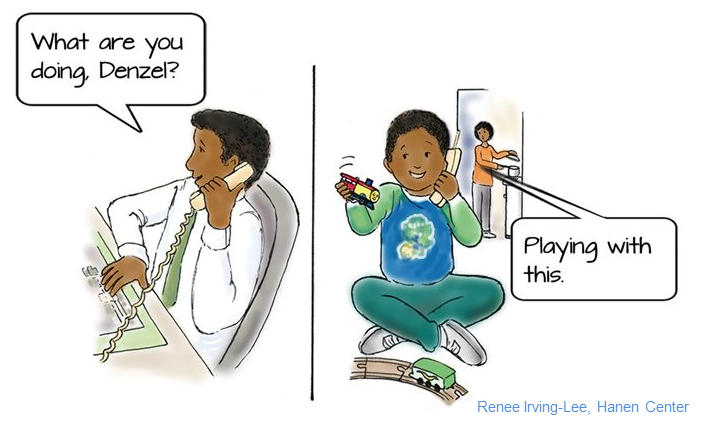
Three-year-old Denzel already has a very sophisticated mind. He has learned to ask for cookies, get dressed, and land airplanes on the roofs of block towers. But on the phone with his dad, he waves his choo-choo train and refers to it as “this”. A three year old does not yet appreciate that other people, possessing different eyes and ears and viewpoints, do not sense and apprehend the world as he does. As a child’s theory of mind matures, they come to understand that different people perceive different things, and can therefore hold different knowledge and beliefs; that beliefs can be correct or incorrect; that people can be deceived; that knowledge and beliefs come with degrees of evidence and certainty. By adulthood, we have learned about different people’s styles and attitudes, their goals and strategies. Across small everyday transactions and large decisions, we know that the way to get along with others is to take stock of what they are thinking. These aspects of other minds are fascinating to us. Virtually every cartoon, comic, joke, song, and show plays on knowledge and ignorance, perceptions and blinders, misunderstandings and snafus, beliefs, desires, and intentions, in short, the mental states of its characters and audience.
A deeper understanding of robots and other autonomous AI agents starts with enrichment of our intuitive Theory of Mind. We know that a washing machine doesn’t really have enough of a mind to actually get angry, even though it seems to behave that way. Then, how much of what we can call, “psychology,” does a robot really have?
Any person or agent’s psychological attributes exist only on a foundation of something more fundamental, which we can call its Cognitive Architecture. A Cognitive Architecture defines the organization of information processing elements that give a brain or mind its basic capacities for interacting with the world, for accessing knowledge, and for reasoning. A mind’s Cognitive Architecture governs how perception and action engage the outside world. It underlies capacities for speech and language. Cognitive Architecture also defines what kinds of memory the agent has, which can include short term working memory, “episodic” memory of events (or episodes), and the ability to consolidate and generalize events into long term knowledge.
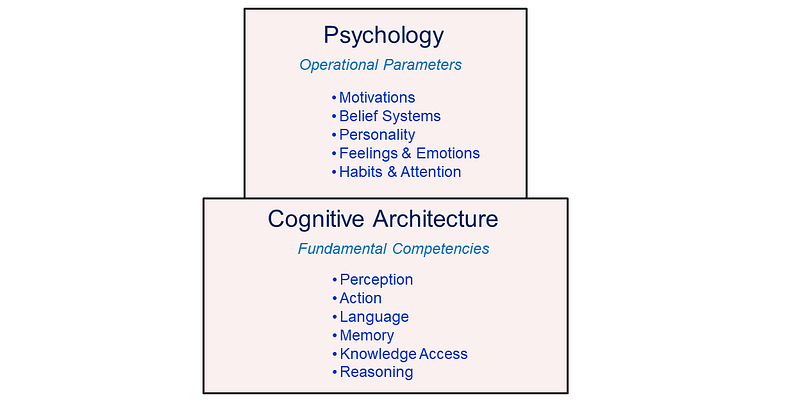
Cognitive Architecture establishes the grounds for Executive Function. Executive Function is a suite of theories from Cognitive Psychology and Neuroscience that outline three main requirements for managing an organism’s information world:
- The capacity to take in new information and process it appropriately with regard to the current situation and long-term knowledge and goals.
- The capacity to focus attention, discard distractions and irrelevant information, and stay on task.
- The capacity for task switching, that is, to accept external and internally driven interruptions, process them, and either return to the previous track or discard it and proceed to new tasks.
Mentally typical people accomplish these things automatically in the course of our waking existence. Psychologists diagnose dementias, cognitive deficits, and imbalances via tests of the aspects of executive function.
The study of Cognitive Architecture dates to the 1970’s, yet the topic is largely overlooked by the current trends of AI which are based on “Deep Learning” in so-called Neural Network models. The Cognitive Architecture of the human mind is not understood, although some theories and models mark forward progress in this relatively young scientific field. By contrast with people, the Cognitive Architectures of today’s AI agents are comically primitive, as we’ll see later.
The intuitively familiar psychological attributes of humans and animals can take shape only to the degree that foundational perceiving, acting, communicating, thinking, and executive function capabilities are soundly established. Only then can we begin to talk about holding knowledge and beliefs that constitute a world view, about feelings and motivations and goals, about habits and character and personality quirks. Only upon a foundational Cognitive Architecture can an agent conduct a coherent conversation in which they might deliberately contribute or withhold pertinent information, intentionally cooperate or disobey, act friendly or gruff. Don’t expect these things from any AI agent any time soon.
To understand the inherent limitations of current AI technology, consider a scale called reasoning sophistication. Philosophers of mind identify three levels of reasoning sophistication for any natural (human, animal) or artificial cognitive agent. These are known as Reactive, Deliberative, and Reflective levels. We need consider only the first two of these for now.
A Reactive agent operates by straightforward if-then, or stimulus-response logic. A Reactive agent generally maintains relatively little memory or continuity of awareness of its moment-to-moment situation. It might maintain some background state, for example a crab being in foraging mode versus shelter-seeking mode. But regardless of mode, it formulates no plans and exhibits no foresight. Reactive agents are perfectly good at running procedures, even elaborate ones. The procedures may have branching structure, so the agent in fact makes localized smart decisions about what to do. But the procedures are set in advance of the behaviors that execute them. These days, many so-called AI assistants, especially text chatbots, are actually programmed this way. Reactive systems can be practical, but they are quite limited in capability.
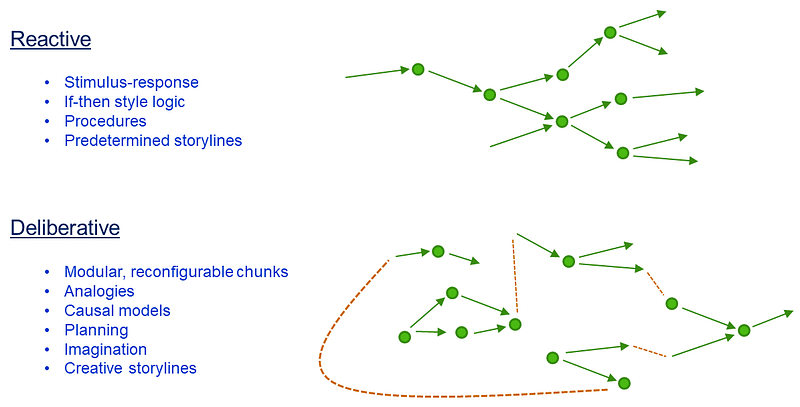
By contrast, a Deliberative agent does maintain internal state, in the form of short-term, or working memory. And its working memory can draw not only from recent perceptual input, but from stored knowledge and long term memories. Imagine a network of localized procedural elements that in a Reactive agent are wired together in a fixed structure. Now shatter these elements and allow them to recombine in myriad ways, in a crucible for thought. A train of thought evolves dynamically in response to both perceptual input and also to an array of internal goals and constraints. A Deliberative agent possess the cognitive apparatus for imagining future scenarios, for drawing analogies, for reasoning in terms of causes and effects, for entertaining alternative narrative storylines. These are the mechanisms of psychology that we normally assume when we regard conscious, intentional creatures such as ourselves and our fellow human beings.
Deliberative architectures are technically much much more difficult to fathom and to build than Reactive agents. AI has a few examples in research labs, but our technology for building Deliberative agents, and our understanding of how our minds achieve this level of sophistication, are quite immature.
Nonetheless, our natural inclination is to impute Deliberative sophistication to people, animals, and machines that exhibit any form of complex behavior. This allows designers of AI agents to exploit our credulity and simulate actual, real psychology, as a veneer that rides on Reactive behavior, even when the cognitive architecture is incapable of supporting Deliberative levels of thinking. A great deal of effort goes into the design of phrasing and artificial dialogue flows that portray conversational AI devices as having a personality and intent to earnestly help its user.
We cannot peer into other beings’ minds. Our senses deliver only a projection. In the presence of a real person, we construct a mental model of them as a full person. If however, what we encounter is merely an artificial avatar, our sensory input over short periods of time at least, might be pretty much the same. Our natural response is as if the avatar were a psychologically rich being.
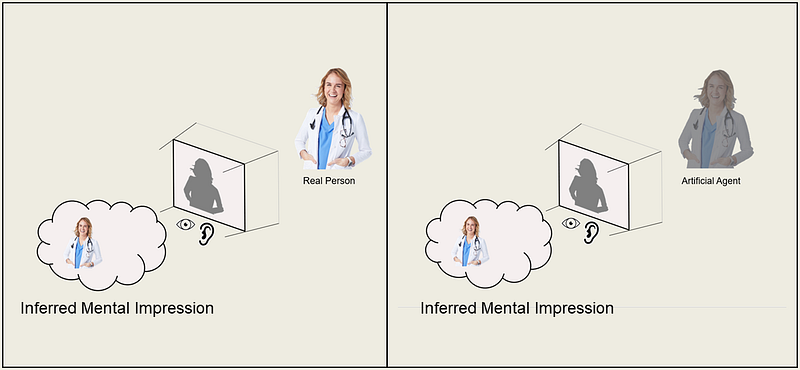
The famous Turing Test says that if we interact with an artificial agent and cannot distinguish it from a real person, then Artificial Intelligence has been achieved. Unfortunately, we are easily fooled.
A stone statue can evoke authentic emotional responses, but we never mistake a statue for a living, breathing, thinking person that it projects likeness to. But what if the statue has human-like skin, and motors that move its mouth and eyes and limbs, and what if it emits utterances that sound logical or even profound? Such is the case with animatronic robots.
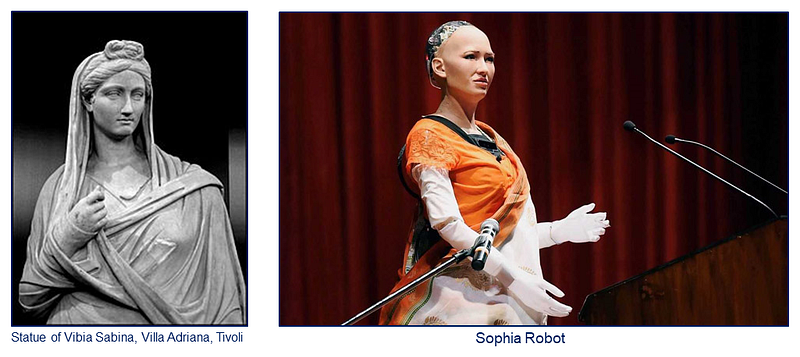
The Sophia robot has made the rounds of talk shows and conference venues. Its creators give it talking points, and news reporters write things like, “Sophia has a certain set of preferences when it comes to working. She has interests in the business sector.” Such nonsense does a disservice to the public. Sophia operates at a purely Reactive level of sophistication, and a simple one at that.
Our gullibility was demonstrated in a famous 1966 experiment at MIT. ELIZA was one of the first chatbots. It was designed with a Reactive architecture to superficially mimic the behavior of a Rogerian psychiatrist. The Rogerian method of therapy is designed to open a patient’s thinking by reflecting their statements back to them for further contemplation.
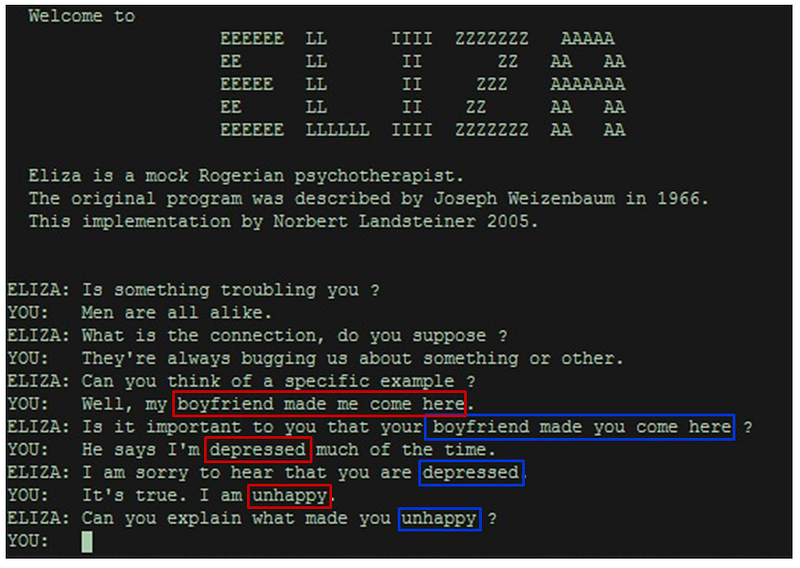
Notice in this dialogue how the person’s utterances are turned around in the form of questions. This was accomplished through relatively straightforward Natural Language Processing methods that identify key phrases in the user’s input.
The author of this program, Professor Joseph Wiezenbaum, observed that users started to take this fake psychoanalyst very seriously. They would shoo him away while they were having a private conversation with this wonderful new AI that really understood them! In his book, Computer Power And Human Reason, Wiezenbaum wrote, “…extremely short exposures to a relatively simple computer program could induce powerful delusional thinking in quite normal people.”
The lesson is, do not be misled by AI agents that appear superficially to be smarter than they really are. In its gory details, Artificial Intelligence technology can indeed be daunting. Yet its apparent sophistication can be just projections, on our part, in response to cleverly designed Reactive procedures operating on primitive Cognitive Architectures. The Cognitive Architectures of contemporary autonomous AI agents lack the fundamental competences we associate with the Deliberative levels of sophistication required of psychology as we commonly know it.
In other words, you can be a robot psychologist. All that’s required is some basic understanding of how today’s AI actually works, and the curiosity to probe and experiment.
In Part III, we examine how conversational agents answer questions. Click here to read Part III: How Do Conversational Agents Know So Much?


