
Immigration | Diversity
HUGS Project Sent Love to Children in Detention Centers in El Paso
Australian artist created tiny books for separated kids so “creativity may bring…a moment of joy”
A woman I barely knew Betsy Lewis phoned me, starting off innocently enough. She said that she was touched by a poem I’d posted on-line “Have I Told You How Much I Love You”. I listened, remembering feeling shy and pushing myself to post the poem in our group.
“It made me think of the children in cages,” Betsy said.
“I imagine sending tiny cards to the children,” she added. “I imagine the children reaching through the wire cages to receive the cards in their tiny hands.”
I had heard grim news reports about these children of asylum seekers who had been separated from parents, or people they trusted to bring the children to the U.S. I had an at-a-distance concern. But with each sentence from Betsy, I let myself be pulled in deeper.
“Each card can be a piece of art.”
The poem was not altruistic; it was a love poem to myself
As she continued I felt embarrassed to tell her that I had written the poem to myself. I had meditated one morning, noticing every fear and doubt about myself that crept up into my thoughts. There was a lot. I had interrupted each putdown, each wobbling insecurity, replacing it with a loving message instead.
After the meditation, I’d written this poem — to myself, and posted it in the creative on-line community “Succulent Wild World” founded by the author SARK.
After our initial phone-call, Betsy and I arranged a zoom call. But we couldn’t figure out how to see each other on the Zoom, ended up on the whiteboard and drew pictures to each other, laughing and talking all the while. I finally confessed to Betsy how this poem was written as a love letter to myself.
“Perfect,” Betsy told me. “The children will hear all the kind and loving messages that speak to their fears.” She did not skip a beat. “The children can hold the cards in their tiny hands. They will treasure them — keep them in their pockets or hide them among their one or two belongings. They will look at them to remind them that someone cares.”
Betsy, who is an artist and quite a storyteller, I realized, emphasized that the cards didn’t have to have words. They could simply give a message of love through art.
And, before I knew it, I got “roped into” the project. Betsy and I both created “MicroMOVEment Miracle Wheels” that we’d learn to make in the online community from its founder SARK. On pie-shaped drawings we each wrote tiny actions we would do towards nurturing this idea into being.
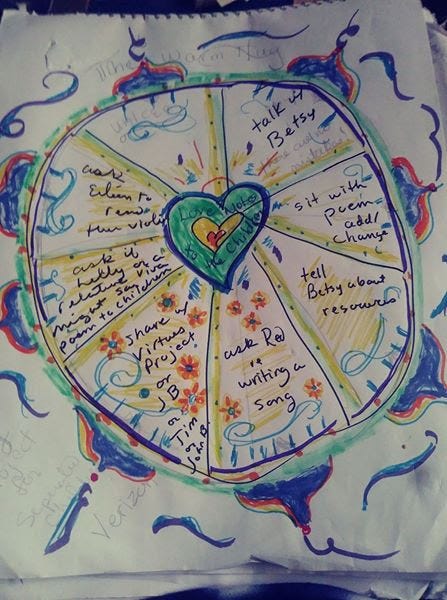
Soft hugs
Betsy mentioned that she had in the past made large soft sculptures of humans to “give hugs” to people. The idea came to me: “Why don’t we call the project “HUGS’? We’ll send hugs through our cards.”
In July of 2018, Leslie Diane Schroeder from the SARK community helped search out agencies with contacts to the detention centers for separated children. Diocesan Migrant and Refugee Services (DMRS) of El Paso, Texas, gave her a name to call back: Katie Hudak, Director of Development.
Nervously I phoned Katie Hudak. She explained that they have a government contract to provide legal services to the children in three detention center. She said an enthusiastic “Yes” to HUGS for the children.
Katie and I spoke back and forth as I asked many questions from the SARK on-line community — how many children, their ages, genders. Katie cautioned us not to write last names, emails, or return addresses on our cards. While I was asking others to send cards to the children, I bought card-stock, feeling I must send cards too, but avoided doing it.
I felt awkward writing to children I didn’t know. But when I, finally, sat at my kitchen table and wrote messages to the children my heart was touched and I felt more committed to them.
Though HUGS was a small initiative, cards began to flow to El Paso from the SARK community in various parts of the globe and from the Baha’is who host multi-cultural singing at Lake Balboa Park in Van Nuys. Mail was also coming due to the efforts of Scott Feraco; he created a series of Spanish language “V”TOON Coloring Pages for the children with superheroes and quotes about virtues like endurance, hope, courage, justice and love. Adults and children colored and sent these “Choose Virtues and Keep Your Dreams Alive” pages to El Paso; the separated children colored them at the detention centers.
The cards and coloring pages traveled to children 0–18 years old at three, and later four detention centers. Bi-lingual volunteers Dana Bee and Nadia Colby helped with translation.
Little dd of Australia makes friends with the separated children in El Paso
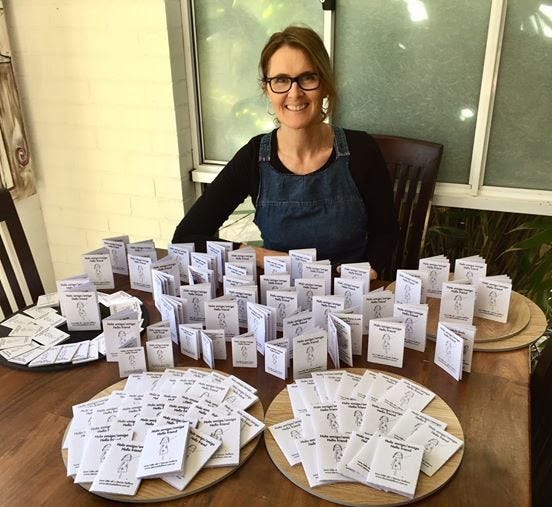
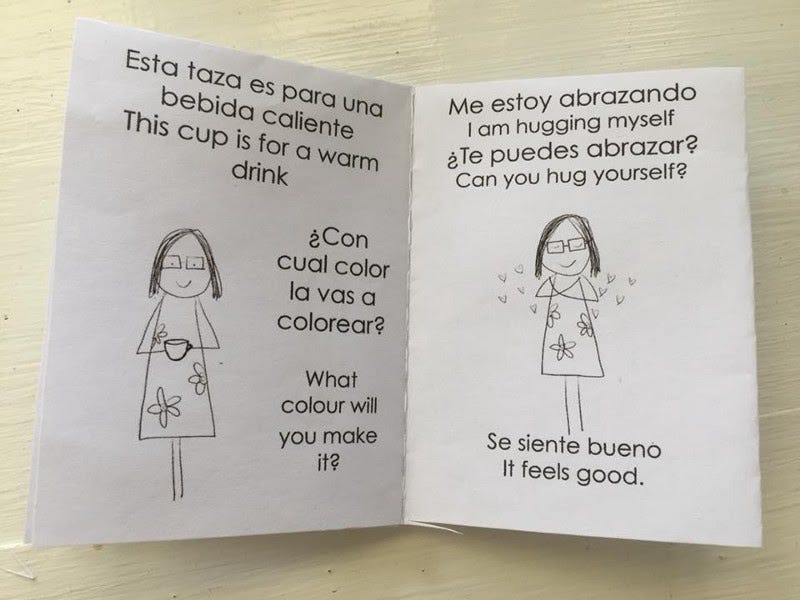
Among envelopes sent from many parts of the U.S. and the world to El Paso, Denise Daffara, sent a large one with over 100 tiny books she created and hand-folded for the children. Her character Little dd introduces herself in Hola Amigo/Amiga, Hello Friend as a friend to the children.
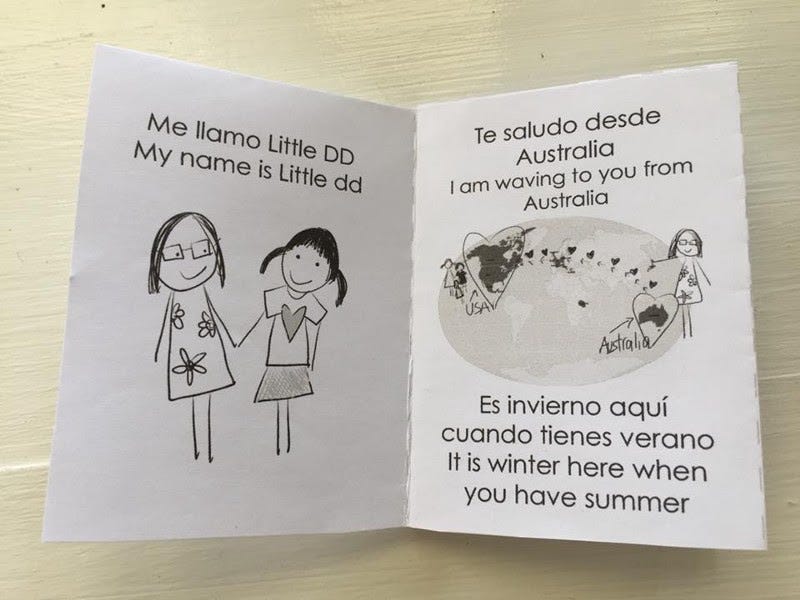
Little dd continues to inspire in the video HUGS: Sending love to children in Texas detention centers created by Denise.
“Having the little project for the darling children is a beautiful way to feel that a little something of creativity may bring at least a moment of joy to those in the center,” Denise wrote. “I can’t comprehend the pain it must be like for all concerned.”
Remembering the kids and our humanity
It is scary to imagine what these children, rarely permitted to be seen by outsiders, are experiencing. Perhaps Little dd from Australia had a clearer perspective from over the Pacific ocean than Americans do.
While I would have preferred to keep looking at Little dd pages and other sweet cards made by children and their parents for the HUGS project, and show them to you, I needed to look up articles about the children and their families, to see how they are faring. I could no longer ask Katie Hudak of DMRS even logistical questions; recently she told me that due to COVID their legal team is unable to visit the detention centers and give HUGS cards to the children.
I got a bag of organic blue tortilla chips and a tub of medium salsa to snack on for the reading about the separated children mission. It was 1 am when I found myself sitting cross-legged in my bed eating non-stop in a daze with a crooked bewildered look on my face. The accounts below are from several of the paralyzing articles I read.
“I believe there are a lot of ways that you can torture a human and [demoralize] their spirit: by not allowing them to keep clean, keeping them uncomfortably cold for weeks, keeping the lights on 24 hours in a warehouse, keeping them inside of a cage for weeks. Yes, I believe all of that can really get into a person’s psyche and torture them emotionally, which is no less than physical torture in my opinion.”
After this, I read about Judge Dolly Gee of California who in July ordered children of three centers released because of serious concerns about COVID spread. Her ruling became unenforceable when another judge refused to release their parents.
What has happened to us, Americans? Have we lost our hearts and minds? Is our innate care and sense of protection for children so numbed by legal complications after legal complications that our souls, as well as those of asylum seekers, are buried under them?
As a social worker, I have been in the position to report situations of suspected neglect and abuse in an elaborate legal system built in the U.S. since 1974. How can we permit a legal web so tangled and lacking in compassion that it makes it all but impossible to navigate it or get out of it without being neglected, traumatized, sexually assaulted, trafficked, deported for non-serious offenses — leaving behind U.S. born family members, or “disappeared”?
How would we feel, women, mothers, if desperate, and, as oft is the case with females, after being sexually assaulted on one side of the border or another, we crossed into a country not knowing the language to find our last resort for our families, only to have our children separated from us and not know where they are….for weeks? Now that sounds like torture to me.
Forgive me for sounding overdramatic. If you look up articles about the situation, such as those in “The First Solution”, or watch “Immigration Nation” on Netflix, you will see that I’m being under-stated. Since COVID hit, new perils resulted: we women would be turned away at the border to try and find shelter in dangerous border towns.
I won’t even go into the impact on the mothers of the estimated thousands of unaccompanied minors turned back from the border who “disappeared”. It seems that the migrants and refugees — adults, children, and babies, are being treated as dispensable sacrificial lambs to the slaughter with the aim of deterring people of certain colors and backgrounds from coming to the U.S.
“If you want a love message to be heard, it has got to be sent out. To keep a lamp burning, we have to keep putting oil in it.” — Mother Teresa
Oh for the child who was told after being separated from her father that she would never see him again (“Immigration Nation”, Episode 1).
Oh for the children in a detention center seen “sitting on the floor wrapping their arms around themselves” when they are sad. They are not permitted to hug or touch others, even siblings.
Through this article, I am hoping to light a little flame so we don’t forget the kids and our humanity. As Betsy Lewis, who first conceived of the idea of sending cards to the little separated children wrote to me, “…the tragic caging and separations continue. ...Hope your grandbaby and mine inherit a much kinder and loving world… we can do this!”
Perhaps these quotes can help cut through our human tendency to deny horrors like the torture of children (except in movies), help us remember our reality, and move us to do something to help — even something tiny is good!
“…you must always remember that the two-leggeds and all the other peoples who stand upon this earth are sacred and should be treated as such.” — Black Elk, The Sacred Pipe
“O CHILDREN OF MEN! Know ye not why We created you all from the same dust? That no one should exalt himself over the other. Ponder at all times in your hearts how ye were created. Since We have created you all from one same substance it is incumbent on you to be even as one soul, to walk with the same feet, eat with the same mouth and dwell in the same land, that from your inmost being, by your deeds and actions, the signs of oneness and the essence of detachment may be made manifest. Such is My counsel to you, O concourse of light! Heed ye this counsel that ye may obtain the fruit of holiness from the tree of wondrous glory.” — Baha’u’llah, The Hidden Words
“All we’re ever asked to do in this life is to treat our neighbor — especially our neighbor who is in need — exactly as we would hope to be treated ourselves. That’s our ultimate responsibility.” — Fred Rogers, Life’s Journeys According to Mister Rogers: Things to Remember Along the Way
Preview YouTube video, “Sending love to children in detention”

Resources and voices to end the torture of separated families:
“[We] urge the federal government to withdraw its policy of requiring separation of migrating children from their caregivers, and instead, give priority to supporting families and protecting the health and well-being of the children within those families. — American Medical Association
The plan to separate undocumented immigrant children from their parents is “malicious and unconscionable”. “…There is ample research demonstrating that family separation can cause long-term trauma leading to mental, physical, and educational development problems in children. For this and other reasons, this policy cannot continue. — National Association of Social Workers, NASW News Releases
“‘In the past six weeks, nearly two thousand children have been forcibly separated from their parents,’ UN High Commissioner for Human Rights Zeid Ra’ad Al Hussein said in his opening remarks to the 38th session of the Human Rights Council in Geneva. …Mr. Zeid said that the American Association of Pediatrics in the US, had called it a cruel practice of ‘government-sanctioned child abuse’ which may cause ‘irreparable harm’ with ‘lifelong consequences’. ‘…The thought that any State would seek to deter parents by inflicting such abuse on children is unconscionable,’ he said, calling on the United States to immediately put a stop to the policy, and ratify the Convention on the Rights of the Child.” — UN News
“The American Bar Association is urging action in Congress to immediately reunify children who have been separated from their parents along the border, and not just for purposes of removal. Find your legislator through our comprehensive location-based search and let your voice be heard. Call or email your representatives right now!” — ABA
Please join your voice to that of the American Medical Association, the American Public Health Association, the National Association of Social Workers, The American Association of Pediatrics, The American Bar Association, human rights experts at the United Nations and organizations working day and night to allay the suffering and related risks of the “torture” and criminalization of asylum-seekers.
To write or call:
Congress and to the White House: The White House, 1600 Pennsylvania Ave., NW Washington, D.C. 20500
The U.S. Capitol Switchboard: (202) 224–3121. They connect directly with the Senate office. You can reach your senator or representative through this link: Congressional Institute
Links (click on articles): Organizations helping migrants and refugees are listed within these articles: Protecting Immigrant Families Partner Organizations [extensive lists], How to Donate to Help Migrant Children at the Border, 9 Organizations Helping Migrant Children that You Can Donate To, Organizations helping immigrants in Texas


