avatarDark Energy Articles

Free AI web copilot to create summaries, insights and extended knowledge, download it at here

1973

Abstract

Pablo Carlos Budassi, <a href="https://creativecommons.org/licenses/by-sa/4.0">CC BY-SA 4.</a>0, via <a href="https://commons.wikimedia.org/wiki/File:Tadpole_galaxy.png">Wikimedia Commons</a>]</figcaption></figure><p id="d267">The formation of “tails” can also occur when galaxies merge. Such is the case with <b>Arp 248</b>. Here the bridge was formed from material coming from the outer spiral arms of galaxies. Highlighted in blue are the areas where new star formation occurs. A third galaxy can also be seen in the image taken by the Hubble Telescope, but it is far away from the others and does not gravitationally interact with them.</p><p id="acac">Such a phenomenon as galaxies merging together is quite common in the cosmos. Scientists estimate that up to a quarter of galaxies are in some stage of merger. It is known that in the distant past the Milky Way will merge with the Andromeda Galaxy. In turn, tidal interactions between the Milky Way’s satellite galaxies — the Large and Small Magellanic Clouds — most likely led to the formation of the so-called Magellanic Stream. That is, a stream of gas connecting them.</p><h1 id="c25c">Atlas of the strangest galaxies</h1><p id="9bbd">The photo of Arp 248 galaxies is part of a project to select future observational targets for the Webb Telescope and the ALMA (Atacama Large Millimeter/submillimeter Array) observatory, as well as Hubble itself. Opportunities for observations are abundant, so — to save time — scientists first look for space objects of scientific interest. In doing so, they use existing astronomical catalogs.</p><p id="baa5">This is exactly what happened in this case. The Wild Triplet Galaxy was listed in a catalog compiled in 1966 by astronomer Halton Arp. His collection, “Atlas of Peculiar Galaxies,” contains 338 galaxies of unusual shape, size or structure. Some of them can be observed with the naked eye.</p><h1 id="3c76">How do galaxies with “tails” form?</h1><p id="9989">In Arp’s

Options

time, knowledge of the formation and evolution of galaxies was much less than it is today. At the time, many astronomers believed (wrongly, as it turned out) that galactic “tails” stretching far into space could not have formed solely as a result of gravitational forces. Arp was among this group.</p><p id="ce55">The scientist created his atlas so that the evolution of unusual galaxies could be studied. Twenty years after the first publication, he and Barry Mador published another collection, “A Catalog of Southern Peculiar Galaxies and Associations.” This catalog is also being used in a project to select interesting objects for state-of-the-art telescopes to observe.</p><p id="f9a8"><i>Source: <a href="https://www.nasa.gov/image-feature/goddard/2022/hubble-inspects-a-pair-of-space-oddities">NASA</a>, <a href="https://www.universetoday.com/158536/the-perfect-tidal-tail-connects-these-two-galaxies-seen-by-hubble/">Universe Today</a></i></p><div id="7638" class="link-block"> <a href="https://readmedium.com/what-is-the-great-red-spot-where-is-it-located-and-what-secrets-does-it-hide-e8331428b543"> <div> <div> <h2>What is the Great Red Spot? Where is it located and what secrets does it hide?</h2> <div><h3>The largest storm in the Solar System is the size of Earth. It has been raging on Jupiter for at least 150 years…</h3></div> <div><p>medium.com</p></div> </div> <div> <div style="background-image: url(https://miro.readmedium.com/v2/resize:fit:320/1*Pl_V2J83ee3oix0KjLwSJA.jpeg)"></div> </div> </div> </a> </div><p id="5595"><b>Cool that you made it to the end of this article. I will be very pleased if you appreciate the effort of creating it and leave some claps here, or maybe even start following me. It would be nice if you also left a tip! Thank you!</b></p></article></body>

Hubble telescope has taken a fascinating photo of galaxies connected by a glowing “tail”

NASA has shown a beautiful photograph of galaxies connected by a long glowing bridge. The photo, taken by the Hubble Telescope, shows the Arp 248 galaxy system 200 million light years away from Earth.
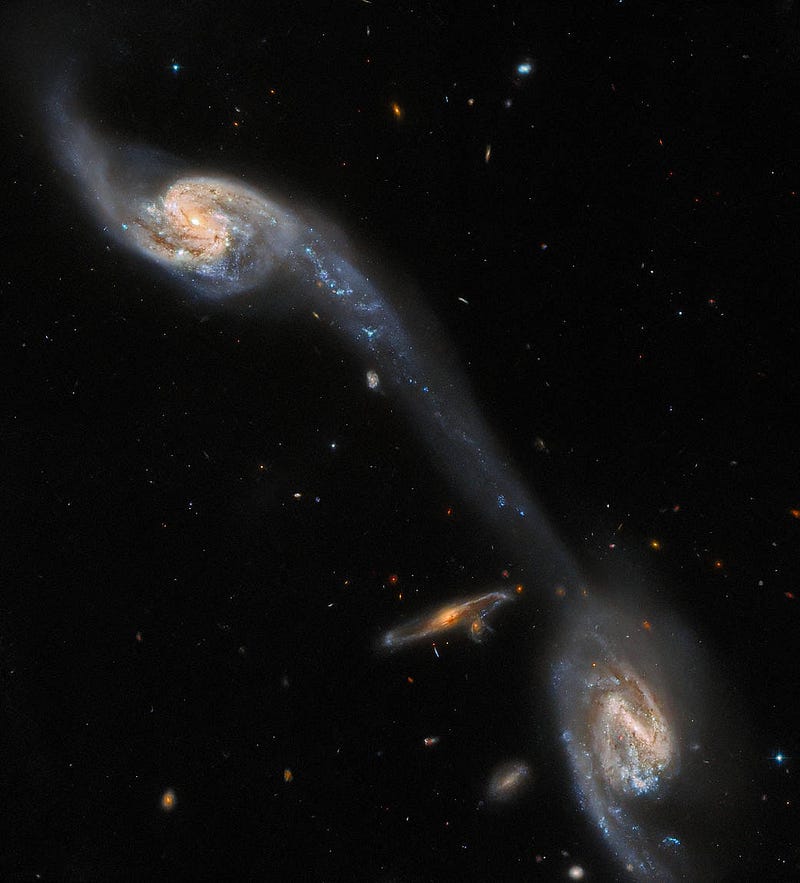
Arp 248 — [Photo: ESA/Hubble & NASA, Dark Energy Survey/Department of Energy/Fermilab Cosmic Physics Center/Dark Energy Camera/Cerro Tololo Inter-American Observatory/NOIRLab/National Science Foundation/AURA Astronomy; J. Dalcanton]

The galaxies known as Arp 248 or Wild Triplet are located in the constellation Virgo. The system consists of three galaxies, two of which are connected by a long illuminated “tail.” It is actually a stream of gas, dust and stars, formed when two galaxies interact gravitationally.

Such “tails” are well known to astronomers. They can trail behind galaxies, measuring hundreds or even thousands of parsecs. One parsec is 3.26 light years or 206,000 astronomical units. In turn, an astronomical unit is defined as the distance separating the Earth and the Sun, which is about 150 million kilometers.

Galaxies with “tails”

One of the most beautiful cosmic “tails” has the Tadpole Galaxy, located in the constellation Dragon. It measures 280,000 light years and is probably the result of one of the galaxy’s spiral arms being stretched out by a neighboring galaxy that has passed by. Tidal forces pull stars, dust and gas out of the Tadpole Galaxy, which will eventually break away from the parent galaxy.
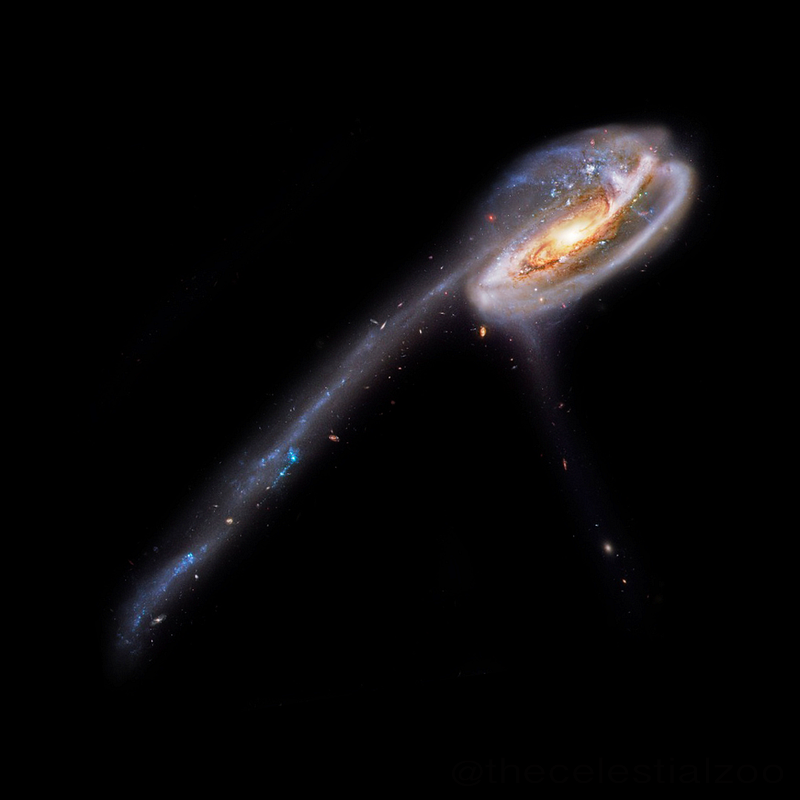
Tadpole Galaxy — [Photo: Pablo Carlos Budassi, CC BY-SA 4.0, via Wikimedia Commons]

The formation of “tails” can also occur when galaxies merge. Such is the case with Arp 248. Here the bridge was formed from material coming from the outer spiral arms of galaxies. Highlighted in blue are the areas where new star formation occurs. A third galaxy can also be seen in the image taken by the Hubble Telescope, but it is far away from the others and does not gravitationally interact with them.

Such a phenomenon as galaxies merging together is quite common in the cosmos. Scientists estimate that up to a quarter of galaxies are in some stage of merger. It is known that in the distant past the Milky Way will merge with the Andromeda Galaxy. In turn, tidal interactions between the Milky Way’s satellite galaxies — the Large and Small Magellanic Clouds — most likely led to the formation of the so-called Magellanic Stream. That is, a stream of gas connecting them.

Atlas of the strangest galaxies

The photo of Arp 248 galaxies is part of a project to select future observational targets for the Webb Telescope and the ALMA (Atacama Large Millimeter/submillimeter Array) observatory, as well as Hubble itself. Opportunities for observations are abundant, so — to save time — scientists first look for space objects of scientific interest. In doing so, they use existing astronomical catalogs.

This is exactly what happened in this case. The Wild Triplet Galaxy was listed in a catalog compiled in 1966 by astronomer Halton Arp. His collection, “Atlas of Peculiar Galaxies,” contains 338 galaxies of unusual shape, size or structure. Some of them can be observed with the naked eye.

How do galaxies with “tails” form?

In Arp’s time, knowledge of the formation and evolution of galaxies was much less than it is today. At the time, many astronomers believed (wrongly, as it turned out) that galactic “tails” stretching far into space could not have formed solely as a result of gravitational forces. Arp was among this group.

The scientist created his atlas so that the evolution of unusual galaxies could be studied. Twenty years after the first publication, he and Barry Mador published another collection, “A Catalog of Southern Peculiar Galaxies and Associations.” This catalog is also being used in a project to select interesting objects for state-of-the-art telescopes to observe.

Source: NASA, Universe Today

Cool that you made it to the end of this article. I will be very pleased if you appreciate the effort of creating it and leave some claps here, or maybe even start following me. It would be nice if you also left a tip! Thank you!

Space
Universe
Science
Life Lessons
Photography
Recommended from ReadMedium