
OCEANS
How Whales Change the Climate. An Ode to the Magical, Magnificent Ocean
Understanding cycles is adapting to climate change
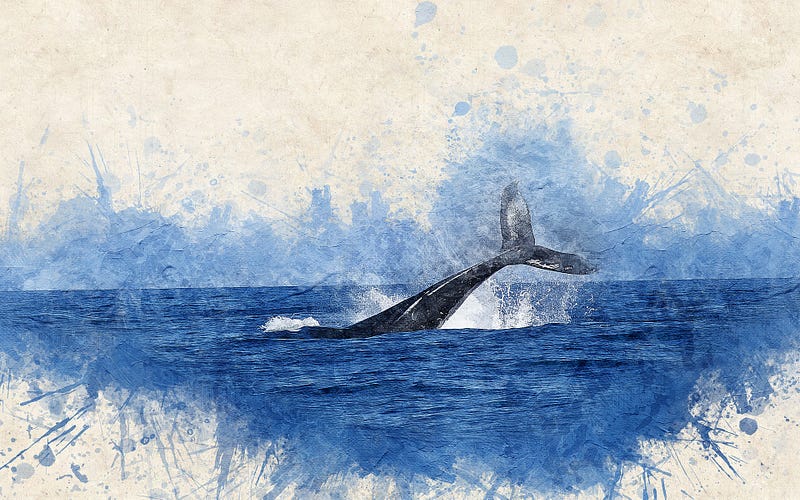
The past two months in Ibiza changed me. The closeness to such a beautiful, clear sea gave me clarity in my life as well. The rocks around the island gave me a feeling of personal passion. Personal purpose. Personal power.
Es Vedra is the Mother of Rocks on Ibiza. And she changed me.
There are things I can do to flip the switch of our world. I’m a storyteller. I’m a creator of futures. I can use my passion, my personal power to make everyone fall in love with our planet again. So we will all find our personal next steps in our quest.
What quest? Why quest? How quest? Well, we need to find out what it means to be human on a planet full of cycles. And feedback loops. And rollercoaster thoughts that are clouding our views.
Today, I want to give you clarity with an ode to the ocean. Whales matter. Whales change the climate. And if we understand how whales do that, we can do that too.
We need to find out what it means to be human on a planet full of cycles
Lungs of the Earth
First of all, let me ask you a question. Are trees the lungs of the earth? Hmm… the answer is yes. Trees breathe in CO2 from the air and breathe out oxygen. How does that happen? Photosynthesis is the answer.
Did you think a tree was created in the soil? Think again. Trees are created in the air by sunlight and chemistry. The sunlight makes sure the carbon, C, and oxygen, O2, get separated. Carbon is a great building block for the wooden stem of the tree. And the oxygen makes the air breathable for animals. And humans.
As an extra effect, forests cool the planet. They are very important elements in the cycles of our self-regulating planet. Especially when they are biodiverse rainforests in the tropics.
Next question. Are trees the most important lungs of the earth? Hmm… the answer is no.
No? No!
The oceans are the most important lungs of the earth. By now, you know that the earth is a self-regulating system in which all elements work together towards evolution. The drawing by Matt Powers in my story “A Permaculture Perspective on Climate Change” gives a peek into the cycles.
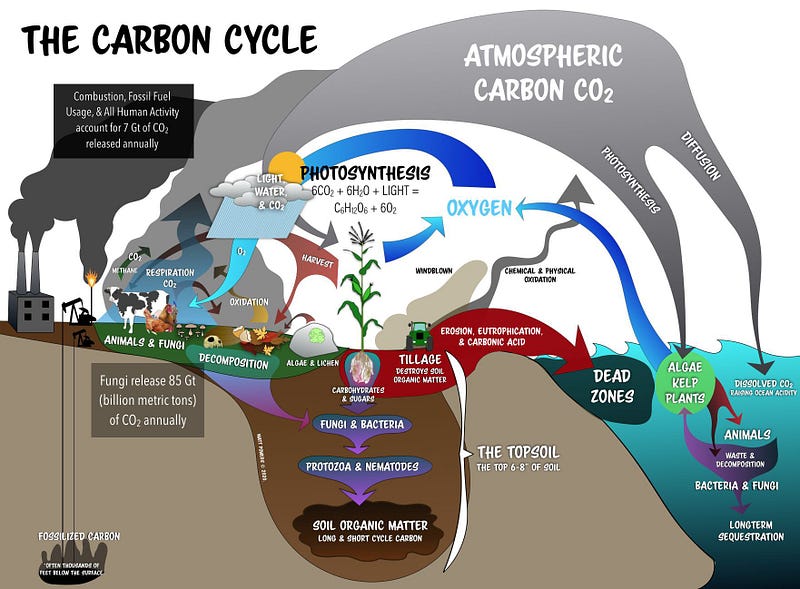
Although the picture is focused on the carbon cycle on land, you see the interaction with the sea. With oceans. With our lungs.
Trees are created in the air by sunlight and chemistry
Oceans as Lungs
So, how about these lungs? Oceans are full of plankton. It’s the name for a diverse collection of organisms found in water (or air) that are unable to propel themselves against a current (or wind).
The world revolves around diverse collections of micro-organisms. In air. In water. In soil. In our guts. They are what keeps our planet, our plants, our animals healthy.
And what makes life liveable for animals, including humans.
For whoever doesn’t believe me, I can only say: watch Symbiotic Earth. The documentary about the life of Lynn Margulis says it all. Micro-organisms are the evolution. Full stop.
But that aside, oceans and plankton. Plankton is a biological carbon pump that takes CO2 out of the air. And although I do NOT believe in industrial solutions manipulating this pump into absorbing the carbon we shouldn’t have been emitting anyway, it is true.
Plankton is a biological carbon and oxygen pump. The oceans are the lung of our planet.
Microorganisms make life liveable for animals, including humans
Whales are Harvesting
Whales eat plankton. So, some scientists thought that killing whales would be good for the plankton. Well, that’s reductionist thinking. We should turn that around. Harvesting something, eating something, is good because the planetary cycles will make sure that more will be produced when it is needed as food.
There are just two rules for harvesting. Never take more than you need. And never take more than half (of one plant). If you stick to those two rules, nature will do the rest and give you abundance like never before.
And if you then follow the cycles, you’ll see that the largest animals, whales, are unusually good at taking CO2 out of the atmosphere.
A large whale will collect during his lifetime 33 tons of CO2 in his body. When he dies he takes this CO2 to the bottom of the ocean to stay there for ages. In comparison, a tree absorbs 1.5 tons of CO2 in the same amount of time. And when we cut it down and make furniture out of it, it’s only a matter of time before it lands on the waste pile or will be burned.
Emitting… you are right… CO2 again.
According to a scientific article in Plos One, rebuilding populations of large baleen whales would store carbon in their bodies equivalent to the amount in 110,000 hectares (272,000 acres) of forest. “An area the size of the Rocky Mountain National Park,” in Colorado, U.S will be needed to absorb as much CO2 as a large population of whales.
Well, if we worry about the scarcity of land to come up with solutions for climate change, think about restoring whale populations.
Harvesting: Never take more than you need. And never take more than half
Ocean and Whales and Breath
Okay, let’s stop the mental information. We know now that oceans are mighty important. We know now that whales are the giants of our planet, making sure we have enough oxygen to breathe. And breath is what it’s all about in our lifetime.
Breathing is our human theme right now. COVID is about breathing. Facemasks are about breath. And the real solutions will be found when we slow down and live mindful lives. How do we learn mindfulness? With breathing…
So, in Ibiza, I put my feet in the sea and took some deep breaths.
An ode to the ocean came to me. An ode to the waves. An ode to the whales. An ode to the plankton wriggling in the waters.
My toes wriggled and I knew I was touching plankton. I knew it was informing me of what life is all about. Via my skin, the micro-organisms were talking to the symbiotic bacteria in my gut. And my body knew what to do.
Laughing out loud!
I was there on the beach, laughing out loud. Taking deep breaths. Knowing that life is so much more than my tiny speck of body in the vastly intelligent universe. But I also knew that my words could move mountains.
So, the next thing I did was write…
Breathing is our human theme right now
Tell me, did you ever fall in love with the sea? With the ocean? With the whales, you just knew were out there somewhere? Tell me. I’ll be so glad to listen to your stories…
Want to connect? You can find me somewhere on our beautiful planet, with my hands in the soil and my eyes gazing at moonshots and quantum leaps. Or find me via Linktree.
© Désirée Driesenaar


