
PERSONAL GROWTH STRATEGIES & STORIES
How to Know You Are Ready To Leave Your 9 to 5?— Achieve Financial Freedom
How long can you survive if you stop working today? Inspired by Rich Dad Poor Dad

I have been hearing great things about Rich Dad, Poor Dad. So I picked up the book.
And I regret not doing it sooner.
The book is full of useful suggestions that can aid your journey to financial freedom. Let me share a formula I created using the learnings from the book.
How Wealthy Are You?
The writer of Rich Dad Poor Dad modeled his understanding of wealth based on a statement from Dr. Buckminster Fuller. Buckminster was an American Architect whose work and writings influenced Robert Kiyosaki. Robert found a statement of Dr. Fuller which formed his definition of wealth.
How long can you survive if you stop working today?
Robert Kiyosaki, one of the authors of the book, did not suggest using savings to calculate wealth. He believes that wealth comes from assets. His definition of asset may also vary from others. According to him, an investment only qualifies as an asset if it generates earnings for us.
So, of course, you can have savings to cover you during rainy days. But that will not make you wealthy according to this definition.
Other personal finance experts also recommend putting your money to work. If you just put your money in savings, the value of money will diminish due to inflation. However, putting it in investments or assets will generate revenue for you, and money’s value will increase.
I converted the principle into the following formula.
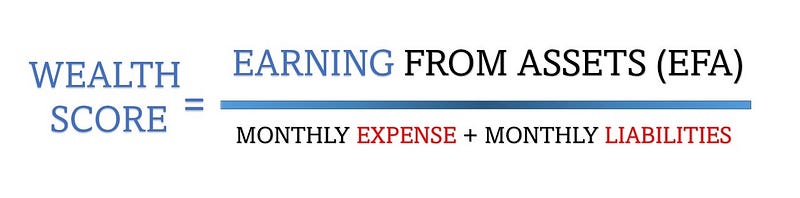
Let’s look at an example:
- EFA or Earning From Assets= $1500
- Monthly Expense = $4500
- Monthly Liabilities = $1500
- Wealth Score = $1500 / ($4500 + $1500) = 0.25
This score means that you can survive 0.25 portion of a month or 7.5 days every month if you stop working today.
How to read the score
If the score is below 1, then you are not wealthy.
If it is at 1, then you are self-sufficient.
The higher it is from 1, the more wealthy or richer you are.
If the score is above 1, that means you can stop your day job if you want. Then you can focus on earning from assets.
Experts recommend that your earnings from assets should cover twice your monthly expenses (+ liabilities) before you leave your day job.
Is Your House an Asset or a Liability?
Let us quickly have a look at the definitions of Assets & Liabilities.
Anything that can generate income for you is classified as an Asset
Any purchase/ development that generates periodic expenses is classified as a Liability.
If you have a house from which you get rent, it is an asset. If you live in your own house, it costs you installments so it is no longer an asset. A house can be a liability in that case. You can argue that a house saves rent so it can be considered to calculate whether a house is an asset.
Examples of Assets
Other assets can be stocks, bonds, a stake in a company, real estate, livestock, and anything else that can generate income for you.
Examples of Liabilities
Cars, Credit card loans, student loans, etc.
How Wealth Score Can Benefit You
- If you are working towards financial freedom, a score above 1 will indicate that you have reached that.
- You can track this score regularly to check your progress. If you see your liabilities are weighing you down, then you can focus on getting rid of them fast. For example, after I refocused on my liabilities, my wealth score increased 52% within a few months.
- Additionally, this score also teaches us to not buy liabilities — especially if you have little earning from assets. If your assets earn you enough, you can funnel some of that into luxury items and potential liabilities.
- You also learn that your expense lowers your wealth score. So expense optimization becomes a priority.
- But ultimately it is about generating earnings through assets. We tend to miss that point and focus on savings. Savings usually don’t keep up with inflation. As a result, we lose our net worth every day.
Final Thoughts
Proper financial education is a must for all of us. Understanding how money works at a young age will help us achieve solvency and grow wealth. It will also help us avoid any financial disaster.
This score — even if you do not seek financial freedom — can help you stay ahead of money troubles.
I am an MBA-trained Marketer with 10+ years of experience in brand building, data-driven marketing, media management, and leading startup & corporate marketing teams. My other articles include —
- How I got into #1 Ranked INSEAD MBA? 10 Proven Steps That Helped Me
- Simple Reason Why People Pay 50% Premium For One Bottle of Coke
- Know the Marketing Growth Funnel — Proven Secret to Get & Retain New Customers — Introducing Part 1
If you are interested to get a notification when I publish, you can subscribe to email notifications. If you are not a Medium member yet, you can become one by clicking on this affiliate link.


