
How We Hallucinate the Legal Fiction of Private Property
The obsolete religious context of ownership

Perhaps the most shameful calamity to befall any late-modern materialist is the loss of his private property and especially his home.
If you find yourself evicted and homeless on the streets, no longer the king of your castle, you’ve been effectively anathematized by the Church of Private Property. As George Carlin said, home is where you keep all your stuff, and we effectively worship stuff, not anything immaterial like God.
Is private property imaginary?
But wouldn’t it be more humiliating to realize that private property is as much a figment of our imagination as the God of that medieval priesthood whose acts of ex-communication from Christendom meant death for the ostracized sinner?
There are preeminent institutions devoted to the laws of private property. Theft is a crime, punishable by a fine or a prison term. Owners pay insurance to protect themselves against damage to their property, whether it be their car, house, or some other treasure. Capitalism is driven by buying and selling products that become privately owned as soon as they’re purchased. Advertisers bombard you with manipulative stories about how you ought to own or consume this or that trinket or manufactured experience.
Philosophers like John Locke have tried to explain why European colonists deserved to own the lands of the New World more than did the natives because the colonists worked harder, mixing more of their labour with the material resources so that the synthesis became an extension of themselves. Even the debate about whether women should be able to abort their fetuses has been construed as being about whether a fetus is an extension of the mother so that she could rightly abort because she owns her body.
The right of self-defense is premised on the same assumption that private property begins with our ownership of ourselves. Indeed, libertarians have built up a philosophy of selfishness that says that the “free” market maximizes that individual freedom to do almost whatever we want with ourselves, in which case any government that interferes with those private expressions is tyrannical. And that philosophy has directed much of the course of American history from that country’s modern inception.
Yet all those institutions — all of that tinkering with and squabbling over applications of the concept of private property — should appear comparable to a sleepwalker’s antics or to the buffoonery we might get up to while under a trance.
Private property and sacred spaces
The problem, you see, is that the ownership of private property isn’t real. It’s all in our heads along with many other fantasies, confusions, and rationalizations.
Take your car, for example. You claim to own it because you exchanged something of equal value with the manufacturer or with the previous owner. You paid money for the vehicle, and you might have sat down at the dealership and signed dozens of official papers as you negotiated the insurance and a complicated payment plan. That rigmarole makes you legally the car’s owner.
But in objective reality, no one owns the car. Indeed, the notion of ownership is precisely as bizarre as the religious notion of a sacred space. In The Dawn of Everything, a revisionary book on anthropology, the authors point out that forager societies that better reflect the prehistoric period of our social development often eschewed the idea of private ownership. They were more egalitarian and experimental in how they organized their social interactions.
Yet foragers made an exception for sacred objects which they did indeed treat as private properties. Drawing from the work of James Woodburn, the authors say,
In Hadza religion and the religions of many Pygmy groups, initiation into male (and sometimes female) cults forms the basis of exclusive claims to ownership, usually of ritual privileges, that stand in absolute contrast to the minimization of exclusive property rights in everyday, secular life. These various forms of ritual and intellectual property, Woodburn observed, are generally protected by secrecy, by deception and often by the threat of violence.
Sacred items are often
the only important and exclusive forms of property that exist in societies where personal autonomy is taken to be a paramount value…It’s not just relations of command that are strictly confined to sacred contexts, or even occasions when humans impersonate spirits; so too is absolute — or what we would today refer to as ‘private’ — property. In such societies, there turns out to be a profound formal similarity between the notion of private property and the notion of the sacred. Both are, essentially, structures of exclusion.
Think of the Holy of Holies, the inner sanctum of the Jewish Temple. No one in Jewish society was allowed to enter except the High Priest, and he could enter only once a year on Yom Kippur. The inner sanctum was holy ground because that was where God was supposed to be most present. Indeed, as the authors point out, “the true ‘owners’ of land or other natural resources were said to be the gods or spirits; normal humans were merely squatters, poachers, or at best caretakers.”
The authors conclude that “If a private property has an ‘origin,’ it is as old as the idea of the sacred, which is likely as old as humanity itself. The pertinent question to ask is not so much when this happened, as how it eventually came to order so many other aspects of human affairs.”
The ghosts of ownership
Private property is arguably, then, an extension of the religious fantasy of sacred spaces. We secularists, too, exclude the rest of the world from using what’s ours by “legal right.” To intrude upon that private space is to violate a taboo. If you’re a conscientious person who’s never stolen anything of importance, and you were forced, say, to break into someone else’s home, you’d feel ashamed and fearful. Not only would that act be punishable under the law, but you’d have committed the secular equivalent of sin; you’d be in the wrong, having desecrated that space that isn’t yours but theirs.
The original meaning of the word “own” is instructive in this context: to own is to possess and thus to be under an obligation (to use the thing as you want or as it should be used). “Own” is thus related to “owe” and to “ought,” and ownership presupposes not just a moral context of obligation, but a religious sense of entitlement.
After all, the word “possess,” in turn, means originally just an occupation or control over the possessed thing. You possess the land when you occupy and control its use, say, with military force. But, of course, no moral sense of ownership follows just from that physical enforcement. A carjacker doesn’t become a car’s true owner, we’d say, just because that thief overpowers the owner at gunpoint and steals the car. No, the kind of possession that substantiates the ownership we have in mind when we take private property for granted must be much closer to the religious notion of a spirit’s possession of a sacred territory or item.
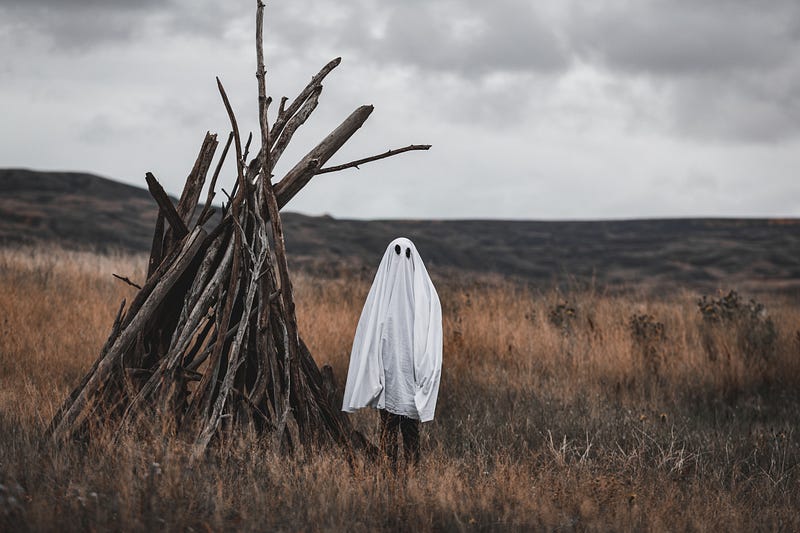
Think of the folktale of a ghost’s haunting of a house. Humans buy the property from the previous owner who died in the house, but that former owner never really left, we might fear. That dead owner haunts the premises and thus is the true owner, the mundane regulations about the transfer of legal title notwithstanding because the dead person spiritually possesses the property. Truly owning the house would require more than mere legal payment since the latter would satisfy only the government and the bank. To fully own the haunted house you’d have to negotiate also with the ghost, freeing the ghost of its moral claim over the house, say, by carrying out the ghost’s last wish.
The point is that legal ownership such as the taking out of a mortgage likely carries moral weight only to the extent that this legal fiction belongs to a similar ghostly or religious context. The dollar bills that we trade for the right to own something have value only because we treat them as though they were haunted by our spirit. We possess the money we hand over to the bank to buy and to own a house, and when we hand over our money, there’s an exchange of ghosts: the bank’s spirit possesses the money, and our spirit transfers to the house which we now haunt even while we live.
Consequently, we’re thought to own the house even if we’re not residing in it, that is, even when we’re not “at home,” physically possessing and controlling the house’s use. If we’re miles away on vacation, the house is still ours because something like our ghost is presumed to haunt or to spiritually possess our home, making it morally rather than just legally ours. Were a thief to break into your house and to feel guilty (rather than just afraid of being caught and imprisoned), it’s your ghostly presence that lingers, or the presumption that you have a spooky moral right over the place that would be scaring the thief.

The trance of mass morality
We’re oblivious to this religious foundation of private ownership, but we unconsciously treat the private property as having a moral aspect that presupposes more than can be justified with any mere legal or philosophical rationalization.
This is therefore a case in which we all operate under a trance in our public life. We treat ownership as sacred, as though there were indeed ghostly presences at work, divvying up material things by taking possession from their supernatural realm, making our favoured corner of the world sacred. Those things or places that are owned are possessed, meaning they’re off-limits for anyone else. And if you steal an item but aren’t caught because you cover your tracks, you’ll feel guilty because we’re trained to act as though that item will be haunted by someone else’s ghost.
To feel guilty, you’ll need to be under the spell of morality. So, the building up of conscience is the social act of hypnosis that sustains the trance which automates our behaviour with respect to private ownership. We’re taught as children to be kind to others and to follow society’s rules because things in the world have value.
The problem is that we no longer accept the explicit justifications for that talk of value since the religious foundation is obsolete. We behave as though we were religious in our worship of private property as something sacred and inviolable because secular institutions depend on that respect for the social order. But the indoctrination is necessarily thin since we know too much to believe there are ghosts floating around, animating commercial transactions.
It would be easy to take this analysis cynically and to conclude that morality is an illusion. Once you eliminate the religious reasons to respect privacy, maybe there are no such reasons at all, so we should all be wanton criminals. That’s not what I’m saying here. There is an enlightened case for moral values, I think, but it’s not what most of us have in mind in our secular practices.
What suffices for mass deference to the spooky aspect of ownership is the hypnotic inculturation of children that eventually supports the conscience and the trance state or the mass hallucination of a ghostly realm of “values” and of “rights” that takes hold of the world of material objects.
We see ghosts everywhere, as though they possess and “own” this or that property, even though we know there’s no such thing as a ghost. We’re so used to identifying ourselves with our favourite fictional characters, as we consume a galaxy of pop-cultural fictions to achieve cathartic release, that we have no trouble adding useful abstractions to the mix. In fact, the generalization, simplification, or idealization behind every single concept or model makes for an illusory abstraction.
Thus, we sleepwalk our way into domestication, and only oddball philosophers would investigate the matter further and seek some vindication of this collective madness.


