
GROWING UP
How Two Years at a Radical School Shaped My Worldview
Sometimes we can find meaning in the most absurd childhood experiences
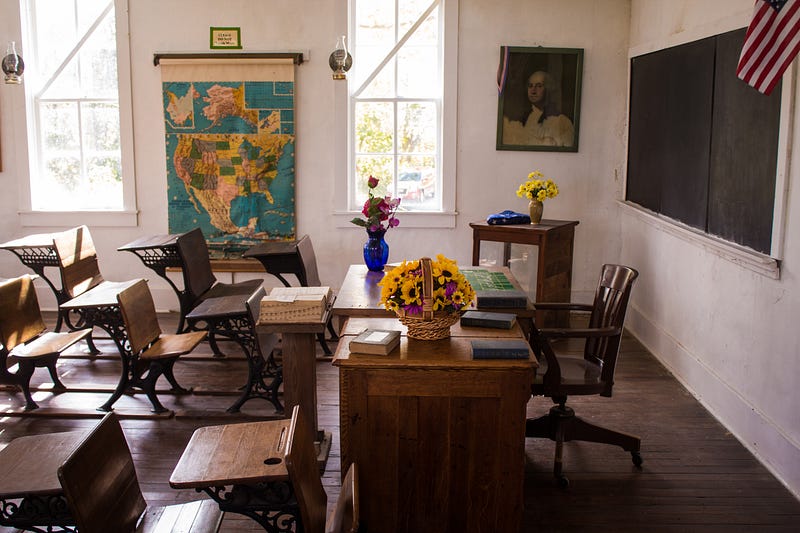
Until I attended a non-denominational private school, every morning started the same way in class. Everyone would stand up, face forward towards the flag, place their hand over their hearts, and then in unison start with “I pledge allegiance to the flag of the United States of America…”
When Europeans, especially those who have never traveled to the US, say Americans are crazy, they do not just mean the guns. They mean thirty nine-year-olds having to articulate their patriotism every morning for an entire school year. Imagine the furor if this was forced upon students in public schools in the UK, France, Denmark, or, hell, even Italy.
When we moved to Minnesota, my parents, despite not being very religious themselves, enrolled my brother and me at a Christian school called New Life Academy (in hindsight, the name should have probably had them think twice). By this point, having already lived in the US for two years, I had pledged my allegiance plenty of times and was so allegiant — if that is even a word — to the Stars and Stripes, that I could do it in my sleep.
Something in the air was different at the new school, however. Instead of following along to the school’s closed-circuit television karaoke style, we were summoned like troops in a barracks. Much like a five-star General, our teacher would stand in front of the class and make sure everyone was paying their due respects as we pledged our allegiances. Allegiances, plural.
After the American flag, we would all pivot forty-five degrees to face another flag, this time a white one with a red cross enclosed in a blue square in the top left-hand corner. And, once again, in pitch-perfect unison, we would begin, “I pledge allegiance to the Christian flag…”
Wait what? Not the state flag or even the school flag, for that matter. The Christian flag? My parents had the same reaction when I told them that after my first day at the new school. As blasphemous as it might be to write this, I would be willing to bet that ninety percent of Christians worldwide would have no clue what the Christian flag even looks like.
Two pledges of allegiance in one morning. One might be prompted to think this was overkill. And yet, after the second pledge to this obscure flag, all the boys in their tucked-in red polos and girls in their long, plaid skirts remained standing as the teacher approached the front of the room holding up a Bible. At this point, on the verge of tears despite having performed this act for decades, she led us in a stern pledge of allegiance to the Bible. The very same famous pledge of allegiance to the Bible that all good Christians partake in every morning all over the world.
After what seemed to be twenty minutes, we were all allowed to sit down and would be invited to bow our heads for the initial prayer. At the time, with the war on terror having recently commenced, the prayer would often entail support for our troops and also for our president in the difficult decisions he had to make to keep us safe. Speaking of the president, every classroom had a framed picture of George W. at the entrance with a small candle underneath it as if it had been his vigil.
The school instilled a God-fearing mentality — emphasis on fearing — in all its pupils. We were given vivid descriptions of the constant teeth-chattering furnace of hell that would await if we did not routinely say our prayers and shoo Satan away from our lives.
I cannot imagine most of the parents were thrilled by the nightmares this would induce in their nine-year-olds. Mind you, this was Minnesota in 2003, not Alabama in the 1950s. My parents had without knowing it thrown me into a radical evangelical cove. I had become a born-again Christian at nine.
When my parents finally wrapped their heads around this during my second year at the academy, they promptly ensured me a place in another school. At the time news was also breaking from Boston about abusive priests and my father had stopped joining the rest of us at church every Sunday. Slowly, my mom also gave up the fight and, to the furor of our family back in the old country, we no longer went to Sunday school anymore.
It was ironic that, as Italians, we were expected to continue the long tradition of being church-going Roman Catholics. Everyone took for granted that we were blindly devout to our lord the Savior. In our extended family, everyone claimed to be religious but very few actually practiced it, although they routinely lied about doing so.
In my family, it was more common to forgive ourselves for not attending church most Sundays because the schedule interfered with watching a football match than actually attending confession. It was during those same football matches that I routinely heard — and uttered myself — some of the most sacrilegious insults to the opposing teams.
The hypocrisy is always what annoyed my father about the church in Italy and so when he found the same in the US, he checked out. He had been actively recruited by Opus Dei as a child in Spain and I think the experience had left him somewhat traumatized.
Fortunately, my parents never tried to influence our worldviews in such existential ways, and so I was allowed to conduct my own religious experiments. Later on, at college, I would regularly go to church on Sundays, sometimes with friends, sometimes alone. I enjoyed the sense of community and I liked the idea that there was a greater meaning to all of this. Plus, I was terrified of the thought that one day it might all be over and the sermons made that a bit more bearable. I was probably also still affected by the images of the hell described at my Christian school.
During my studies, I was intrigued by Jesuitism, a big fan of Pope Francis (as a turnaround CEO), Thomas Aquinas, the Talmud, and Calvinism. I followed papal conclaves with great interest but mostly because of — like with any other election — the political intrigue and maneuvering.
I also enjoyed diving deep into Eastern religion and often wondered how they could all claim to be the ultimate truth simultaneously. Ultimately though, I was more influenced by moving to highly secular places like The Netherlands and Denmark where old churches with dwindling parishes are repurposed to be bars and discos.
To this day, I remain undecided about what my religion — if any — is and I am quite comfortable with that, just like I am comfortable having friends who are highly religious and learning about their faith. I am fascinated about how religious narrative — especially in the US and Italy — intersects with the other fundaments of our societies like politics and education.
Like many Italians, however, I worship my football club more than the Vatican. That is an emblem to which I have pledged my allegiance on many Sundays and also blasphemed to exhaustion more than my fair share of times.
My travel storytelling centers on long-form first-hand accounts with a focus on vivid depictions of the local culture through the people I meet along the way. I also work as a travel advisor tailoring travel adventures all over the world, more info here: https://www.foratravel.com/advisor/nicola-volpi and am host of the Lost In Postulation podcast: a podcast exploring the intersection of pop culture and the mundanity of daily life.