avatarLynda Coker

Free AI web copilot to create summaries, insights and extended knowledge, download it at here

1565

Abstract

forward the present tension, conflict, or mystery.</i></li><li><b>The layering for depth </b><i>Layering is not as easy as it may seem. Too much layering or layering with the wrong color or texture will bury the elements underneath. <a href="https://ijnet.org/en/story/organizing-complex-story">The same is true when plotting a story.</a> It’s best to begin with light, softly positioned additions, preserving the integrity of the story underneath. Over time, these lightly applied plot points will blend to form the depth I want my story to have.</i></li><li><a href="https://blog.bookbaby.com/2018/02/importance-of-setting-in-your-story/"><b>The story that the setting reveals </b></a><i>This principle is very interesting to me. When creating fabric art, I don’t always know where I will end up. But somewhere deep within is a sense of the emotion that I want this piece to convey. In the case of, <b>The Autumn Leaves,</b> the emotions I wanted to convey were harmony, peace, and contentment. As a writer of romantic fiction with a happy-ever-after ending, the same sense of emotion must be revealed by the time I type, The End.</i></li></ol><p id="d681">Remember, you don’t have to be an art critic to figure out why a piece of art attracts you and how you might apply that aspect in your writing.</p><div id="518d" class="link-block"> <a href="https://readmedium.com/how-to-write-great-fiction-tip-7-61c9d7df0c61"> <div> <div> <h2>How to Write Great Fiction — Tip 7</h2> <div><h3>Can your

Options

story hook a reader in 10 pages or less</h3></div> <div><p>medium.com</p></div> </div> <div> <div style="background-image: url(https://miro.readmedium.com/v2/resize:fit:320/0*Ik2pDUnlANlE8b4b)"></div> </div> </div> </a> </div><div id="a99c" class="link-block"> <a href="https://readmedium.com/how-to-write-great-fiction-tip-1-8ae1149ccb0"> <div> <div> <h2>How to Write Great Fiction — Tip 1</h2> <div><h3>Reading comes first</h3></div> <div><p>medium.com</p></div> </div> <div> <div style="background-image: url(https://miro.readmedium.com/v2/resize:fit:320/0*QUUCE5dUoLcfbmfn)"></div> </div> </div> </a> </div><div id="a39c" class="link-block"> <a href="https://readmedium.com/texas-heat-introduction-and-chapter-1-cc2135d7140"> <div> <div> <h2>Texas Heat—Introduction and Chapter 1</h2> <div><h3>A thin line runs between betrayal and sacrifice. Figuring out the difference could cost a man his heart.</h3></div> <div><p>medium.com</p></div> </div> <div> <div style="background-image: url(https://miro.readmedium.com/v2/resize:fit:320/1*QrAvWnzQjfOYwX1Ypoj_oQ.jpeg)"></div> </div> </div> </a> </div></article></body>

How to Write Great Fiction — Tip 6

The principles of art can enhance your writing skills
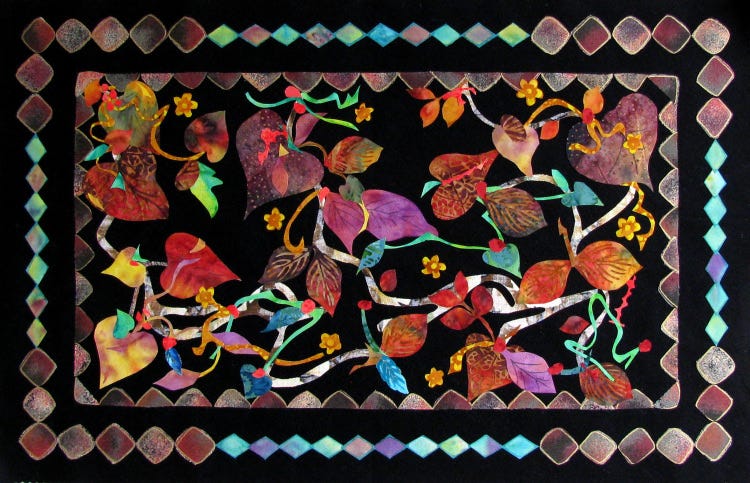
Photo by Lynda Coker

Many writers know how to capitalize on other areas of interest to enhance their writing. When I started applying that principle, I saw how my love of designing fabric art could also enhance my skills.

Let me use one of my fabric art pieces (Cover Photo) to illustrate my point. On the surface, this art form and writing have nothing in common. But that perspective is way too shallow. Let’s go deeper.

Specific elements in this art piece make it appealing to the eye.

  1. The use of complementary colors On the color wheel, complementary colors are opposite each other. They are widely different yet they have the ability to bring out the best in each other. This is exactly the type of character I strive to create when writing a leading couple of romantic stories.
  2. The use of highlight and shadow One of the mistakes I made in my early days as a writer was telling too much of the story up front instead of letting it unfold in a more interesting way. Leaving some story details in the shadows, at least for a time, serves to highlight or bring forward the present tension, conflict, or mystery.
  3. The layering for depth Layering is not as easy as it may seem. Too much layering or layering with the wrong color or texture will bury the elements underneath. The same is true when plotting a story. It’s best to begin with light, softly positioned additions, preserving the integrity of the story underneath. Over time, these lightly applied plot points will blend to form the depth I want my story to have.
  4. The story that the setting reveals This principle is very interesting to me. When creating fabric art, I don’t always know where I will end up. But somewhere deep within is a sense of the emotion that I want this piece to convey. In the case of, The Autumn Leaves, the emotions I wanted to convey were harmony, peace, and contentment. As a writer of romantic fiction with a happy-ever-after ending, the same sense of emotion must be revealed by the time I type, The End.

Remember, you don’t have to be an art critic to figure out why a piece of art attracts you and how you might apply that aspect in your writing.

Books
Writing Tips
Fiction
Art
Writing
Recommended from ReadMedium