
How to Write an Article Every Day With This Easy Mind Mapping Technique
Get those ideas out of your head and into your messy, sweaty hands

Why is it so hard to take a vague idea that you know is a good one, and turn it into an article other people might actually want to read? Creating can be like quicksand. You walk in, unsuspecting, and end up struggling to just reach solid ground. But it doesn’t have to be so hard.
If you have a pile of ideas and three or four word notes but struggle to make them amount to anything, then this strategy is for you! You can take any idea, plug it into the mind map, and pop out a bunch of writing prompts that will get you going in the right direction. You can experiment with my ideas like a mad scientist until you get some sort of Frankenstein’s monster that will go out and roam the lands, killing peasants and such! Or at least, you can use mind mapping to create new content from nothing but simple one-liners you have saved up.
To show you how I use mind mapping, I’m going to share my process from start to finish. I’m having someone pick a random topic for me, and then I will write an article in one go. The instructions I gave were that the topic needs to be vague and not particularly helpful. I’m getting the topic from my anonymous helper now… I’ll let you know as soon as she finishes typing het SMS reply.
Ok, here we go. The topic I was given to write an article from scratch in one day is :
weasel
What? How do I take that and make an article? Talk about rooster block! Ok, so I’m drawing a total blank. That’s perfect. This will show the true power of mind mapping in the hands of an unlicensed laptop operator who has nothing to lose by losing. Here we go!
Start with blank space
The first step is to put your topic in a big, blank space on paper or a whiteboard. I prefer paper, but you could do it any way that works for you. I’ve heard some use Post-it notes and an open chunk of wall.
Alternatively, you could use an app like SimpleMind Mind Mapping. I downloaded it into my iPhone today because I have a brain like a squirrel and need one more distraction real bad. This might be better for you if you lack things like paper and pens but somehow own a miniature supercomputer.
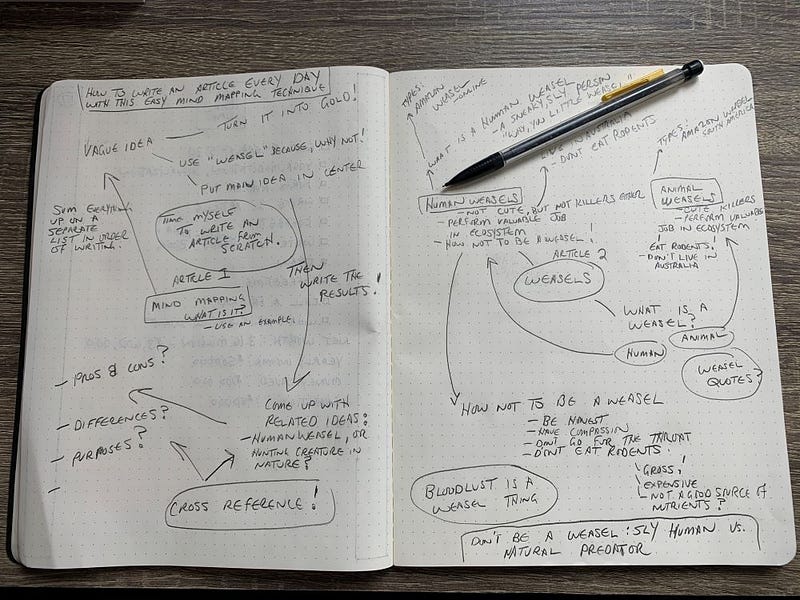
Take your word or article idea and put it on your blank space. I just slam that word right in the middle. So today, I wrote “Weasels” in the middle of the page. Now what? I just go with the next thing that pops up. I’ve got “What is a weasel?” which leads to “human weasels” and “animal weasels” in my head, so I write those things down and connect everything up with some arrows. I leave space around each thing, so I can scribble whatever comes up. Next, I just break everything down and cross reference wildly.
Notice that so far, I really don’t know what my article is going to be about. But it doesn’t matter. I just keep chugging through until I have all of my ideas down. I don’t stop until my white space is almost full.
At this point, I have two mini headers: Human Weasels and Animal Weasels. I put “cute killers” under animal. I put “not cute, but not killers either” under human. I write “ perform valuable job in ecosystem” under animal, and then I decide that human weasels probably perform a valuable job in human society too. I start drawing a blank, so I do a quick internet search on weasels to get more ideas.
Use research, but not too much
Be careful at this step. Don’t get sidetracked into endless websites and reading. Go out to the internet forest, grab a handful of berries and run straight back to your mind map at the edge of the trees. If you get lost in the forest, you will wander around reading Dilbert cartoons about weasels all day and come out exhausted. Your article won’t get done, and as a result you will feel like a sad piece of human garbage. Stay focused!
Reading an entry on weasels shows me that they eat rodents, and don’t live in Australia. So I put “Eat rodents! Don’t live in Australia” under Animal Weasels. Then I cross reference that idea. I go over to Human Weasels and write “Can live in Australia — don’t eat rodents.”
Types of weasels becomes another header — I notice the Amazon weasel of South America on the Wikipedia page, so I add that to the sheet, which makes me think of the Amazon Weasel who uses Amazon online to rip people off with fraudulent reviews. And this starts me thinking about human weasels in the workplace.
I think that How Not to be a Weasel might be my article title. Of course, any wild weasel from the forest obviously has no choice in the matter. So, my article will be about human weasels, right? I put that down under “Human Weasel” and I pop over to Sharethrough.com to try a few variations of headlines on for size. I like spending a few minutes during the mapping process thinking about my headline. I might change it later, but it’s better to get my brain working on it early. I can edit it a couple times before publishing.
I end up with “Don’t be a Weasel: Sly Human vs. Natural Predator” and write that on my sheet. I also realize that I need to put “Bloodlust is a weasel thing” on the sheet, because it popped out of my brain’s sludge pile.
All I’m missing is how to actually not be a weasel. I come up with “ Be honest, have compassion, don’t go for the throat, and don’t eat rodents.” I add this plus a few notes about how eating rodents is gross, expensive and maybe not a good source of nutrients?
And that’s it! The mind map is complete! Any holes in the story will get filled in with random bullpoop as I go. Here’s a picture of the mind map for this article you’re reading, as well as the one for the weasel article.
The next step is to figure out my writing order. I like to number the items on the map from one to whatever. Then I go to number one, and start typing. If I write something and later need to move it or delete it, then I do. Nothing needs to be fixed in place for the rough draft.
I quickly hammer out the first run without stopping to fix mistakes. Then I go fill my coffee cup, make some toast, and come back in about 15 minutes for the first edit.
Read it out loud
I read my whole article out loud. I might read it to my cat, although she never reacts. Sometimes I think she doesn’t really understand me at all.
Anything that is really goofy gets caught at this step. I fix all of the most obvious mistakes and reword a few sentences. Then I go for another 15 minute break and walk around aimlessly, looking out the window or going out on the deck with coffee.
Ok, break’s over. I read every word to myself and force myself to actually pay attention. I fix more mistakes. I add words or delete entire sentences.
Next I get some pictures from Unsplash, or other sources that will give me legal permission to use them. My criteria for pictures is that they have to make me feel something when I look at them. If what I get from a picture is “Meh” then it is no good. If I feel fascinated, or it really pops for me, then I go with that one.
If I can’t find a picture in one hour, then I stop looking temporarily. Maybe it’s just my mood. I have to shelf this for later on in the day. But most often I see one and grab it. I always get the picture taker’s name and put that underneath to give proper credit and meet everyone’s guidelines around here.
One last run through
It’s really important to edit this puppy at least one more time. I force myself to read every bit of the article from start to finish. If I get distracted I go back to the top and start again. I’ve caught some silly mistakes right before hitting publish.
After my final edit, I stop and see how I feel about it. Does everything seem complete? Did I end up creating something with good flow, that has an eye catching photo and will keep interest for more than 4.5 seconds? If I’m in doubt, I can let it sit and work on something else for a while, then come back to it. Quite often I don’t publish until the next day, when I give it yet another edit.
After any remaining tweaks, I lovingly wrap my bouncing baby article in tags (keywords) and leave it on the doorstep of a publication. I hope to someday have one of my babies get adopted by rich parents like The Writing Cooperative or The Startup. My personal strategy to get to that point is practice, practice, practice. Time to pop out some more babies!
Here is my finished weasel article, in all of its glory. Remember, this is a topic picked by someone else, about which I had nothing to say until I mapped it out. Using a mind map you could write about almost anything if you have access to Google, which we all do.
Now you have a powerful tool to write about anything when you’re drawing a blank. I keep a notebook full of ideas, and if I’m stuck for something to write, I scan through it for something I’m interested in that day. Then I open my mind map notebook and get those mental gears spinning.
Using the map, I create an article out of nothing. Even if the end product isn’t something that I want to publish, it’s writing, and that means it’s practicing my skills instead of sitting there looking at a blank screen with drool coming out of the left corner of my mouth. Even my cat understands that the drool look is unattractive on a human.
Do you struggle to find your writing voice? This is something most of us think about. Maybe this write up will inspire you to strike out and be fabulous:


