
How to Write a High-Quality Post for Medium and Not Get Embarrassed at What You’ve Written
A free course

No one can guarantee you’ll make it online but they all swear you will.
A great writer I know took courses from two top Medium writers and eventually gave up on the platform. They told her not to write about what interested her but what the audience wanted until she got famous. And they didn’t stress how important it is to keep your own voice. Finally, she wasn’t consistent long enough, so she didn’t make it.
There is no way you can make someone a good writer overnight. Writing is not only about typing, but also about thinking, jotting, research, and editing. It is a process that needs an inquiring mind and time. But there is a formula you can start with, even if you are a non-native English speaker like me.
Also, there is no universal key to success but this recipe helped me find followers in the beginning. In November 2020, I created a 5-day course on writing and digested the basics. I’m publishing it here now as a part of this blog post so someone else can understand how it works more quickly than I did.
It is practical and concise: No-fluff, no tricks-to-hack-the-system, but basic writing for those who still find this process hard. It’s also interactive and gives you small concrete tasks to do because that’s the only way to learn how to write better.
Check it out. Read only one chapter a day and do the task it requires. If you’re consistent, your writing know-how will improve after a while. It will take you months, maybe even a year but then you’ll have a solid skill for any platform, and going viral is just a matter of time.
Feel free to save this post and share it with others 👇
Day 1
I used to be a teacher. I don’t believe in mere listening, I believe in students’ exercise. Therefore, each day I’ll give you two tasks: reading and writing.
Today’s task for you is to write a Medium post. Think of an idea you’d like to elaborate on or something that happened to you that others would be interested in. Write about it. Any topic, any length, any form you like. Save it on your desktop, you’ll need it in the future.
…
As for the reading material, here is what I learned about Medium after a month on being active on the platform: How to Write on Medium to Get Noticed.
After you read it, don’t forget to write a post! And make sure you have a few hours for tomorrow’s task.
Day 2
There are many ways to write a blog post: a how-to, case study, rant, experience blog, etc. But if writing still feels a bit too much, try the form that always helps me.
First, copy yesterday’s post. Then read the instructions below and in the second copy implement the tips I am giving you. Or if it’s easier, write another post. And, please don’t delete yesterday’s copy.
…
And now, the reading part.
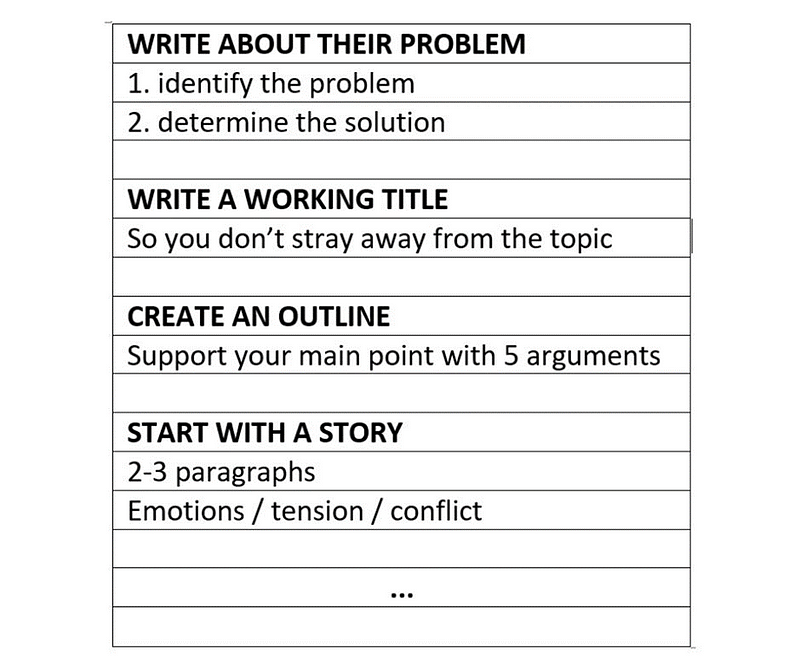
NOTE: Before we start, open a table at the end of this article. It will help you be more systematic and efficient later. It should look like this:
Let’s get back to reading.
How to Write a Post When Writing Doesn’t Come Easy
A formula that always works for me
Some people sit, type it all out, and press “Publish“ in less than an hour. But churning out content doesn’t make high-quality pieces. It can be if you’re an experienced writer or under a strong impression. Otherwise, good writing takes time.
Writing is about thinking, jotting, research, and editing as much as it is about typing. Why not combine the blogosphere and journalism into something that reads easily but doesn’t sound like cheerleading?
Give People What They Want to Know
You are excited about the idea but do others keep thinking about it?
Did you overcome your fear of flying? Are you good at communication? How did you recover from a breakup? Did you get a dream job? Will your article make them laugh? Or inspire them to start changing their unnerving habits?
Teach, motivate, or entertain. Tell them a story. Before you start writing, identify these two components: their problem and your solution.
- The problem is what the readers struggle with:
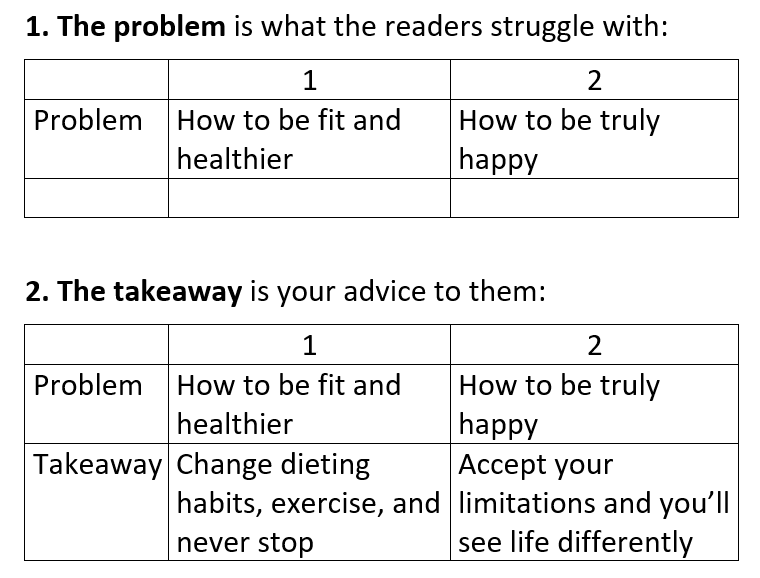
Write down these two pieces of information and that’s your foundation for the article. Then give it a “name“.
Write a Working Title
It will help you not stray away from the main point.
After you finish the piece, you’ll find the final headline. If you’re lucky and very skillful, your first idea will remain. But it usually doesn’t.
Create an Outline
Try to support your main point by giving five arguments. To have just three is also fine, as well as seven. They will become subheadings. Jot down ideas to explain each one. You could delete some later or change their places in the text. This is the skeleton of your article.
Before you elaborate on your points, focus on the beginning.
Start with a Story
In 2–3 paragraphs write a personal experience — yours or somebody else’s. We love to see the evidence in numbers but it’s the narrative that sticks in our heads. We’ve been listening to stories for 40,000 years. Your brain understands and remembers the point better if it’s presented as cause-and-effect, not graphs.
Surprise the readers from the start. Use a conflict or emotions to bring in tension. Don’t say how you felt but paint the picture, so they’ll feel as if it happened to them.
Tomorrow you’ll get more tips on how to write an effective introduction. Now let’s get to the main body of the article.
Elaborate on Every Argument (Subheading)
Explain each point in 2–3 paragraphs. Write freely, without inhibitions, as if you were drunk. If you can’t remember a specific word, write whatever comes to your mind and continue.
Give one detail per sentence. Don’t overwhelm the readers with information. Write in plain English even if you are trying to explain a scientific experiment. English is the native language of only some 25–35% of the Medium readers. A few lines per paragraph will do. Vary the length of a sentence and paragraph for more dynamics.
If you are new to the audience, start with a quote. That will add authority to your words. State the research from credible sources. Explain what you think.
Repeat the process with every subhead. Gradually guide the readers to the discovery. Your takeaway will solve their problem.
Wrap It Up in the Conclusion
Mention the key ideas from the subheads but don’t repeat every single point you’ve made. Then explain the universal message you are trying to convey. If you are aiming for inspiration, give people hope, or make them feel good about themselves.
…
That’s all about writing for today. On Day 3 I’ll show you how to keep your readers stay with you after the headline.
Day 3
Let’s talk more about the introduction today.
Write the Introduction
A great headline makes you stick out from the internet sea. Without it, people won’t click and realize how good your writing is. But only 20% of those who clicked read the whole article. The key is to grab them by the throat from the start.
Write every sentence so they want to keep on reading. Or as Bukowski said: “The secret is in the line“. Don’t let them go away to someone else’s piece.
Here are the tips on How to Hook Readers with an Irresistible Introduction.
After you read the tips, try to implement at least two of them in your post (in copy №2).
Put a CTA
Put it somewhere in the text. If the publication doesn’t allow it, then put at least a link to your old post from the same publication. See this no-CTA as an opportunity to write better, so the readers want to click on your avatar and check out your Medium profile. On it, add a link or two to your website or the book you wrote.
Choose a Compelling Featured Image or Create Your Own
You can also do this after the whole editing process. But since finding an adequate picture takes time, it’s also good to do it now.
Lately, I’ve been playing in Canva by adding my details to Creative Commons images. A bit of basic graphic design is a nice way to stick out.
Write a description of the image and usage rights underneath. Every publication has its own rules about it. Don’t forget to write Alt Tag for every picture you have with the keyword you’ve chosen in the text. It will help search engines rank your post better.
That’s it for now. Tomorrow I’ll tell you what helps non-natives as well as native speakers write better English.
Day 4
Yesterday you saw the power of a hook (introduction).
Today we’re going to talk about editing. On Day 1, you concentrated on getting your thoughts out of your head and onto the screen without much thought. After writing the first draft, take a break. When you come back to it, you’ll be able to see the post from a new perspective.
Leave It to Chill for a Few Hours, Then Shread It
For editing, you’ll need to read the piece several times. Always concentrate on one aspect only: grammar, vocabulary, SEO and hyperlinks, flow, etc.
Cut and edit like a vicious 7th-grade teacher:
- Delete every extra word.
- Replace every adjective and adverb with nouns and verbs if possible — they are more effective parts of speech.
- Cut the long sentences into two.
- Change the pace by writing a short sentence next to a long one.
- Leave out so, well, thing, stuff, and the brackets for a better reading experience.
Don’t be afraid to delete 30–40% of the text. Bring juicy information in every sentence of the introduction to pull the readers into the story hole.
Where does it sound too monotonous? Are the subheads capitalized? Are the articles good? What can you use instead of good, bad, and OK? Can you find a synonym for perfunctory?
I’m a non-native English speaker. With practice, I learned how to use dictionaries quickly and not sound like a 4th grader. I wrote a piece on how to write better English and many natives found it useful! Here it is — How to Improve Your Vocabulary and Write Better.
…
Now go back to your post and try to find better words. Exercise how to use dictionaries to write better. Over time you’ll learn how to use them efficiently.
Tomorrow you’ll read how a best-selling author uses literary techniques to make you flip pages which you’ll want to use as well.
Day 5
Yesterday we played with dictionaries. If they become a part of your writing routine, your language will improve noticeably.
Today we’ll look up to a mistress of storytelling and a New York Times best-selling author Elena Ferrante. Her books make you flip pages relentlessly until you realize it’s 2 a.m. and promise yourself: “OK, just a few more.“
Here are the techniques that make you glued to the book: Tips from Elena Ferrante on How to Write Better.
…
When you read the article, exercise Ferrante’s techniques. Go back to your post and put a sensory detail here and there, cliffhangers when you transition from one idea to another, and create a psychological transformation of your character throughout the post (if possible). Then finalize your piece.
Go Back to the Working Title
Think out 5–10 headlines:
- Write bold statements people disagree with: You’ll Never Be as Lucky as a Communist Worker Was
- Ask them questions: How Does Gwyneth Paltrow Still Sell Trash for Big Money?
- Write what they search for on the internet. Use Ubersuggest and find a word/phrase with great search volume and easy SEO difficulty: An Attitude of Gratitude Gets a New Life after 56 Days.
Make them feel something. Stir their curiosity. Let them know you hold the key to what’s bothering them.
Give a clear idea of what your piece is about. Start with Why and How. How-tos often work. Use a strange word or give your words authority like “experts say…“
Play at the intersection of clickbaity and journalism. Medium editors hate clickbaity, so avoid mystery and exaggeration. However, many authors still use it. They write a generic headline but add a specific phrase to make it less clickbaity.
When you have chosen the winning headline, check its length together with the first sentence (the lead) on Word Counter. It has to be below 100.
Here’s the post on 7 free tools for a simple but catchy headline.
Wrap It Up
Write 5 tags that belong to Medium categories. Find the right ones on Medium Topics.
Write the SEO description like this: Click “…“ at the top right corner of the Medium page, choose the option “More settings“, and then scroll to “SEO settings“.
Then choose a publication to submit to and press Publish.
Now go back to the post you wrote on Day 1 of this mini-course. Can you see the difference between these two versions?
Keep on writing. The more you write, the more it feels like a routine. After you’ve mastered this form, start experimenting. Break the rules in search of your mode of expression.
And always add to the conversation. On Medium, it’s all about originality and authenticity. You don’t get curated if they’ve heard it all before. Research the platform before you start writing.
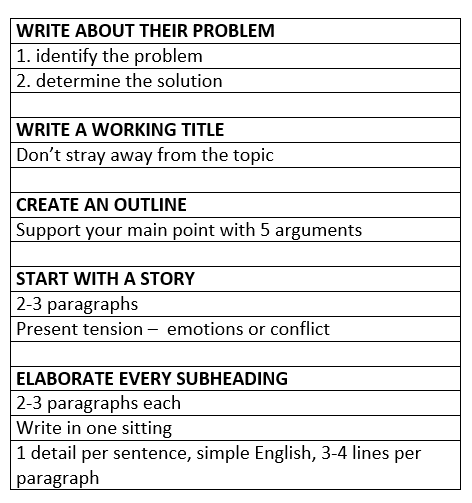
And one more thing… Here is a cheat sheet on how to write a post. You may want to go back to it as you write new posts:
Cheat Sheet for Writing a Post
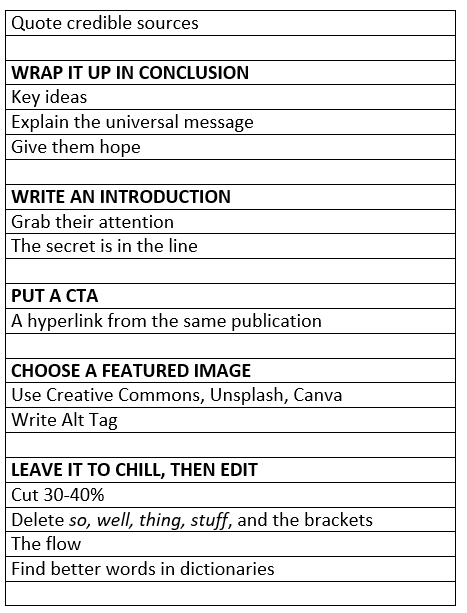
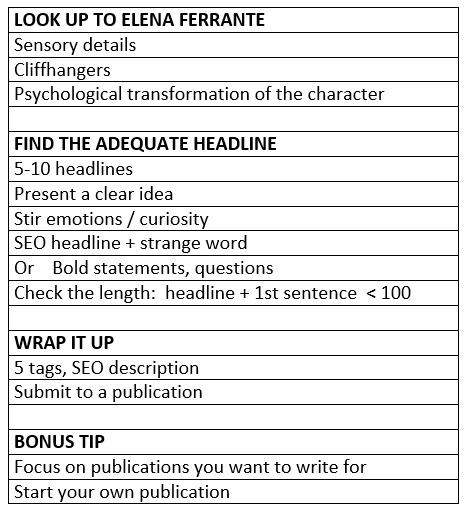
That’s all for today. Tomorrow I’ll give you a bonus tip.
Day 6 — Bonus tip
After these 5 days, I hope I’ve helped you make writing easier. It takes practice, reading, and trial and error to write quality articles more quickly and with confidence.
Today I’ll give you a few thoughts on Medium publications:
- Pitch the pubs you usually read that still accept new writers. Study the form of their posts and trending topics. Add something new to the conversation to have a better chance of curation.
- To pitch a publication you haven’t read much, spend at least a few days reading its most popular posts. Again, study the form and topics.
- Write consistently in 2–3 pubs for a while to have people remember you and gain them as followers. Then pitch a new one.
- Pitch smaller pubs for more loyal fans and bigger pubs to reach more followers.
- As you gain confidence, start experimenting with the form. Some posts will flop but some may take off. You never know which article will become popular.
- Give yourself time to gain a wider readership. It usually takes a few years if you don’t want to cheat the system and follow people until they follow you back, and then unfollow them. And remember: A big number of formal followers may not bring you a wider readership.
- In the end, start your own pub. Here are the reasons Why You Should Have Your Own Publication Even If You Can Submit to Top Pubs.
I hope I cleared out some of the beginners’ questions and doubts. Remember that you can write well and get paid only if you keep on writing.
Feel free to save this article or share it with others. Good luck with writing 😊