
Insomnia? Know How To Get A Deep Sleep And Wake Up Refreshed Every Morning
Your body needs rest, not just sleep.

A well-rested body can take on any challenges of life with full force. However, we find it difficult to give enough rest to our bodies and mind. We have access to every luxury imaginable. Yet, we relax and wake up refreshed every morning. No thanks to the hectic life we lead. Like me, have you ever asked yourselves if the very luxuries we are after are the problem?
Most of us are lucky enough to sleep on a bed for 8 or more hours. Then why aren't we able to reset. Why are we discontent even after enough sleep? We equate sleep with rest. But is that so? Does sleeping for 8 hours equal full rest? Not unless you can ensure a deep slumber.
“Sleep is not a requirement in one’s life. What the body requires is rest. Sleep is just one form of rest.” — Sadhguru
What does proper sleep imply? Let's look at how the body enters sleep.
The chemistry behind sleep
First, we should know the role played by two chemicals — Melatonin and Cortisol.
Melatonin — Is the hormone that makes you sleepy or drowsy.
Cortisol- Is the hormone that is in control of alertness (stress).
For us to enter sleep, the amount of these chemicals should invert. More melatonin equals sleepy. More cortisol equals waking up or low-quality sleep.
Darkness triggers Melatonin. Melatonin levels start to increase 2–3 hours before your usual bedtime.
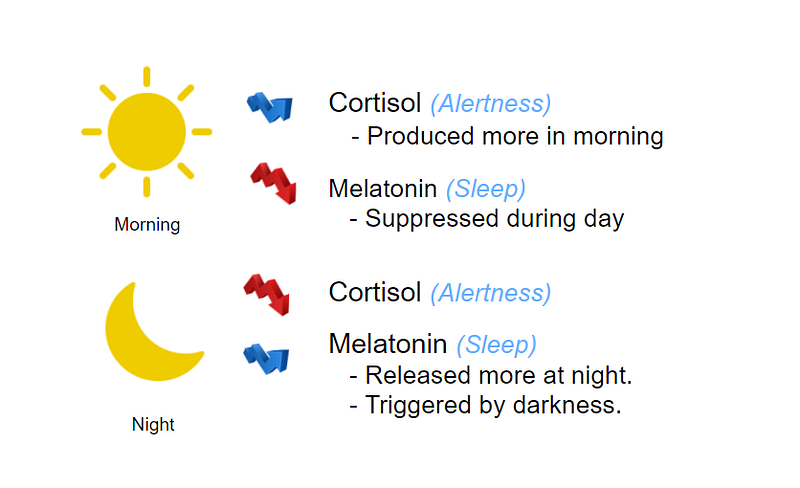
Our body produces more melatonin at night, thus initiating sleep.
That was simple.
The biology behind sleep
Secondly, we should know about biological clocks.
Heard of the biological clock? There is more than one. Our bodily functions are organized around the biological clocks.
The circadian rhythm is one of the biological cycles our body follows. Its job is to time bodily functions based and external (environmental) cues. The most prominent environmental cue is daylight (and the absence of light). The clock cycle lasts circa. 24 hours i.e. a day.
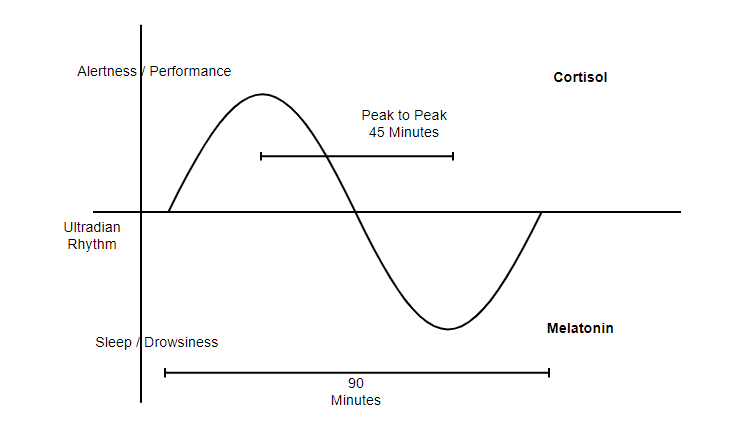
The ultradian rhythm is a shorter and higher frequency cycle that is about 90 minutes for adults. The REM and Non-REM sleep follow this rhythm. Our level of alertness and drowsiness also follows this rhythm (hint — Chemicals).
Ok. That wasn’t too complex either!
Did you know? The study of the biological clock is called Chronobiology.
How it all comes together
Lastly, we need to know how this chemistry and biology come together.
For good sleep what do we need?
- Higher level of Melatonin
- A lower level of Cortisol
What affects these chemicals?
- Darkness controls the release of Melatonin
- Stress increases Cortisol
- Ultradian rhythm affects alertness and wakefulness
- Circadian rhythm affects the release of chemicals
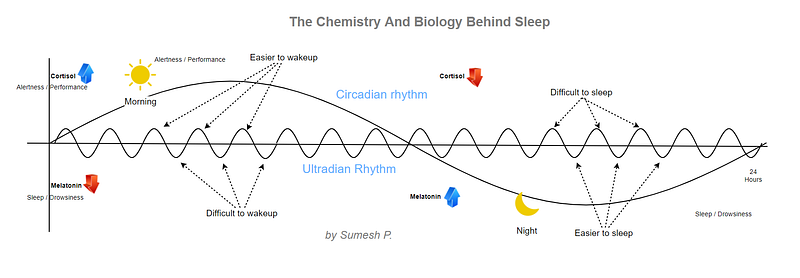
Onto the golden question. What can you do to improve your sleep?
Identify and be coordinated with the biological clocks
From the graphical depiction, we see it is easiest to fall asleep in the latter part of the Ultradian cycle. This is when alertness goes down, and melatonin causes drowsiness. When you miss that ideal timing, it might take another 90 minutes or so to catch the next cycle. Shifting the bedtime leads you to miss this ideal opportunity and delays sleep. So, try to identify your peak of alertness and drowsiness during the night. Then align your bedtime to synchronize with the lows of the ultradian cycle.
- Keep Lights Off, or dim lights before bedtime This increases Melatonin release and acts as an environmental cue.
- Reduce blue light from phones, TV, etc. Avoids melatonin inhibition due to blue light.
- Establish a bedtime routine, reading books, shower, etc. Acts as an external cue.
- Reduce stress, avoid stressful activity. Reduces cortisol. Go for a walk, listen to music, breathing exercises.
- Get sunlight early in the day. Reinforces environmental cues for circadian rhythm.
- Maintain cooler (comfortable) temperature. Helps improve the release of melatonin.
- Use pleasant aromas, scents. Help reduce stress.
- Avoid Caffeine. It increases cortisol levels.
- Avoid eating just before bedtime. Avoid sugar spikes. Glucose interferes with melatonin.
- Avoid EMF (Electro-Magnetic Fields). Turn off electronic devices in the room or keep them away.
- Avoid alcohol, smoking.
- Get adequate Vitamin D. Improves the functioning of melatonin-producing glands. Sunlight!
- Limit Fluoride. It is believed to interfere with melatonin release. Reduce fluoride in water.
The conclusion
If we want to wake up refreshed, we should help our body get proper rest. It can mean giving up on some of the habits of the modern-day. Leading a life where we feel constantly tired is no way to live. We must pause and listen to and do what our body wants!


