How to use the Yijing (I-Ching) for better Decision-Making?
A Personal Tool-Box to engage Fear, Anxiety and Uncertainty

The only permanent constant is the constancy of change. Change can be managed. Disaster can be mitigated. Crisis can be transformed into opportunity. Nothing is deterministic or inevitable. With the right action, a failure can become a blessing; and the lack of proper action can also convert a blessing into a disaster. This is the central promise of the ancient Chinese manual for human decision-making called Yijing (I-Ching) or The Book of Changes, your Personal Tool-box.
The ancient Chinese first envisioned the philosophy and cosmology of Yijing (I-Ching) in the years before 10,000 BC, and which was only written by King Wen and the Duke of Zhou in the 11th Century BC. It was used initially for the practice of divination. Two of its earlier manuscripts have been lost, to be survived only by the writings of King Wen until the Han Dynasty (206 BC–220 AD) when in 125 BC, the Han Emperor ordered efforts to begin collecting and compiling all Yijing (I-Ching) manuscripts with additional commentaries.
The fall of the Han Dynasty brought 900 years of chaos, wars, corruption, death and turmoil, akin to the Dark Ages of Europe after the fall of the Roman Empire in the first century AD, but only worse, as fear, uncertainty and anxiety gripped ancient China to make them the recurring themes within the Yijing (I-Ching). Much of the “modern” Yijing (I-Ching) literature were written and adapted by eminent scholars and Yijing Masters over the past 2000 years.
This is why the Yijing (I-Ching) has attracted a sizable following outside China from India, Africa, Europe to the West and Americas as a practical decision-making tool to engage today’s VUCA environment characterised by volatility, uncertainty, complexity, and ambiguity.
A Basic Understanding of the Yijing (I-Ching)
The Yijing (I-Ching) is a personal decision-making and relational tool. It has been applied to Politics, Economics, Military, Science, Medicine and Life generally. At the core of the Yijing (I-Ching) philosophy is the notion of permanent change, an endless fluxing of transformational movement from relative “stability” to radical, sometimes chaotic, disequilibrium before returning to another level of stable order. The yin (陰)-yang (陽) forces of change generate the energy (氣) to drive the perpetual endless transformation cycle of change.
The Bakua
According to the Yijing (I-Ching), natural forces can be visualised and represented by things and concepts such as mountains, water, lakes, sun, fire, thunder and wind, which can also refer to ideas that can be grasped, positions that can be determined, situations that can be identified, human relationships that can formed and processes that can be discerned. It develops 8 Trigrams to captures these things and ideas.
The 8 Trigrams are arranged in an octagonal shape comprising 8 (ba) areas (guas) or Bakua (八卦) of the Yijing (I-Ching). Each gua (卦) has “yao” (line) symbols consisting of 3 lines each to describe the heaven-man-earth relationship within the respective Trigram. Each line in the “yao” symbol (line symbol) is either yin (陰), 2 short lines representing the receptive (female) force of nature, or yang (陽), 1 long line representing the creative (male) force of nature.
The Bakua (八卦) was discussed previously in an earlier article and shown again below:
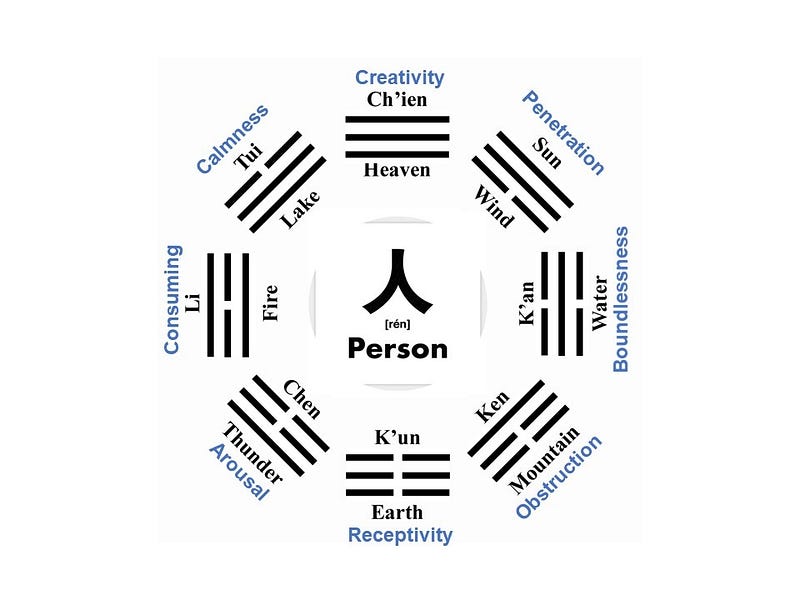
The 8 forces of change, namely; creativity, receptivity, boundlessness, consuming, obstruction, penetration, calmness, and arousal (associated with and symbolized by the 8 Trigrams) systematically regulate the natural laws of change embraced by the Yijing (I-Ching).
The confluence and conflation of these 8 forces drive the change movements of the universe, and in each and every situation or context of the human condition. Their interaction accounts daily for favourable and unfavourable outcomes in human personal and community (political, social, economic) life.
The 64 Hexagrams
The natural forces of yin (陰)-yang (陽) are found in the 8 Trigrams to symbolize the opposing yet complementary forces pushing and pulling among one another to form a multi-dimensional and multi-directional change resulting in situational possibilities or action frames represented by the 64 hexagrams of the Yijing (I-Ching). I have placed Man (人) at the centre to recognise his agency and active role in responding and managing the permanent change cycle. The 8 Trigrams activate (agitate, excite, reinforce) each other as strong and weak Yin-Yang forces engage in continuous transformation, renewal and revival.
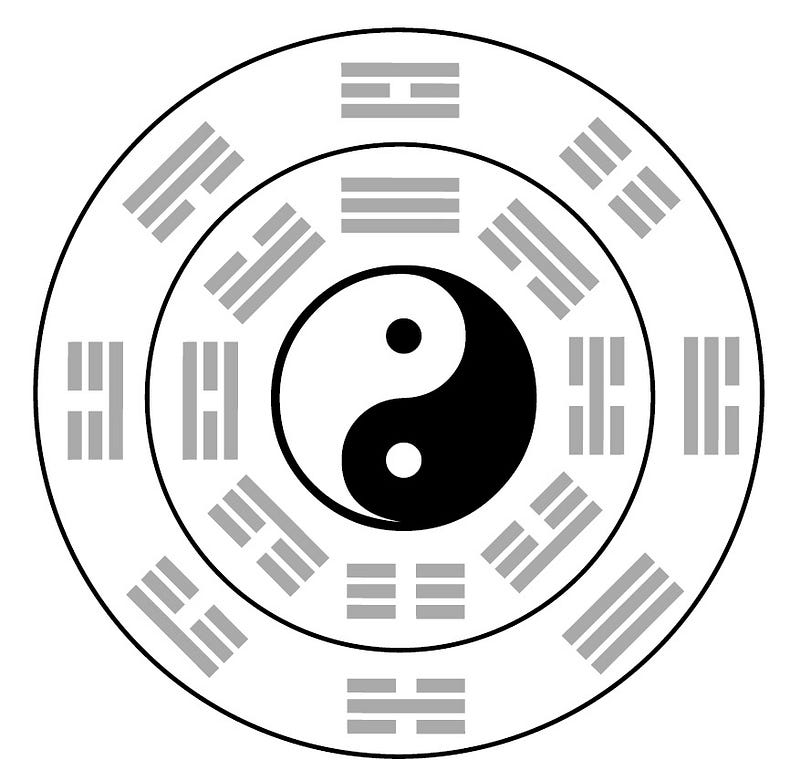
Each Hexagram is formed by 2 Trigrams placed on top of each another. There are therefore 64 Hexagrams composed by 8 x 8 Trigrams (= 64 Hexagrams). They can be visualized using a 2-Ring Wheel which depicts the 8 Trigrams in both Inner and Outer Rings. When either the inner or outer wheel is rotated, it reflects various pattern of movements of the lines which also create different pairs of 6-Lined Hexagram. The complete 64 Hexagrams are shown here -
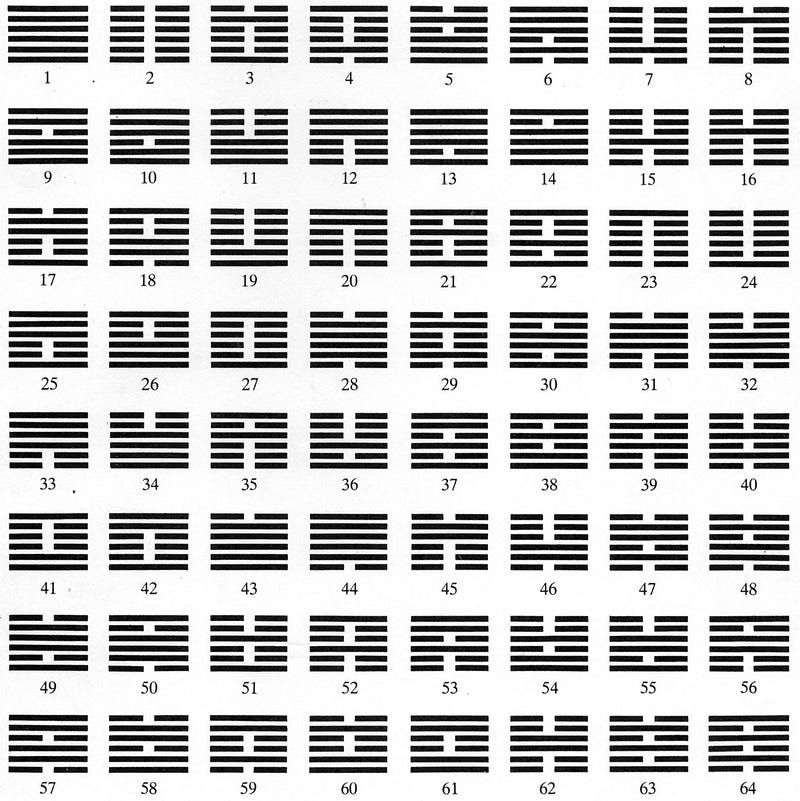
It is not necessary to read all the Hexagrams in its sequence (1–64). There is no logical reason in the progression from one Hexagram to the next in numerical sequence. The meaningfulness of each Hexagram is derived from the situational context of the person who is consulting it.
The relevant Hexagrams are the ones which reflects your specific situation and directly appear to address the questions in your mind.
The systematic unpacking of the universe and its impact on human relations and environment is reflected in the 64 Hexagrams. There are no other human conditions or situations outside the 64 Hexagrams. Carl Jung, the eminent Swiss psychiatrist, regards them as “Archetypes” in the collective consciousness of universal patterns and images. Their elegance lies in their simplicity in being able to explain all human situations in a comprehensive manner. The mysterious connectedness of the 64 Hexagrams reveals the awesomeness of the universe and cosmic forces.
According to the Hexagrams in the Yijing (I-Ching), the universe or cosmos is orderly because it has only a few simple rules, such as the ebb and flow of the yin and yang forces. Like the Hexagrams, it is stable and follows a fixed pattern such as the four seasons, solstices and weather formation. It is also as predictable as the Hexagrams because transformational change occurs based on the predetermined rules and patterns.
The 64 Hexagrams therefore provide the typology of change management actions. Its strong emphasis on orderliness, stability and predictability makes the Yijing (I-Ching) a valuable and effective personal decision-making Tool-box to engage fear, anxiety and uncertainty in today’s VUCA world.
Creating Your Own Hexagrams
The First Step in creating your own Hexagrams is to know what is it that you want to know. Framing the right questions — as specific and open-ended as possible — is part of the “correct” answers you obtain. Unless you are clear and definite about what’s on your mind, among many other competing thoughts and worries, the Yijing (I-Ching) will respond with matching clear and definite answers. Avoid close-ended “Yes or No” or ”Either/Or” types of questions. You should place the specific questions in a relevant time-frame to enable a clearer interpretation of the indicative Hexagram.
Some appropriate questions are:
- What does the situation really mean?
- What’s the best thing to do in this situation?
- How can the desired actions be accomplished?
- What are the results of the desired actions taken?
- What circumstances would be best for a particular action(s)?
- When should some particular action(s) be performed?
- What would happen to this person, object, people, project, etc., during a particular time-frame eg time, day, week, month, or year?
The Second Step is to obtain the 6 “yao” lines of your Hexagram using 3 identical coins, as shown by the following diagram:
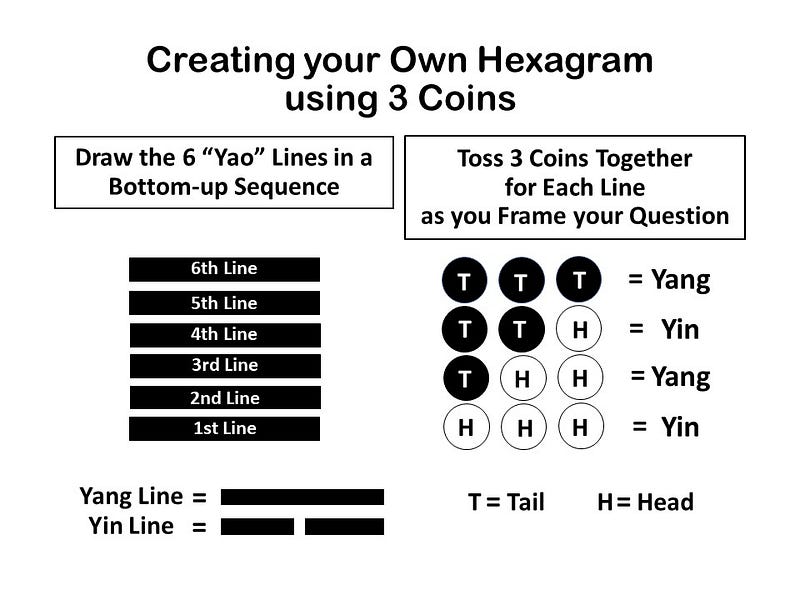
A Hexagram is constructed from the base to the top, with each throw of the 3 coins determining one line sequentially. To obtain a Hexagram, the 3 coins are tossed six times, the 1st throw determines the base line and the sixth throw the top line. The coins are best held and shaken in the hollows of both hands so as to focus the mind on the specific question.
Identify the 6 lines of the obtained Hexagram and read its description Online here.
The 6 Lines of the Hexagram can be described as follows:
- 1st or base line stands for the “emotional assessment” at beginning and before a situation worsens as a matter of grave concern;
- 2nd line stands for the appearance or the cognitive “conscious evaluation” for the situation;
- 3rd line stands for the conditionality or circumstances of the situation, how the situation has consolidated and developed;
- 4th line stands for an attempt to take action or the uncertainty of intended consequences;
- 5th line stands for the anticipated fully developed situation coming into its anticipated final “unfavourable” or “favourable” position;
- 6th or top line marks the end of the process. At this point, the situation comes to the extreme as it has developed fully and will start to transform or change into another situation.
Creating a Hexagram is not a game of random chance, even as we toss 3 coins to tell us what line to draw. The Yijing (I-Ching) does not believe in the existence of random chance. It is the unseen forces of “yin” and “yang” around us which determine the outcomes of the coin toss.
A Hexagram is best regarded as a field of action where different forces or players are interacting in the given situational context. The 6 lines of the Hexagram point to the choice options that address the specific situational context. Given the dynamism of human thinking and actions, they represent the arena of possible actions to alter or change the human relationship configuration as well as the geographical, spatial and timing of the specific situational context.
The initial Hexagram will show what has already happened, is happening or set to happen, and such configurations can be altered and changed by changing certain lines in the initial Hexagram to transform into or create a more favourable one. In this manner, the Yijing (I-Ching) leverages on human creativity and ingenuity seen in the formless dynamism of human affairs. To the Yijing (I-Ching), nothing is deterministic or inevitable. Everything can be changed because everything is already changing within the endless change nature of the universe.
Since the 64 Hexagrams form an exhaustive set to represent ‘all there is’ (“Archetypes”), the derived Hexagram therefore represents a WHOLE situation or context and become the ‘key’ to unlock associated interpretations so as to unpack the choice options available. It could also point to other related Hexagrams. Reading together all related Hexagrams with reference to the same context shall render the full meaning of that situation framed by the questions.
The 64 Hexagrams represent the 64 stages found in the process of continuous change, and in 6 phases of change (6 “yao” lines) within each Hexagram. Guided by the Yijing (I-Ching), one event (tossing coins) at a particular time (the present) can reveal meaning in relation to other events which will happen at another time (in the future). Within the Hexagram structure of six lines, the yin and yang lines are related to each other in very specific ways, and represent its six phases of change.
An example of phased changes is seen in the 8 Hexagrams of the House of Heaven, one of the 8 Houses associated respectively with each of the 8 Trigrams of the Bakua, as follows:
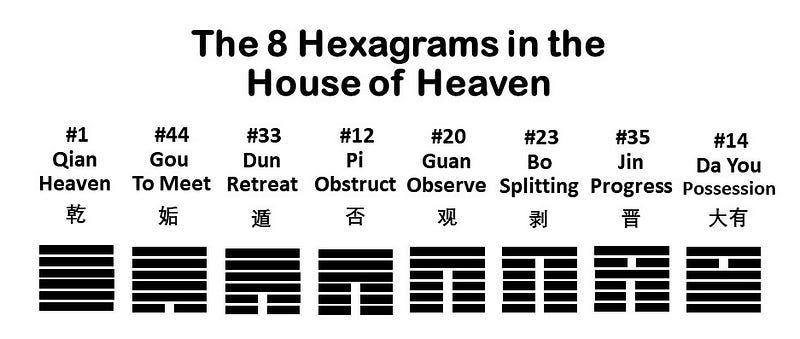
You can read the changing situations as each line changes for a better understanding of continuous change. Without any specific contexts for interpretations, their respective descriptions have therefore no applicable meanings.
A word of caution here. The perception that everything is changing continuously seems to point to the illusion of time. Change is perceived as indicative of time. However, time is a permanent continuum of past, present and future. Time does not change. Events happen synchronously and not by causation. In the absolute reality, there is only the present which contains both the past and the future, when seen in the duality nature of time.
A Hexagram Application — The Origins of the 8 Trigrams and 64 Hexagrams
The Yijing (I-Ching) was asked: did the structure of the eight trigrams and 64 hexagrams develop gradually or was it instantly available at some point?
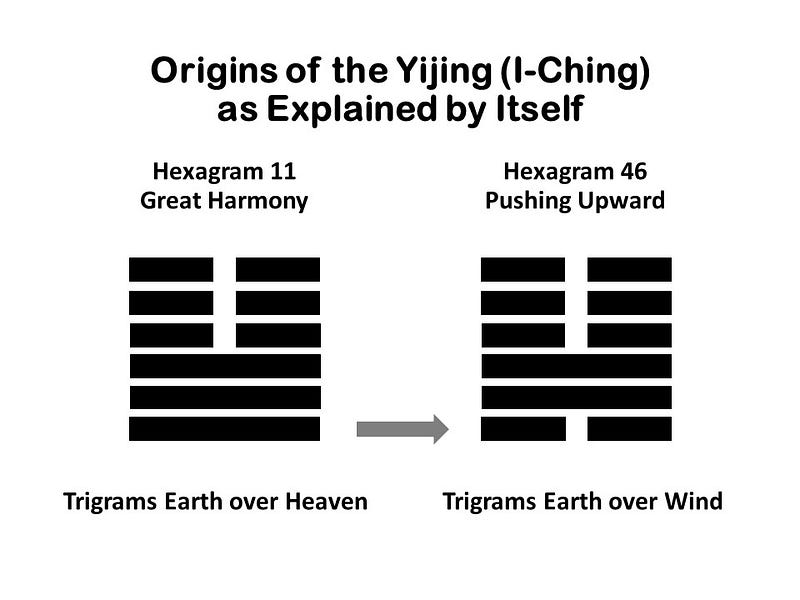
The answer was Hexagram 11 line 1 changing into Hexagram 46.
Hexagram 11 (The Great Peace) is composed of the Trigram Earth over Trigram Heaven, indicating that the Yijing (I-Ching) resulted from the great harmony of heaven and earth, and which inspired, as it was observed and received by, the people on earth like the ancient Chinese. Hexagram 11, line 1, reads that “some grass was pulled out with shoot and root”, indicating that something is suddenly “uprooted”, possibly meaning that the structure of the Yijing (I-Ching) was “suddenly available”.
The bottom Wind Trigram (“penetration”) of the changed Hexagram 46 tells us that someone (maybe Fu Xi or King Wen or someone else) had a deep insight (“penetration”), an epiphany moment perhaps, into the true nature of the cosmic “reality” of the universe (Heaven + Earth) and, in that enlightenment, deduced the entire holistic structure of the Yijing (I-Ching) immediately, instead of adding piece-by-piece together or developed gradually.
Interesting answers indeed. You can always try asking the same question of the Yijing (I-Ching), and see what answers come forth.
CONCLUDING REMARKS
The Yijing (I-Ching) is neither predictive nor prescriptive. At best, all its oracles via the Hexagrams are provisional. They remind us of the contingency of human existence which creates fear and anxiety from uncertainty. It is the human condition in the daily struggles to achieve the “great harmony” between the purity of “heavenly principle” (Tian-yi) and the perversion or vicissitudes of “human desires” (Ren-wei).
When guided by the Yijing (I-Ching), ordinary people are able to grasp and make sense of the events happening around them. And as they become more sensitive and receptive to “signs and omens”, they can make better choices regarding advancing or retreating in certain unfavourable or favourable situations. With inherent free will, the Yijing (I-Ching) points to the various possible situational outcomes to empower better choices. Humans are masters of their own fate as long as they are prepared to influence and grow in wisdom to improve it, by doing the right thing at the right time and in the right place. Use the Yijing (I-Ching) Tool-box to make better decisions wisely.