
How to use AI and ML in FP&A?
With the rapid increase in the amount of data available, and the lowering barriers of entry there is huge potential for Artificial Intelligence (AI) and Machine Learning (ML) to transform the Financial Planning and Analysis (FP&A) industry.
Let’s start with, what is FP&A?
FP&A stands for Financial Planning and Analysis. It is a function within a company’s finance department that is responsible for partnering up with the business to do forecasting, budgeting, and analyzing the company’s financial performance.

This includes creating financial models, analyzing financial data, and providing insights and recommendations to management on how to improve the company’s financial performance. The goal of FP&A is to help management make informed decisions about the company’s financial future.
How to use AI and ML in FP&A?
There are several ways that artificial intelligence and machine learning can be used to improve FP&A operations:
- Forecasting: Machine learning algorithms coded in Python can be used to create more accurate financial forecasts by analyzing historical financial data and identifying patterns that can be used to predict future performance. One particular use case that we will explore in depth below in the article is rolling forecasts.
- Budgeting: Machine learning can be used to identify key drivers of financial performance and generate more accurate budget projections.
- Anomaly detection: Machine learning models can be used to identify unusual or abnormal financial transactions or patterns, which can help identify potential fraud or errors.
- Automation: Machine learning can be used to automate repetitive tasks, such as data entry and data cleaning, allowing FP&A teams to focus on more strategic tasks.
- Predictive modeling: Machine learning can be used to build predictive models that can help identify future trends and opportunities, and help management make more informed decisions.
It is important to note that while machine learning can be powerful in FP&A, it should be used in conjunction with human expertise and domain knowledge. It is also important to have a good data quality, data governance and data management practices in place before implementing machine learning models.
As previously noted, the use of analytics in decision making within the finance function has been on the rise.
Gartner reports that finance analytics and reporting make up a significant portion of finance function spending.
To assist with this trend, I created the “Finance Analytics Neural Map” back in 2021. This map aims to provide finance professionals with an understanding of the various areas of finance analytics and data science that they should be familiar with in order to fully utilize these tools in 2021.
We have mapped 7 key areas: Programming Languages, Places to Learn, Must Learn, In the cloud, BI Platforms, Data Visualization and New Technologies.
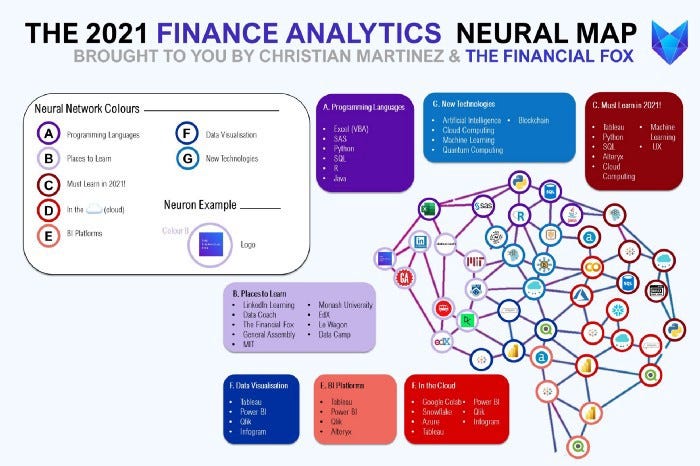
To kickstart and start using ML and AI for FP&A, I will recommend you to learn one or more of these technologies: Microsoft Azure, Tableau and Alteryx.
How to improve your rolling forecasts with AI and ML?
A rolling forecast is a type of financial forecast that updates continuously over a specified period of time. In a FP&A context, a rolling forecast typically covers a 12- or 18-month period, with the most recent month being the “current” month, and each subsequent month being added as it becomes the current month. This allows the organization to continually update their forecast as new information becomes available, rather than relying on a single annual forecast.
Machine learning algorithms, such as ARIMA, LSTM, and Prophet, can be used to analyze historical financial data and identify patterns that can be used to predict future financial performance. This can help create more accurate rolling forecasts.
AI and ML can also be used to build predictive models that can help identify future trends and opportunities, and help management make more informed decisions. For example, you can use supervised learning models like Random Forest or XGBoost, which can be trained on historical data to predict future financial performance.
Lastly, machine learning can also be used to automate the process of updating the rolling forecast, by integrating it with financial data and automatically updating the forecast as new data becomes available.
Rolling forecasts are useful for organizations that operate in rapidly changing environments, as they allow for more frequent updates to the forecast and greater flexibility in responding to changes in the business environment. They also provide management with more up-to-date information, which can be used to make more informed decisions about the future direction of the organization.
It’s important to note that a rolling forecast does not replace the annual budget, but it is a complement to it. The annual budget is still needed for long-term planning and strategic decision-making, while the rolling forecast is used for short-term planning and operational decisions.
I will be also creating some Python tutorials on how ML can be used in FP&A soon!
In the meantime, if you want to learn what is Machine Learning, you can read this article.
If you enjoy reading stories like this, why not consider becoming a Medium member for just $5 a month? Your membership will give you unlimited access to all stories on Medium. If you are enjoying my content and sign up using the link below, I’ll earn a small commission at no extra cost to you.