
How to Think Like a Champion: Michael Jordan’s 8 ‘Growth Mindset’ Traits
Greatness is the inevitable outcome that blooms from a growth mindset.
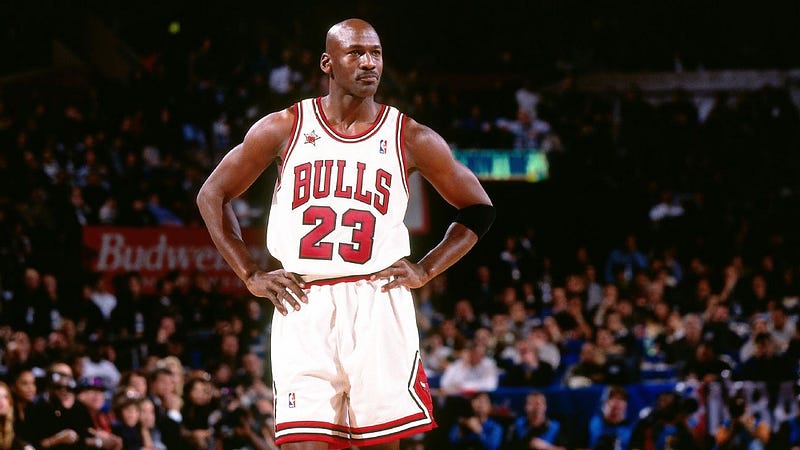
“People in a growth mindset don’t just seek challenge, they thrive on it. The bigger the challenge, the more they stretch. And nowhere can it be seen more clearly than in the world of sports.”
I read those words in psychologist Carol Dweck’s book, Mindset, a few days before I watched The Last Dance (a Netflix series that chronicles the story of Michael Jordan and the Chicago Bull’s quest to success), and as the emotional series came to an end, I realized this:
Michael Jordan was a human with average talent who transformed himself into the greatest basketball player who ever lived. He wasn’t born with the raw talent of a champion, he molded his character into one.
How did he do it?
One word: Mindset.
According to Dweck, there are two mindsets: fixed and growth.
People with a fixed mindset believe that their abilities are fixed. They seek easy tasks that bolster their ego and if things don’t go their way, their confidence cracks, and they refuse to adjust course.
People with a growth mindset believe that their abilities can be developed. They are open to learning, tackling problems, charting new courses, and stretching themselves in the process.
And as evident in The Last Dance, Michael Jordan was a living example of how greatness is not born, rather, greatness is self-nourished. Greatness is the inevitable outcome that blooms from a growth mindset.
“We like to think of our champions and idols as superheroes who were born different from us. We don’t like to think of them as relatively ordinary people who made themselves extraordinary.” — Carol Dweck
Here are eight powerful ‘growth mindset’ traits that you can apply to your own life as you journey onto your own path of greatness. They will help you build the character of a champion, so you can think like one.
1. See Setbacks as The Natural Path to Success
Michael Jordan didn’t walk his way to the top; setbacks were the natural path to his success since the early days.
Perhaps the biggest failure that went on to define who he would become arrived when Michael was still a teenager in high school. He was cut from the varsity basketball team because he wasn’t ‘good enough.’
The news devastated him.
His mom encouraged him to wipe his tears aways, go back to the court, and discipline himself. So he got up, picked up a basketball, and went to the court to practice. He got up at 6.00 am every single day to practice before school. He was determined to rise back up and succeed.
“I’ve missed more than 9000 shots in my career. I’ve lost almost 300 games. 26 times, I’ve been trusted to take the game-winning shot and missed. I’ve failed over and over and over again in my life. And that is why I succeed.” — Michael Jordan
Your path to greatness is not straight. It’s as volatile as waves roaring amidst a story sea. There will be days when you will fall down crashing into the floor. There will be days when you feel defeated, looking up ahead at a mountain that seems too steep to climb. There will be roadblocks. There will be walls. And there will be setbacks and failures.
You will fail over and over again, but that doesn’t mean you’re further away in life. It means you’re that much closer to where you want to be. Your only job is to figure out how to keep going.
As Michael explains:
“If you’re trying to achieve, there will be roadblocks. I’ve had them; everybody has had them. But obstacles don’t have to stop you. If you run into a wall, don’t turn around and give up. Figure out how to climb it, go through it, or work around it.”
2. Want it Badly Enough
At the University of North Carolina, head coach Dean Smith shares a story that demonstrates the depth of Michael Jordan’s desire to succeed:
“Jordan tells me one day that he wants to be the best player to ever play here. I said ‘you gotta work harder than you did in high school.’ He said ‘I worked as hard as everybody else.’ I said ‘oh excuse me, I thought you told me you wanted to be the best player to ever play here.’ He said: I’m going to show you, nobody will ever work as hard as I work.’ He wanted to learn, he wanted to grow quickly.”
Whatever it is you want, you have to want it badly enough. You have to want to learn, grow, and rise up to the challenge — no matter how difficult it becomes.
In the words of Dweck:
“The passion for stretching yourself and sticking to it, even (or especially) when it’s not going well, is the hallmark of the growth mindset.”
3. Practice and Constantly Upgrade Yourself
In 1993, after winning his third NBA championship, Michael Jordan decided to retire from his basketball career and transition into baseball. In the first few months as a baseball player, he really struggled with batting.
So what did he do?
He practiced.
He practiced batting early in the day. He practiced after regular batting practice. He practiced before the games and after the games. As batting coach Mike Barnett said, “his work ethic was the best I’ve ever been around.”
Michael Jordan’s philosophy was simple — you earn success through determined, consistent practice. So if you want to get better at something, go practice it. If you want to become better, commit to upgrading yourself — and you can only do that through consistent effort and practice.
There is no escaping hard work — if you ever find yourself searching for ‘hacks’ and ‘quick wins,’ then you’re playing in the zone of a fixed mindset.
“If you do the work you get rewarded. There are no shortcuts in life.” — Michael Jordan
After winning his first championship in his professional career, and as he engulfed the golden trophy in his arms, holding onto it like a mother embraces her child, Michael collapsed. With tears streaming down his face, he uttered these three words: “Seven-year struggle.”
Real, honest, earned success takes time, effort, and hard work. Never let anyone fool you into thinking otherwise.
4. Always Be Present
Mark Vancil, the author of Rare Air, said that Michael’s gift “was not that he could jump high, run fast and shoot well. His gift was that he was completely present — he was never anywhere else.”
There’s a scene in The Last Dance where Michael was in his hotel room jamming on the piano and celebrating another NBA championship win. At that instant, one of the reporters asked him: “Is there another year in ya?”
Michael replied: “It’s the moment, man. Get in the moment and stay here. Just stay in the moment till next October, then we’ll know where the hell we are.”
Your greatest power lies in your ability to ‘just be’. Be in the here and the now. Be fully present, exactly where you are, doing what you can, with what you have. That is freedom. That is salvation. Your ability to free your mind from the fears of the past or the worries of the future and to be fully focused on what is within your control: the present moment.
Celebrate your life one day at a time and enjoy what you have.
In a world that lives in chronic worry of ‘what was’ and ‘what could be’, allow yourself to flourish in your gift of living in the ‘what is’.
5. Don’t Think About Missing a Shot You Haven’t Taken.
Building on the previous point, Mark Vancil goes on to explain that “the big downfall of a lot of players who are otherwise gifted is thinking about failure. Michael didn’t allow what he couldn’t control to get inside his head.”
Being present is rooted in your ability to focus solely on what you can control.
The reason comes back to this: What you give your attention to expands. If you focus on things you can’t control (worrying about the outcome), you’ll be draining your mental energy on thoughts that don’t elevate you.
As Michael would say:
“Why would I think about missing a shot I haven’t taken yet?”
Why would you think about failing at a project you haven’t even started yet? Why would you think about flopping at a vocation you haven’t even tested yet? If you think more about failure than success, then you’re more likely to fail than to succeed.
Don’t think about missing a shot you haven’t taken.
Imagine the possibilities instead.
How do you train yourself to do this? Believe in yourself. Believe that you can. Expect yourself to make it. As Michael says:
“You have to expect things of yourself before you can do them.”
Most people live their lives in fear because they project the past into the future. They think about missing shots they yet haven’t taken, instead of imagining how the ball will sink in once they have taken that shot.
6. Give Your Best, all the Time.
In the sixth game of the 1995 Eastern Conference Semifinals, Michael Jordan and the Chicago Bulls were eliminated from the NBA playoff by the Orlando Magic, and Jordan took it to heart.
Usually, after a season ends, the players take some time off to vacation and relax. But coasting off after a failure wasn’t the written definition in Jordan’s ‘how to respond to a setback’ internal compass.
When his personal trainer, Tim Grover, walked up to him after the game and said: “Michael, you know, I’m about to get out of here, let me know when you want to me to see you.” Michael responded: “I’ll see you tomorrow.”
He was ready to step back on the court and improve his game.
You see, Michael Jordan believed that he had an obligation to his teammates, the organization, and anyone who was going to sit down and take three hours off their day to watch him play. He had an obligation to himself. And it was this: “To give my best, all the time.”
When you sit down to write an article, you have an obligation to yourself and your reader to put forward your best. So give it your time, energy, and attention. When you prepare dinner for your circle of friends, you have an obligation to them to give your best. So cook slowly, with love. When you practice your chosen art, you have an obligation to yourself to give your best. So why rush through it?
“I play to win, whether during practice or a real game.” — Micahel
Don’t play for the sake of playing — play to enjoy and win. You have an obligation to yourself and to everyone else your work touches: Give your best, all the time. Why? Because, as Michael hints, that’s the secret to living a life free of regret: “If it turns out that my best wasn’t good enough, at least I won’t look back and say I was afraid to try.”
7. Go Inward and Turn on a Switch
On the eve of 1997 NBA finals game five between the Bulls and the Utah Jazz, Michael Jordan fell ill to food poisoning.
Leading up to the game, he had spent the entire day in bed. He couldn’t eat anything or keep anything down. But of course, he wasn’t willing to give up on his team, so he mustered all the strength in him to play.
In the first half of the game, Jordan missed his shots. He was visibly shaken by the flu symptoms. As one of his teammates described it: “It was like the life just went out of his body. He was gassed.” But, in the words of Scottie Pippen, “a lot of times when you’re sick, you’re able to find something deep down inside you that you didn’t know was there. And I think it was just one of those games where he wanted to win so badly, that he stayed with it.”
In that game, Michael Jordan carried his team to victory. He played 44 minutes in total and scored 38 points.
Can you fathom how mindblowing that is? To achieve those numbers, at your peak condition, in a given game is already an accomplishment on its own, but to be able to do it with a body that was aching from the fatigue of illness and distress — that is the power of mindset.
“Limits, like fears, are often just an illusion.” — Michael Jordan
One of his teammates described it best when he said: “Michael went somewhere and he found a switch.”
That somewhere lay deep within him.
That somewhere is the seed of character.
And, in the words of Carol Dweck, “character is the ability to dig down and find the strength even when things are going against you.”
So when a gust of wind blows you off your horse, find the courage to get back on that saddle, and ride onward. It helps you build character. When an earthquake of emotions shatters the very foundation upon which you’re building, turn inward to ignite the fire and keep going. It helps you build character.
That’s what ‘Amor Fati’ is all about: the conscious practice of acceptance as your life events unfold, wrapped with the relentless inner willpower to rise back up.
8. Ignore What People Think and Do it for Yourself
When Michael Jordan announced that he’s retiring from basketball to pursue baseball, the world was baffled. They were bewildered at how the king of basketball would bow down at a time when he was still at the peak of his prime.
Michael, however, couldn’t care less what people thought:
“I can care less what people do. This is what I want to do. I’m not doing what they think I should be doing.”
Stop living your life for others — live it for yourself.
Do what you want. Do what you love. Do what you think is right for you. Don’t do it for fame or money or for someone else’s approval. Do it because you cannot live without it. Do it for you. Don’t do what others think you should be doing. Do what you know you absolutely must be doing.
That’s the recipe for a life of peace, joy, and contentment. And I truly believe that’s the unspoken secret to success.
What it Means to Have a Growth Mindset
In Mindset, Carol Dweck writes:
“The mark of a champion is the ability to win when things are not quite right — when you’re not playing well and your emotions are not the right ones.”
A mark of a champion is ‘character’, and character grows out of ‘mindset’.
Michael Jordan wasn’t born with talent, he cultivated it. He worked hard — harder than anyone else in the league. He learned how to stay present and keep his focus under pressure. He rose back up after setbacks. He bounced around from one failure to another. And he stretched beyond his ordinary abilities to transform himself into an extraordinary performer at his art.
In short, he developed grit — and you can do the same.
Perhaps it’s best, then, to end with these words from Michael Jordan:
“I can accept failure, everyone fails at something. But I can’t accept not trying.”
Sign-up to my free weekly newsletter for more articles like this.


