
Gun Violence and Children
How to Talk Reassuringly to Children About the Deadly Double Mass Shooting in Ohio and Texas
It’s hard to know what to say to children about two deadly mass shootings hundreds of miles apart that occur.

In the wake of the double shootings that occurred in Texas and Ohio, parents can feel like they are at a loss as to how to explain things to their children. These events were hard enough for adults to cope with. Before we’d even been fully able to process the first shooting in El Paso, less than 15 hours later we found ourselves mourning yet another senseless act of gun violence. hundreds of miles apart. Before all was said and done, 31 one people had died with dozens more injured.
There’s no single correct way to address violence with children. The way parents approach this discussion or if they do so at all, depends on the child’s age and individual factors such as their temperament. While there are some suggestions and guidelines based on cognitive development and intellectual ability, parents have to decide how much to tell them based on what they know about their child.
Being Realistic About Controlling Your Child’s Access to Information
Children need to be given some freedom to determine what they are ready to hear. At the same time you may not be able to block all information from them so preparing them for what they may come into contact with is important. This means you will need to be aware yourself of what information is available and most likely for them to be exposed to when they are away from you.
For example, you might be able to block information while they are at home by supervising their computer time and keeping televisions and radios turned off. But you may not be able to block them from seeing what is on the news stands or what adults are talking about that they may overhear.
What’s Appropriate for Very Young Children?
The American Psychiatric Association and the American Academy of Pediatrics recommend not discussing the topic with children before the age of 8, especially if it doesn’t directly affect your family. Before this age children may struggle to understand and process information about violence and death. But again it depends on the child’s emotional and cognitive maturity.
For example, young children tend to be egotistical and can have difficulty separating themselves from the world around them. They often link their own behavior, feedback from the important adults in their life, and world events together in terms of causes. In other words, if they act out and are told that they are being “bad,” they will feel they are to blame somehow for bad events that may occur around the same time. Even if they don’t believe they are necessarily responsible for things that occur in the world, they may believe that they will grow up to do similar bad things.
However, often even very young children will hear about major crisis events especially if everyone is talking about them. It’s better for them to hear about them from a parent or trusted adult instead of from another child or the media. Unless the child is with you all the time so that you can control what they hear, even young children need accurate information, that is not overly vague but conveys the message that it’s okay to be upset but that they are safe.
No matter what the age or developmental level of the child, a good place to start is asking the child what they’ve heard. Even if you do your best to filter information, most children will still have heard something, no matter how old they are. Once you determine what they’ve heard, you can correct misconceptions and ask what questions they have about what happened. I still feel that the best rule of thumb is to assume that children will ask for certain information when they are ready to handle it.
What’s Best for Older Children?
Older children and teens might ask more questions and may request and benefit more from additional information. But even with older children, it’s best to keep the dialogue straightforward and direct. With adolescents it can also be helpful to talk with them about adaptive coping responses. You may want to include a discussion about tobacco, alcohol and other substance use and why relying on substances to cope can create more problems than it solves.
Technology and Mobile Devices
Today, many children have access to news and the internet on their cell phones and at school. Using parental controls that you may not normally use to limit their access to specific types of information may help in this regard. Additionally, you may want to speak with your child’s teacher about what they have access to in the classroom.
While your child may become angry over these actions which they believe impinge on their rights, realistically, children have the rights you decide to give them. Part of your job as a parent is to make decisions that will safeguard the well-being of your child even when they don’t understand that is what you are doing.
Even with these safeguards in place, children may find a way around them to access information. Often children will try to learn about something just because it is forbidden. But while they may be able to do so does not mean they are ready to handle what they learn and you can’t put the genie back in the bottle. Once they have seen horrifically graphic images of violence, they cannot unsee them, and this can lead to problems that last for some time or that require professional help to alleviate.
Sometimes it may feel like we are lying to children in an effort to prevent them from being scared that they are in danger, and we may in fact, not be telling the entire truth. But remember that the aim is to help children feel confident that they are safe so they can continue to enjoy their childhood without constantly looking over their shoulder. Depending on the age of the child and their ability to process information, this may mean saying things that are not entirely true when the complete truth may make matters worse for them.
Suggestions for Talking With Your Child About Mass Shootings
- Make sure you have people you can process things with. Whether it’s clergy or a professional counselor, it’s important for you to have someone to talk to. If you aren’t able to handle your own emotions about the violence, you won’t be able to help your child do so.
- Reassure children that they are safe — Emphasize that the important adults in their life will make sure they are safe. This can be hard sometimes if children are the ones who have been hurt or killed because they may ask why the adults in those children’s lives didn’t keep them safe. One way to handle this is to say that because this happened adults know better what to do to keep children safe.
- Be sure to validate their feelings — Sometimes when situations are difficult we try to make children feel better by telling them not to be scared or upset. Yet, even though it’s well intentioned, this can come acrossive as dismissive. Explain to them that all feelings are okay when a tragedy occurs and let them talk about however it is that they feel.
- Make sure you seperate your child’s behavior from their overall character. If they are able to see that it is only certain actions that aren’t acceptable which they are able to change they will be less likely to view themselves as the type of person who carries out acts such as the ones recently committed.
- Avoid graphic details. While we all want to know enough about a situation so we know what’s going on, children especially can become overwhelmed by explicit details of tragic events. It’s generally best to share just the basic information with children but to avoid more graphic types of details or unnecessary information about tragic circumstances such as who a victim left behind. Graphic or disturbing images or video coverage should definitely be avoided.
- Limit television and internet time and carefully supervise to prevent children from hearing sensationalized stories of the event which could include mention of other similar events, overwhelming them and flooding them with strong negative emotions.
- If you do choose to have your child view some of the coverage, record it beforehand. That will let you preview it and determine whether you feel the content is appropriate for your child before you sit down with them to watch it. It will also allow you to pause it to answer questions your child raises and discuss different parts of it when you need to.
- Be aware of what’s out there and anticipate what your child may come into contact with when they aren’t with you so that you can prepare them.for what they might see or hear
- Sometimes it takes more than one conversation to reassure your child. If you are having a hard time with the event for more than a day, it is likely that your child is as well. Be sure to check in with your child the next day and determine based on how they seem to be doing whether you should return to the topic again after that.
- Don’t be concerned if the child suddenly seems to have a negative reaction after the event occurred. Sometimes, children don’t respond until well after the violence took place. This is not out of the ordinary. Process the information as you would have if the reaction occurred in the immediate aftermath of the event. If the response seems to recur over time however, you may need to consult a professional about the best course of action.
How Do I Know If My Child May Need More Help?
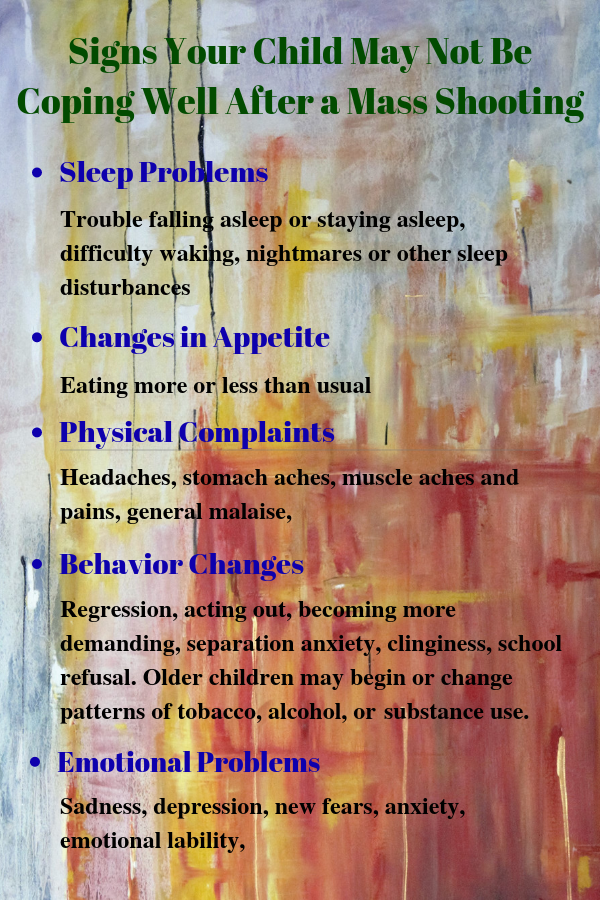
If children don’t have a chance to practice adaptive coping, sometimes parents may see signs that indicate that they are having a tough time adjusting. Sometimes it can be difficult to determine if if a child’s reaction is within the typical range of responses to an extreme event or whether they might need extra support If you are concerned about your child’s reaction, talk to their pediatrician or mental health professional.
The Takeaway
Parents, teachers, child care providers, and others who work closely with children should determine what information is appropriate to child a child about a mass shooting event, then filter information accordingly. Presenting it in a way that the child can accommodate, adjust to, and cope with will help them adjust to any confusion or concerns they may be experiencing.
You can find additional resources for helping children after a mass shooting and other serious crises at the National Child Traumatic Stress Network.
Natalie C. Frank has a Ph.D. in Clinical Psychology. She specializes in Pediatric Psychology and Behavioral Medicine.

If you enjoyed reading this story, you might also like these:
You can find links to my other work on Medium and follow me here. Thank you for reading and for supporting Mental Gecko!