
How to Survive the Blood-Sucking No-See-Ums of Florida and Live to Tell About It
Stop Scratching!
It Sounded Like a Great Idea
“Let’s go down to that little place on the docks and grab a bite to eat,” our son said to us one evening when we were visiting him in Florida. “It’s really pretty down there, and we can take our time and enjoy the sunset.”
I love a good sunset, and coupled with food and fellowship with people we love; I couldn’t think of a better way to spend the evening. What could possibly go wrong?
Silly me. I didn’t even consider that
“The best laid plans of mice and men often go awry,”
to quote the Scottish poet, Robert Burns.
Watching the Sunset
We stood on a wooden dock, leaning against the railing over the still water, watching the sun turn from yellow to gold to orange as it dipped lower in the sky. Soon it was hanging just above the horizon, cloaked in fuzzy apricot clouds rimmed with lavender. The lavender turned to purple with a fuschia-edged halo before the once-brilliant sun turned murky violet and dropped out of sight.
The sight of the setting sun had been so beautiful that I had been transported to a different plane of existence for a moment, ignoring my physical presence while contemplating the ecstasy of the natural world.
But my physical self was shocked back to reality with sudden, insistent, burning itch-points all over the back of my neck. My ears. My lower arms. My ankles. Behind my knees. Even the arches of my feet.
My frenzied fingers couldn’t scratch enough places to still the urgent itching. Everywhere.
That gorgeous sunset of coastal Florida, in the evening, standing above water, had presented the dreaded No-See-Ums with an open-bar, no-limit, absolutely free, happy hour of my blood. Their blood-sucking drunkenness nearly drove me insane.

What Got Me
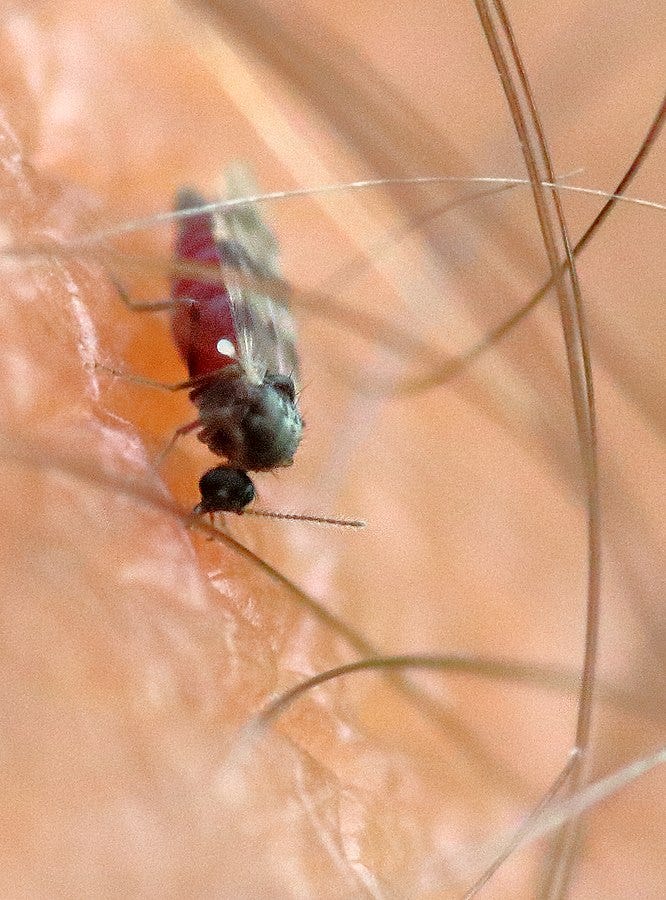
No-See-Ums have multiple aliases: Biting Midges, Biting Gnats, or Punkies. Sometimes, people call these teeny, tiny insects “Sandflies,” or “Sandfleas,” but they are not. Technically, No-See-Ums are winged bugs from the “Ceratopogonidae” family, which has more than 4000 species. Biting Midges exist throughout the world, and 47 different varieties exist in Florida alone.
It’s not hard to figure out why they’re called “No-See-Ums.” These biting gnats are tiny, just 1–3 millimeters long, the size of a pencil point, small enough to get through window screens. They’re so small they aren’t easily visible. They fly in warm months and are most active at sunrise, sundown, and on cloudy, still days.
No-See-Ums like to hit the skin on the backside of humans: their backs, shoulders, and necks; their calves and behind their knees. Those areas are protected from the breezes that could throw the tiny insects’ flight pattern way off course. Sheltered behind a body, the annoying little blood-suckers can drink until they’re sated, undetected until it’s too late to stop them.
Since No-See-Ums fly with friends, you don’t get bitten once. You get bitten dozens and dozens of times. You are landed on not by one lone insect, but by a nearly invisible horde of female Biting Midges who need the protein in your blood to feed their larvae.
Every creature is a wonder with a purpose. But once bitten, it’s hard not to think of these itty-bitty, teeny-weeny insects as anything but pure evil.
Why The Bites of No-See-Ums are Worse Than Mosquito Bites
Anyone who has ever told you that if you just stop thinking about it, you won’t itch, does NOT have an allergic reaction to bug bites, and has never experienced the agonizing urge to scratch a deep, distinct, unrelenting itch.
I thought I would lose my mind with the prickle and pain of No-See-Um bites.
No-See-Um bites are worse than mosquito bites for these reasons:
- The little Biting Midges have saw-teeth, not just a needle-like inserter like mosquitoes, causing more irritation and inflammation.
- The bites and resulting bumps congregate in large clusters of bright crimson dots or large red welts. While they itch intensely, the skin lesions may not show themselves for hours or even days. In my experience, the itching and welt are at their worst a day or two after the bite.
- The welt from a No-See-Um bite can be up to two inches in diameter. A mosquito bite welt is usually less than 1/2".
- The sting of a Biting Midge results in a lesion that takes weeks to heal and can itch the whole time; the itch and the welt of a mosquito bite disappear in 3–4 days.
- Because of the intense itch caused by a No-See-Um and the inability of a Biting Midge victim to abstain from scratching, the bites often get infected.
Why Some People Itch More than Others
No-See-Um females have a “needle-like sucker tube,” AND an injector tube. A female will inject her saliva, which contains an anticoagulant, into your body. That anticoagulant keeps the blood pooling and won’t allow it to clot, making it easier for the Midges to suck it up.
The more allergic your body is to the anti-coagulant, the more you itch. For some people with severe reactions to insect bites (like me,) the itch lasts for days.
Six Things To Do If You’re Bitten
Lots of advice exists about how to treat No-See-Um bites, none of it guaranteed, but all worth a try.
- Wash the bites with cold water to eliminate any trace of the saliva of No-See-Ums.
- Rub affected area with rubbing alcohol.
- Put cold packs of ice or frozen veggies on the bites for ten minutes.
- Some people believe that putting very hot water on the tip of a cotton swab and applying it to the bite eases the pain and itch.
- Victims of No-See-Um bites (without medical training but based on real-life experience) suggest rubbing Vicks Vaporub on the bite or misting the itchy areas with Lemongrass Spray.
- Over-the-counter antihistamines and topical ointments like Benedryl can help with the itch and inflammation.
Take Preventative Measures
We can’t eliminate the bug population, but if we know that those itch-inducing insects are out there waiting to pounce, we can take preventative action.
Wear long sleeves and pants when you’re going to be out in the prime biting times of sunrise or sunset. If you’re an avid outdoors person, you know about special tightly woven fabrics that wick sweat and help keep your body temp constant. Such fabrics are made into “wilderness wear.” This special apparel will keep the No-See-Ums out.
If you know that you’re going to be outdoors around water, douse yourself with a repellent containing DEET, known to prevent No-See-Um bites. Avon’s Skin-So-Soft has been reported to repel Biting Midges, and others say that natural chemicals like Pyrethrum, derived from the flowers of Chrysanthemums, or the common garden herb, Rosemary, can deter No-See-Um bites. Citronella is also noted as a helpful repellent.
Be aware that the biggest bite times are in the early morning and evening, and prepare accordingly. Apply repellent liberally.
Live to Tell About the Attack of the No-See-Ums
If you’re a person allergic to the anticoagulant of the Biting Midge, you will understand the severe, gripping itch worse than being rolled in poison ivy.
Eventually, the itch will go away, and the No-See-Um bites will fade, leaving only darker pink spots on your skin that linger like leopard dots for a month. But you WILL survive and live to tell the tale, laughing hysterically at people who tell you not to scratch.
Now, let me tell you what happened when I got bitten by a fire ant…
Melissa has been bug-bait since she was born, a blood-bank for mosquitoes, no-see-ums, and chiggers. She likens the intense desire to scratch bug bites to her urgent need to write.
**This content is not intended to be a substitute for professional advice, diagnosis, or treatment. Always seek the advice of your physician or another qualified health provider with any questions you may have regarding a health condition.
Also by Melissa Gouty :


