
The Fascinating Science Behind Why Creativity Is Associated With Fire
A hot-mind sciku
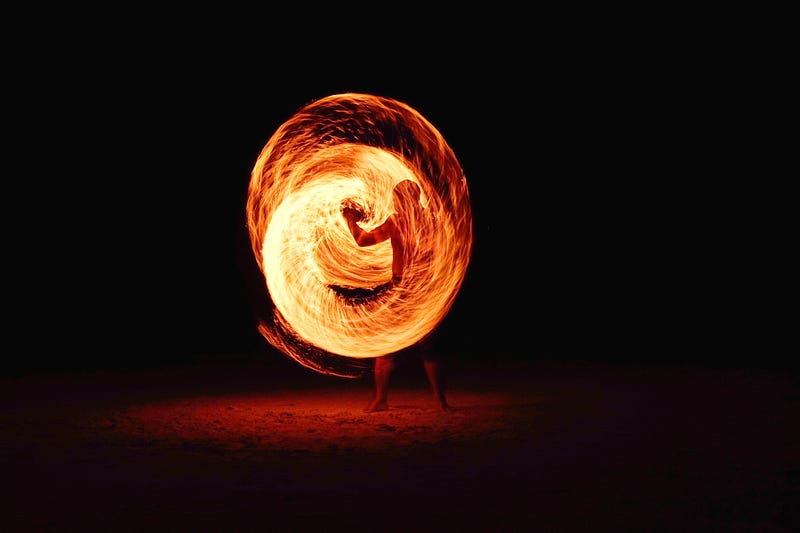
….“An idea ignites, Fast, white-hot, raging, changing the world forever.”
The concept of fire in the creative process
The first time I heard the phrase, “fire in the belly,” I knew exactly what it meant — only I felt it not only in my belly but also in my head, my fingers, my toes, my heart. I feel that creative urge — that insistent drive to produce —glowing embers heating me from the inside out.
My experience is not unique. Creativity is often associated with fire. Consider these statements:
“The mind is not a vessel to be filled but a fire to be kindled.” — Plutarch
The works must be conceived with fire in the soul but executed with clinical coolness. — Joan Miro
and
“Education is not the filling of a pail, but the lighting of a fire.” — William Butler Yeats
I keep a note near my keyboard with a quote from beloved children’s author, Roald Dahl. He, too, relates to the concept of heat in the creative process. He says,
“I began to realize how important it was to be an enthusiast in life. If you are interested in something, no matter what it is, go at it at full speed ahead. Embrace it with both arms, hug it, love it, and above all, become passionate about it. Lukewarm is no good. Hot is no good, either. White hot and passionate is the only thing to be.”
I am delighted to find myself experiencing the heat that thousands of artists feel, to be in the company of greatness in some small way.
But I was absolutely ecstatic to find that there is a scientific basis for the connection between creativity and fire that I’ve always believed in.
The fascinating science behind the connection between creativity and fire
More than two million years ago, humans began to control the use of fire, an advancement that changed, forever, the way we think.
Fire didn’t just provide warmth and fuel for cooking food. It provided light, protection, and time.
An interesting Smithsonian article, “Fire Good: Make Human Inspiration Happen,” outlines three ways that FIRE changed our mental abilities and made us smarter, more productive, more creative humans.
1) Fire changed our regulation of time
Once humans began to control the use of fire, they could start one at night. Instead of just sitting in the dark, having a fire at night expanded productive time to sixteen hours per day. Brains began to adapt, evolve, and remain alert for longer periods of time.
2) Fire altered the quality of our sleep
Because fires could keep animals away at night, people could partake in more relaxed, longer, deeper periods of rest, resulting in more Rapid Eye Movement (REM) sleep. More REM sleep resulted in more time for the brain to generate long-term, procedural memories as well as more dreams. Now that people were getting more sleep, we could retain more information about how to do things.
Being able to control fire and use it at night provided peoples with 25% REM sleep, giving us the ability to develop memory to accomplish multi-step, long-term tasks, like making tools. More sleep also moved us above the amount of deep sleep that animals like monkeys and apes get, who only average 15% REM sleep.
(We can totally understand this principle in modern life. When we’re well-rested, receiving plenty of REM sleep, we can think so much more clearly, remember so much more, and do so much more planning and deliberating.)
3) Fire was a focus for meditative thought
About 100,000 years ago, humans developed the ability to do many things and once, including achieving an altered mental state that allowed us to imagine, speculate, and make contingency plans. People developed “working memories,” as well as the ability to attain a meditative state, allowing for creative thought.
The theory is that it was fire that helped early humans develop that meditative state as small groups huddled around a campfire.
Anyone who has ever sat by a fire, gazing into the flames or staring into embers understands the ability to mentally escape to a place where the mind is by itself, not surrounded by the real world.
No wonder creativity is associated with fire
It’s no surprise to me. Creativity, great art, and passion for producing work are always associated with heat and fire. Now I know it’s because, millions of years ago, the use of fire allowed our brains to expand.
I intend to take full use of that incendiary gift, knowing that, like artist Claude Monet,
“I have so much fire in me, and so many plans.”
And believing, with all my heart, that
“The most powerful weapon on earth is the human soul on fire. “ — Ferdinand Foch
Melissa Gouty believes in hot minds and fiery souls. Her debut book, The Magic of Ordinary, a memoir about the power of a father’s love, will be released on January 15, 2021, and be available at Amazon, Barnes & Noble, Kobo, Apple, and Google Play.
If you’re interested in creativity, you will appreciate these: