
How to See Life in the Time of The First American
Learning from the life of America’s first celebrity
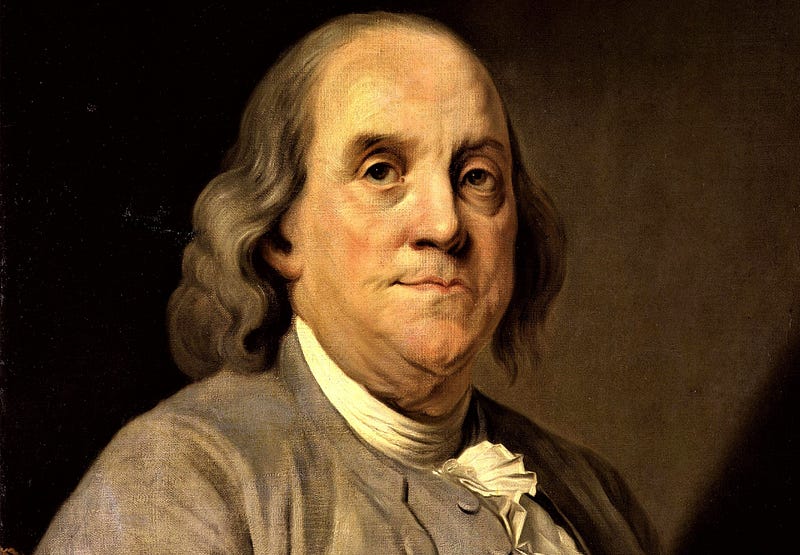

Let’s learn from one of the founding fathers and a polymath. He helped draft the Declaration of Independence and the U.S. Constitution. Because of his tireless campaigning for colonial unity, he earned the title “The First American.” He was also known as America’s First Celebrity, with an especially strong following in France. Some noteworthy positions he held include serving as the sixth president of Pennsylvania, The United States Minister to France and Sweden, and the first Postmaster General of the United States. Many know him as a prolific inventor, and to list his many accomplishments is beyond the scope of this article.
Yes, he is none other than Benjamin Franklin! Franklin was born in Boston and died in 1790 at 84 years old in Philadelphia.
In this article, we will look at a few of the many maxims he published in poor Richard’s almanac, his autobiography, and in other writings from the era. I have attempted to label and group the maxims in an order that will help you get the most out of each section.
Witticisms
“He that sows thorns, should not go barefoot.”
“There are no gains without pains.”
“Better slip with foot than tongue.”
“The worst wheel of the cart makes the most noise.”
“If Man could have half his wishes, he would double his Troubles.”
-
“The Proud hate Pride — in others.”
“An ounce of wit that is bought, is worth a pound that is taught.”
“Virtue may not always make a Face handsome, but Vice will certainly make it ugly.”
“Genius without education is like silver in the mine.”
“Better is a little with content than much with contention.”
“When the well is dry we know the value of water”
Life and Living
“Early to bed, early to rise, makes a man healthy, wealthy and wise.”
“Haste makes waste.”
“Diligence is the mother of good luck.”
“Wish not so much to live long as to live well.”
“Well done is better than well said.”
-
“Work as if you were to live 100 years, pray as if you were to die To-morrow.”
“The things which hurt, instruct.”
“Who is strong? He that can conquer his bad habits”
“God helps them that help themselves.”
-
“Have you somewhat to do tomorrow; do it today.”
“Reading makes a full man, meditation a profound man, discourse a clear man.”
“Either write something worth reading or do something worth writing.”
“Let us then up and be doing, and doing to the purpose; so by diligence shall we do more with less perplexity.”
-
“Want of care does us more damage than want of knowledge”
“Half the truth is often a great Lie”.
“Sin is not harmful because it is forbidden, but it is forbidden because it is hurtful.”
-
“Do not do what you would not have known.”
“The noblest question in the world is, What Good may I do in it?”
“…there will be sleeping enough in the grave….”
Relationships
“When you’re good to others, you are best to yourself.”
“To err is human, to repent divine, to persist devilish.”
“Be slow in chusing a friend, slower in changing.”
“Tell me my faults, and mend your own. Men take more pains to mask than mend.”
-
“A quarrelsome Man has no good Neighbors.”
The sting of a reproach, is the truth of it.
“Love your enemies, for they tell you your Faults.” …
-
“Beware of him that is slow to anger: He is angry for some thing, and will not be pleased for nothing.”
“Anger is never without a Reason, but seldom with a good One. Search others for their virtues, thy self for thy vices.”
“Whate’er’s begun in anger ends in shame.“
“Approve not of him who commends all you say.”
-
“The Wolf sheds his coat once a year, his disposition never.”
“Fish & visitors stink in 3 days.”
Wisdom
“Fools multiply folly.”
“Be neither silly, nor cunning, but wise.”
“Speak little, do much.”
“Silence is not always a sign of Wisdom, but babbling is ever a mark of folly.”
“He’s a Fool that cannot conceal his Wisdom.”
-
“Humility makes great men twice honourable.”
“How many observe Christ’s Birth-day! How few, his Precepts! O! ’tis easier to keep Holidays than Commandments.”
“Necessity never made a good bargain.”
“They that won’t be counselled, can’t be helped.”
“Distrust & caution are the parents of security.”
“Wink at small faults; remember thou hast great ones.”
-
“He that can compose himself, is wiser than he that composes books. Glass, China, and Reputation, are easily crack’d, and never well mended.”
“To-morrow, every fault is to be amended; but that To-morrow never comes.”
“By diligence and patience, the mouse bit in two the cable.”
“Would you persuade, speak of Interest, not of Reason.”
-
“Reading makes a full Man, Meditation a profound Man, discourse a clear Man.”
“Proclaim not all thou knowest, all thou owest, all thou hast, nor all thou canst.”
“Experience keeps a dear school; but fools will learn in no other, and scarce in that; for it is true, we may give advice, but we cannot give conduct.”
-
“You may give a man an Office, but you cannot give him Discretion.”
“Only a virtuous people are capable of freedom. As nations get corrupt and vicious, they have more need of masters.”
“They who would give up essential Liberty, to purchase a little temporary safety, deserve neither liberty nor safety.
Time
“Lost time is never found again.”
“Dost thou love life? Then do not squander time, for that is the stuff life is made of.” “Employ thy time well if thou meanest to gain leisure; and since thou art not sure of a minute, throw not away an hour.”
“If time be of all things the most precious, wasting time must be the greatest prodigality, since lost time is never found again; and what we call time enough always proves little enough.”
Wealth and Poverty
“What more valuable than Gold? Diamonds. Than Diamonds? Virtue.”
“Pay what you owe, and you’ll know what’s your own.”
“Plough deep, while Sluggards sleep; And you shall have Corn, to sell and to keep.” “He that is rich need not live sparingly, and he that can live sparingly need not be rich.”
“Wealth is not his that has it, but his that enjoys it.”
-
“The poor have little, beggars none, the rich too much, enough not one. Poverty wants some things, Luxury many things, Avarice all things.”
“He that’s content, hath enough; He that complains, has too much.”
“Having been poor is no shame, but being ashamed of it, is.”
-
“Diligence overcomes Difficulties, Sloth makes them.”
“They who have nothing to be troubled at, will be troubled at nothing.”
“If you desire many things, many things will seem few.”
“There are lazy Minds as well as lazy Bodies.”
“He that waits upon fortune, is never sure of a dinner.”
“Hunger never saw bad bread.”
“Sloth makes all things difficult, but industry, all things easy. — He that rises late must trot all day, and hall scarce overtake his business at night, while laziness travels so slowly that poverty soon overtakes him. Beware of little expenses; a small leak will sink a great ship.”
I recommend reading some of Franklin’s works, especially his autobiography and Poor Richard’s Almanac. You will not only find them entertaining, but enjoyable and fascinating to read.
To gain the most value from Franklin’s wisdom, I suggest you take your time to reread each section of this article slowly. With your journal in hand, capture your insights for each quote or group of quotes. In doing so you will develop keen insight that will prove to be invaluable to you as you move into the future.
As always, to gain the most from this exercise do it with someone close, so you can benefit from one another’s insights.
I leave you with this final quote from Franklin, which will provide direction for your future:
“Think of three Things, whence you came, where you are going, and to whom you must account.”
- Benjamin Franklin
Bill Abbate Leadership Writer and Editor in ILLUMINATION.
Thank you for reading this article! If you enjoyed it, please check out others below.