
How to Respond to Journal Reviewers
The art of writing responses to reviewers’ comments for journal articles
Getting published is an important aspect of research in order to gain visibility to your work. To get your work published, you may have to go through several iterations of revisions and polishing until your manuscript reaches the standards and expectations of the target journal and its reviewers. If you are new to research and you get the reviewers’ comments, you may feel lost and the process of responding to comments seems to be a mystery. In this article, I will share with you some tips I have learned on how to prepare a revised submission, how to handle criticisms and how to respond accordingly.
Disclaimer: This article is based on my experience responding to review comments for the journal articles I have published. The examples provided are generic and are not related to any specific field.

You have worked hard on your article explaining your latest solution, polished every paragraph, checked all figures and tables, revised the flow many times, and finally, submitted your perfect manuscript for peer review. Now you keep on checking your inbox every two hours, waiting for an email of acceptance. Then one day, you see that there is an email requesting major revisions to your article. It is utterly shocking! The first few thoughts that come to your mind will be “How come the reviewers did not love my brilliant work? How can they reject the current version of my perfect work? Have they misunderstood my method?”. These are very normal reactions, especially if you are new to research.
How to Get Started?
The first thing to do is to go through the reviewers’ comments (of course!) and see what they have said. They can be good or bad.
Good (positive) comments
If the comments seem to be pretty positive, then you should be proud of yourself as the reviewers truly appreciate your work. The comments may have suggestions to improve your algorithms, requesting to include more datasets or requesting for more explanations of the results. All you have to do is revise your manuscript while keeping those comments in mind. Cool!
Here is an example of a positive comment.
This manuscript presents a novel tool
to . In my opinion, this tool is very interesting and will be helpful to improve . The paper is well written but I feel that the results need more extensive analysis and discussion. The tool is easy to install and run. The source code is well documented and freely available on GiHub. I strongly recommend this paper for publication.

Bad (negative) comments
If the comments are pretty negative, have criticised a lot and are (sometimes) quite harsh, just have a quick look. Here is an example of a negative comment.
Although the authors claim that they have introduced a novel tool to address
, I do not see any novelty in terms of algorithms in this work. Currently, there are many tools available to solve this problem and the results of seem to be the same or sometimes worse than existing work. Hence, I do not see the use of another tool with “border-line” results.
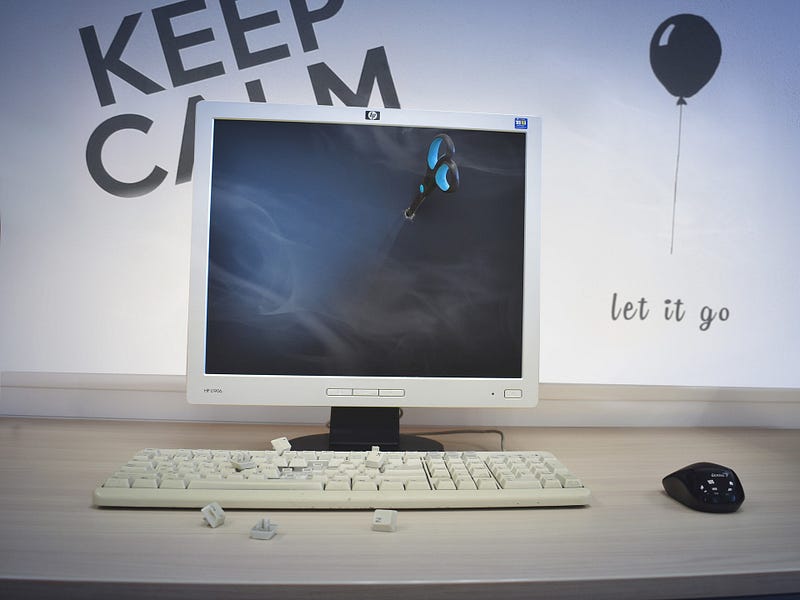
I got some pretty harsh comments once and I was very angry. What I did was, I threw away the printed copy of the comments and did not look at them for a few days. Taking time off helped me to let my emotions settle, calm myself and prevented me from acting on my impulses. When I read the comments for the first time, I would have given some harsh and heated responses, which I would have definitely regretted later. After I became calm and clear-minded, I revisited the comments. I took my time to read and understand what the reviewers are telling.
Do not get upset at the first glance at reviewers’ comments as it will not do any of us any good.
Note that if the journal rejects your article saying that it is out of their scope, then you should try submitting to another journal with a suitable scope.
How to Accept Criticism?
Accepting criticism and responding to them takes practice. It is true that you have dedicated all your effort and many hours of hard work for this manuscript, but still, reviewers find that it is not up to the standards of the journal. I’m not saying that reviewers are neglecting your hard work. They do know how much time and effort you have put to prepare the manuscript. They need your piece of work to be thorough and perfect. You should be calm and look at these comments as a positive thing to improve your work.
Normally, most of the top journals have reviewers who are experienced and knowledgable. We may not know everything about the field as beginners, but they have been working in the field for decades, and have experience reviewing similar work. Reviewers can provide valuable suggestions to improve your work and point out unclear parts. I have experienced this first hand where reviewers have suggested better solutions to my methods.
Always try to be calm and open-minded towards criticisms.
Here is an example comment criticising the authors’ work.
Although the authors claim this method is novel, there are similar existing work that the authors have failed to cite.
The reviewers may have failed to understand the novel part of your work. In such cases, you have to clearly emphasise what are the key components that contribute to the novelty of your work. If you have genuinely missed certain things pointed out by the reviewer, then you can include them in your revised manuscript.

How to Handle Disagreements With Reviewers?
There can be instances that reviewers have misunderstood certain things and have suggested totally irrelevant points. Always be respectful of others’ opinions. We are human and we make mistakes! If you disagree with a comment, then you can clearly explain why you think you disagree (and why you think you are correct). Make sure to be polite and respectful when you are responding.
Here is an example scenario of disagreement and how you can respond to it.
Comment:
I am not convinced by the authors’ choice of tools for the performance comparison. I believe
and would give better results for comparison as they are . I suggest the authors should provide performance with state-of-the-art tools such as and so that the reader can see the clear improvement.
Response:
We thank the reviewer for the suggestion. We did not include
(citation 1) and (citation 2) as they are not relevant to our scope. and are based on whereas our tool is based on . . However, we have included two recent tools (citation 3) and (citation 4). It can be seen that has been able to significantly improve the results…
Always be polite and respectful.

What to Include in a Revised Submission?
When you prepare a revised submission for a “major revision” of your work, it should include the following 4 things.
- Cover letter
- Track changes document of your revised manuscript
- A clean version of your revised manuscript
- A document with responses to reviewers’ comments
1. Cover letter
You should include a cover letter addressed to the editor of the journal. This is normally written by the corresponding author on behalf of all the authors. This cover letter generally provides details about the manuscript and accompanying documents for the revised submission. It is a nice practice to thank the editor for giving you another opportunity to improve your manuscript and appreciate the reviewers for their effort in reviewing.
Here is a sample cover letter addressing the editor.
Dear
,
Thank you very much for the opportunity to revise our paper titled
. We would also like to thank the reviewers for their time and effort spent on reviewing our manuscript. Their insightful inputs have definitely helped to improve our manuscript. We believe that we have addressed all the comments and suggestions provided by the reviewers.
The changes made in the revised submission are further detailed in the document titled “response_to_reviewers.pdf” with the corresponding responses to the reviewers’ comments. All the numbered items (sections, pages, figures, equations and tables) are consistent with those presented in the revised manuscript. For convenience, the reviewers’ comments are included in italics as well.
We look forward to hearing a decision from you soon. Thank you for your consideration.
Sincerely,
You can also find a detailed example of a cover letter from Proof-Reading-Service.com.
2. Track changes document of your revised manuscript
When you are revising your article according to the reviewers’ comments, you have to mark the changes you have done. Many journals request you to mark the changes (e.g., change the font colour to red for the changed sections or use the “track changes” feature of MS Word) to indicate what you have changed and where the changes are done. It will be easier for the editor and reviewers to identify what has been changed compared to the original version of your manuscript.
3. Clean version of your revised manuscript
You should include a “clean” version of your revised manuscript which does not show any changes marked and shows your manuscript in its final form. This allows the editor and reviewers to see your manuscript without any distractions.
4. Responses to reviewers’ comments
When you submit a revised version of your manuscript, you have to accompany a document detailing what changes you have done/not done according to the reviewers’ comments. This document should answer each comment provided by the reviewers. It helps the reviewers to identify what you have changed without having to go through the entire manuscript.
Different people follow different styles when it comes to presenting responses to the reviewer’s comments. I have seen some follow a tabular approach and some follow a list-like approach.
- Tabular approach: Create a table with 2 columns. The first column contains the reviewers’ comments and the second column contains the relevant responses.
- List-like approach: List down all the reviewers’ comments and provide individual responses below each comment.
Personally I prefer the list-like approach as it allows you to add content freely (including text, images, tables, etc.).
You can start the document by adding a heading (e.g., Response to Reviewers’ Comments), the manuscript title, author names and manuscript ID. Make sure to add the manuscript title and manuscript ID.
Next, you can list the comments and relevant responses. Here are some example comments and responses.
Response to Reviewer 1
Major Comment 1:
I am not convinced by the authors’ choice of tools for comparison. I believe
and would give better results for comparison. I suggest the authors should provide performance with state-of-the-art tools such as and so that the reader can see the clear improvement.
Response:
We thank the reviewer for the suggestion. We did not include
(citation 1) and (citation 2) as they are not relevant to our scope. and are based on whereas our tool is based on . However, we have included two recent tools (citation 3) and (citation 4). It can be seen that has been able to significantly improve the results… The new results can be found in Section on page of the revised manuscript.
Minor Comment 1:
In some cases,
drops. The authors should discuss the possible reasons in the discussion section.
Response:
We thank the reviewer for the comment.
. As suggested, we have included these reasons in Section on page of the revised manuscript.
Minor Comment 2:
The writing and organization of the paper need to be substantially improved. The manuscript needs to be proof-read thoroughly.
Response:
We thank the reviewer for pointing out the issues in writing and organization of the manuscript. We have addressed the above issues and re-written other parts accordingly and proof-read as well.
Response to Reviewer 2
…
Note the writing style of the responses. Always be polite and be grateful towards the reviewer for pointing things out. If you disagree with the suggestion, you can decline the reviewer’s suggestion politely and state your reasons clearly. If you have added new content, refer to them by figure/table/equation numbers with section numbers and page numbers within your responses.
A common practice to follow is to combine the cover letter and the document with the responses to reviewers’ comments together (i.e., begin the document with an introductory part addressed to the editor and then add the reviewers’ comments with responses) to form a rebuttal letter. You can find some great tips on how to write a great rebuttal letter. You can decide how to formulate your responses, either as a cover letter with a separate document with responses or as a rebuttal letter, depending on the journal requirements and your personal preference.

What to Keep in Mind When Responding?
1. Be polite
Reviewers can make mistakes and sometimes they may misunderstand things. Be patient and polite in such cases. Try your best to explain things as clearly as possible.
2. Be respectful of the reviewers
In most of the times, they are not paid for reviewing your article. They do it for the betterment of the field. They dedicate their time to review your article and provide feedback. Hence, be respectful when addressing them.
3. Be clear and precise
Make sure to respond to the point without writing everything you know. Use short and clear sentences. If required, add visual cues such as equations and figures to make your explanations more clear. And most importantly, make sure to address every point raised by the reviewers. Even though you don’t agree and refuse to do the requested changes, make sure to mention that and clearly state your reasons while maintaining a polite tone.
Final Thoughts
In my opinion, writing responses to reviews’ comments is an art and you need to practice to be perfect. I hope you found this article useful and feel free to use these tips and samples in your work.
Thank you for reading!
Cheers!
References
[1] How to respond to reviewer comments — the CALM way (https://www.elsevier.com/connect/authors-update/how-to-respond-to-reviewer-comments-the-calm-way)
[2] How to write a great rebuttal letter (https://www.editage.com/insights/how-to-write-a-great-rebuttal-letter)
If you are interested in more experiences related to research, higher studies, career advice and data science, feel free to check out the following articles.


