avatarRuben Bouma

Free AI web copilot to create summaries, insights and extended knowledge, download it at here

3876

Abstract

or 10 to 15 hours adenosine is much higher. Adenosine creates some sort of sleep hunger.</p><figure id="2aef"><img src="https://cdn-images-1.readmedium.com/v2/resize:fit:800/0*Gdd4aSStoFx0DaHG.jpeg"><figcaption>Image credit: <a href="https://sites.psu.edu/lifeitmoveson">https://sites.psu.edu/lifeitmoveson</a></figcaption></figure><p id="cb0f">To better understand and think about adenosine, you have to think about <a href="https://pubmed.ncbi.nlm.nih.gov/20164566/">caffeine</a>. For most people, caffeine wakes people up and makes them more alert. Caffeine has the ability to bind to adenosine receptors in the brain, acting as an adenosine antagonist, meaning that caffeine blocks the sleepiness signal. Therefore, if the caffeine subsides, adenosine can bind to those receptors again, even with greater affinity, resulting in an increased hunger to sleep.</p><p id="e7ca">The second force, which governs when you sleep and when you’re awake, is <a href="https://www.ncbi.nlm.nih.gov/books/NBK519507/">the circadian force</a>. Inside the brain of any mammal is this tiny area called <a href="https://pubmed.ncbi.nlm.nih.gov/23899592/">the suprachiasmatic nucleus (SCN)</a>, which is located directly above the optic chiasm and roughly 3 cm behind the eyes. The SCN is responsible for controlling circadian rhythms. It generates neuronal and hormonal activities which regulate many different body functions in a 24-hour cycle. It determines when we want to be asleep and when we want to be awake. Part of this 24-hour cycle of the circadian clock is a block of sleep ranging from 6 to 10 hours per cycle. The most powerful factor to determine when you want to sleep and when you want to be awake is <i>sunlight</i>.</p><p id="a9b7">Most people tend to wake up within 1 to 3 hours after sunrise. After waking, adenosine levels in our brain and body are low and our system generates an internal signal, in this case primarily releasing the hormone <a href="https://pubmed.ncbi.nlm.nih.gov/23835138/">cortisol</a> from the adrenal glands, which sits above the kidneys. This releasing pulse of cortisol must occur early in the day because it wakes you up, makes you alert, and gives you a feeling of being able to and wanting to move and to go out for school, for exercise, or social relationships.</p><p id="adbc"><a href="https://pubmed.ncbi.nlm.nih.gov/27749086/">Moreover</a>, after this rise in cortisol levels in the morning, a cellular timer is set which dictates when another hormone, melatonin, is secreted from the pineal gland. This hormone makes you sleepy. When you wake up in the morning and experience this rise in cortisol levels, a cellular timer is set which tells your brain and body that in about 12 to 14 hours melatonin is being released from the pineal gland. So, you have this wakefulness signal, cortisol, that triggers the sleepiness signal, melatonin, and these two mechanisms are interacting every single day.</p><figure id="0197"><img src="https://cdn-images-1.readmedium.com/v2/resize:fit:800/0*bPoAYitFBZKIoOVI.jpeg"><figcaption>The hormones Cortisol (Alertness/activation hormone, also known as one of the stress hormones) and Melatonin (recovery and rest hormone) during the circadian rhythm. Image credit: <a href="https://focuswrx.com/sleep-to-be-at-your-best-part-1/">https://focuswrx.com/sleep-to-be-at-your-best-part-1/</a></figcaption></figure><p id="fe65">So, how can you use sunlight to wake up earlier?</p><p id="4e5e">As diurnal creatures, we humans are programmed to be home in bed at night and outdoors when the sun is shining. That is why this key pacesetter for many of the body’s circadian rhythms, melatonin, is produced during the dark hours and stops when our eyes are exposed to daylight.</p><p id="9309">When people are exposed to sunlight after waking up, their nocturnal melatonin production occurs sooner, which leads to

Options

entering their sleep more easily at night. This melatonin rhythm phase advancement caused by exposure to light has been effective against insomnia, <a href="https://pubmed.ncbi.nlm.nih.gov/9376643/">premenstrual syndrome</a>, and <a href="https://pubmed.ncbi.nlm.nih.gov/30883670/">seasonal affective disorder</a>.</p><p id="5ccc">Furthermore, serotonin, the melatonin precursor, is also affected by daylight. Serotonin is only converted to melatonin in darkness when normally serotonin is produced during the day. High serotonin levels, in the presence of melatonin, reflect long days and short nights, i.e., longer exposure to ultraviolet radiation, whereas high melatonin levels correspond to long nights and short days.</p><p id="908a">Additionally, exposure to sunlight in the evening, i.e., viewing the sunlight around the time of sunset, ensures that <a href="https://pubmed.ncbi.nlm.nih.gov/11834834/">melanopsin cells</a> in the eyes give a signal to the SCN, a.k.a. the circadian clock, that it is the end of the day. By viewing sunlight around the time of sunset the mechanisms of the wakefulness and sleepiness signals are protected by the negative effects of light later in the day.</p><h1 id="c5be">Conclusion</h1><p id="5ab9">In short, viewing early morning sunlight is the solution to reset your waking rhythm and to get you out of bed in the morning. The human eye’s non-forming-image cells receive rays of sunlight and advance the hormonal cycles that wake you up and make you go to sleep. 2 to 10 minutes of light exposure directly after waking and these hormonal rhythms will advance their cycle resulting in an earlier waking rhythm. Continue this process for 2–3 days and you definitely will be on time for your next meeting early in the morning. This science-based tool undeniably helped me to become an earlier riser, did it also help you?</p><p id="c869">Thank you for your interest in science! Feel free to put questions, comments, and suggestions for future articles in the comment section.</p><p id="f760"><b>If you want to support:</b></p><ul><li>If you are not a <b>Medium</b> member yet, you can <a href="https://r-bouma98.medium.com/membership"><b>my referral link</b></a><b> </b>so I can get a part of your fees from <b>Medium</b>, you don’t pay any extra.</li><li>Subscribe to <a href="https://r-bouma98.medium.com/subscribe"><b>my Newsletter</b></a><b> </b>to get best tutorials, research, education, and scientific-based tools for everyday life directly in your email inbox.</li></ul><p id="54c7">While you’re here, check out one of my other articles.</p><div id="01d9" class="link-block"> <a href="https://readmedium.com/a-simple-stress-reducing-breathing-tool-to-calm-you-down-b038a0b3719c"> <div> <div> <h2>A Simple Stress-Reducing Breathing Tool to Calm You Down</h2> <div><h3>This science-based tool makes you relaxed and calms you down in real-time.</h3></div> <div><p>medium.com</p></div> </div> <div> <div style="background-image: url(https://miro.readmedium.com/v2/resize:fit:320/1*w6LEBUFnuBfarXg8qJUleA.jpeg)"></div> </div> </div> </a> </div><div id="89dc" class="link-block"> <a href="https://readmedium.com/how-to-learn-skills-faster-b20a78058831"> <div> <div> <h2>How to Learn Skills Faster</h2> <div><h3>How taking short breaks may help our brains learn new skills.</h3></div> <div><p>medium.com</p></div> </div> <div> <div style="background-image: url(https://miro.readmedium.com/v2/resize:fit:320/1*KIHoJA7SI0FojfUmo3N40A.jpeg)"></div> </div> </div> </a> </div></article></body>

How To Reset Your Waking Rhythm by Viewing Morning Sunlight

This science-based tool can get you out of bed earlier.

Photo by bruce mars on Unsplash

Did you know the eyes aren’t just a part of the brain but they really are the brain?

The human eye is part of the sensory nervous system and through the years of evolution, this sense organ is pushed through the skull connecting the internal system with the outside world. The brain uses signal information from the eyes to elicit the perception of color, depth, movement, shape, and other features.

The retina of the eye consists of photoreceptive cells, i.e., rod and cone cells which can detect visible light and send this information to the brain, and photosensitive ganglion cells, the human eye’s non-image-forming cells. These cells receive light signals which affect regulation and suppression of the hormone melatonin, entrainment of the circadian rhythm, and adjustment of pupil size.

So, if you’re not feeling awake during the early parts of the day or you want to become an early riser, viewing bright light early in the day could be the solution. Light is the principal control of our 24h day-night cycle, influencing everything from metabolism, sleep, and body temperature. Without light, our genetics called tau, determine the pattern our body will run on.

Daily discrepancies can add up because your tau, or circadian rhythm, may not exactly match the 24 hours cycle that governs how our society works. Therefore, falling asleep and waking up late may result in a delayed sleep phase syndrome, while conversely, falling asleep and waking up early may lead to advanced sleep phase syndrome. By properly-timed exposure to sunlight, each of these conditions may be helped. In people who suffer from difficulty sleeping as a result of insomnia, light exposure can be helpful to regularize patterns of wakefulness and sleep.

Morning Light Therapy

For most people, typically within the first hour after waking up and crawling out of bed, exposure to sunlight is most beneficial to reset your circadian clock. After waking, spend between 2 to 10 minutes getting direct sunlight exposure into your eyes and repeat this process for 2–3 days. Watching sunlight through a windowpane may not have the same effect because the light we get from being outside on a summer day can be a thousand times brighter than we’re ever likely to experience indoors. Furthermore, don’t wear sunglasses or a sun visor. And, although the sunlight in the morning is less intense, don’t harm yourself by looking too hard directly into the sunlight and damaging the retinal cells in your eyes.

Neurobiology of sleep and light therapy

What is sleep? And what governs the timing of onset of sleeping?

How well we sleep and the quality of our wakeful state is determined by 2 ‘forces’. The first force is a chemical force called adenosine. This chemical builds up the longer we are awake, meaning that after a good restful night of 8 hours of sleep, adenosine is low in our brain and body and if you’re awake for 10 to 15 hours adenosine is much higher. Adenosine creates some sort of sleep hunger.
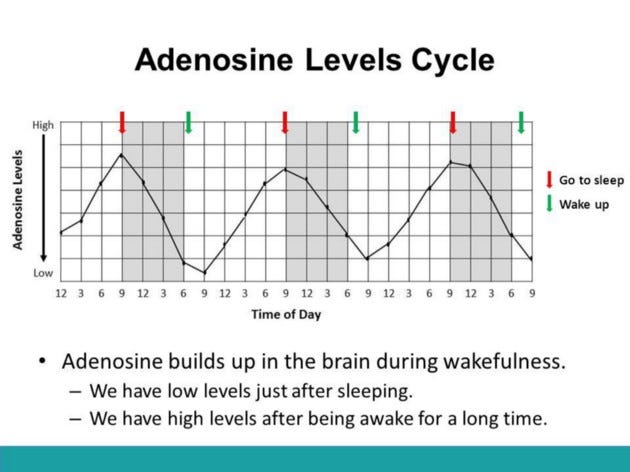
Image credit: https://sites.psu.edu/lifeitmoveson

To better understand and think about adenosine, you have to think about caffeine. For most people, caffeine wakes people up and makes them more alert. Caffeine has the ability to bind to adenosine receptors in the brain, acting as an adenosine antagonist, meaning that caffeine blocks the sleepiness signal. Therefore, if the caffeine subsides, adenosine can bind to those receptors again, even with greater affinity, resulting in an increased hunger to sleep.

The second force, which governs when you sleep and when you’re awake, is the circadian force. Inside the brain of any mammal is this tiny area called the suprachiasmatic nucleus (SCN), which is located directly above the optic chiasm and roughly 3 cm behind the eyes. The SCN is responsible for controlling circadian rhythms. It generates neuronal and hormonal activities which regulate many different body functions in a 24-hour cycle. It determines when we want to be asleep and when we want to be awake. Part of this 24-hour cycle of the circadian clock is a block of sleep ranging from 6 to 10 hours per cycle. The most powerful factor to determine when you want to sleep and when you want to be awake is sunlight.

Most people tend to wake up within 1 to 3 hours after sunrise. After waking, adenosine levels in our brain and body are low and our system generates an internal signal, in this case primarily releasing the hormone cortisol from the adrenal glands, which sits above the kidneys. This releasing pulse of cortisol must occur early in the day because it wakes you up, makes you alert, and gives you a feeling of being able to and wanting to move and to go out for school, for exercise, or social relationships.

Moreover, after this rise in cortisol levels in the morning, a cellular timer is set which dictates when another hormone, melatonin, is secreted from the pineal gland. This hormone makes you sleepy. When you wake up in the morning and experience this rise in cortisol levels, a cellular timer is set which tells your brain and body that in about 12 to 14 hours melatonin is being released from the pineal gland. So, you have this wakefulness signal, cortisol, that triggers the sleepiness signal, melatonin, and these two mechanisms are interacting every single day.
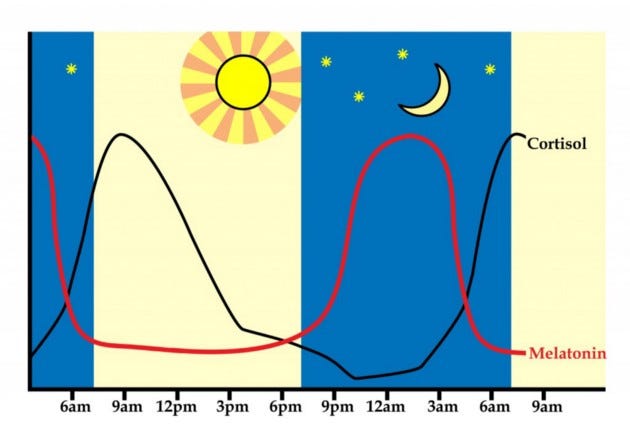
The hormones Cortisol (Alertness/activation hormone, also known as one of the stress hormones) and Melatonin (recovery and rest hormone) during the circadian rhythm. Image credit: https://focuswrx.com/sleep-to-be-at-your-best-part-1/

So, how can you use sunlight to wake up earlier?

As diurnal creatures, we humans are programmed to be home in bed at night and outdoors when the sun is shining. That is why this key pacesetter for many of the body’s circadian rhythms, melatonin, is produced during the dark hours and stops when our eyes are exposed to daylight.

When people are exposed to sunlight after waking up, their nocturnal melatonin production occurs sooner, which leads to entering their sleep more easily at night. This melatonin rhythm phase advancement caused by exposure to light has been effective against insomnia, premenstrual syndrome, and seasonal affective disorder.

Furthermore, serotonin, the melatonin precursor, is also affected by daylight. Serotonin is only converted to melatonin in darkness when normally serotonin is produced during the day. High serotonin levels, in the presence of melatonin, reflect long days and short nights, i.e., longer exposure to ultraviolet radiation, whereas high melatonin levels correspond to long nights and short days.

Additionally, exposure to sunlight in the evening, i.e., viewing the sunlight around the time of sunset, ensures that melanopsin cells in the eyes give a signal to the SCN, a.k.a. the circadian clock, that it is the end of the day. By viewing sunlight around the time of sunset the mechanisms of the wakefulness and sleepiness signals are protected by the negative effects of light later in the day.

Conclusion

In short, viewing early morning sunlight is the solution to reset your waking rhythm and to get you out of bed in the morning. The human eye’s non-forming-image cells receive rays of sunlight and advance the hormonal cycles that wake you up and make you go to sleep. 2 to 10 minutes of light exposure directly after waking and these hormonal rhythms will advance their cycle resulting in an earlier waking rhythm. Continue this process for 2–3 days and you definitely will be on time for your next meeting early in the morning. This science-based tool undeniably helped me to become an earlier riser, did it also help you?

Thank you for your interest in science! Feel free to put questions, comments, and suggestions for future articles in the comment section.

If you want to support:

  • If you are not a Medium member yet, you can my referral link so I can get a part of your fees from Medium, you don’t pay any extra.
  • Subscribe to my Newsletter to get best tutorials, research, education, and scientific-based tools for everyday life directly in your email inbox.

While you’re here, check out one of my other articles.

Life
Life Lessons
Health
Self Improvement
Mental Health
Recommended from ReadMedium