
How To Remain Mindful While Writing On Multiple Social Media Platforms
Create like an artist, while feeding the algorithm.

Here’s a secret — I don’t love social media.
If it were up to me, I’d live in a log cabin writing short stories, returning to society once in a blue moon for character study.
But, I’m not there yet.
And, the reality of life is… you need to make money.
Here are 5 principles I use to create 200+ pieces of content, across multiple platforms, every month … without burning out.
Even though mass content creation isn’t my thing.
Productivity isn’t about doing more.
In fact, the opposite.
I truly believe mental organization is the key to getting more done.
Productivity isn’t about doing more— but rather focusing your energy on what matters.
To be 100% honest, I believe the amount of effort it takes to be successful creating online is unhealthy. It’s very rare to find someone who is both highly successful and truly balanced as a person.
That said, in life, there are times to push and others to coast. Currently, I’m in a phase of pushing in hopes of creating enough momentum to keep my dream of writing full-time alive.
After recently quitting my 9–5, I’ve been working tirelessly to solidify my once side hustle into a sustainable business. Right now, I create content on 5 different platforms:
- LinkedIn (3 posts per week)
- Medium (3 articles per week)
- Twitter (14–20 Tweets per week)
- YouTube (1 video every single day)
- Gumroad (1 product per month and 1 weekly email)
This is in addition to responding to comments, and DMs, spreading engagement, and creating graphics… it’s a lot, to say the least.
I’m one misstep away from slipping off the cliff of productivity and tumbling into burnout.
No one is immune to burnout.
As a foundation, it’s important to remember this — you can’t do it all. But, it’s also important to remember that your efforts now are compounding toward a better future.
I’ve had the privilege of chatting with some of the largest writers on the internet. And, they all say the same thing:
It gets easier after 10K — no matter the platform.
When you first start writing online, it takes a lot of energy to create momentum. But, once you build an engaged base of readers, things get easier.
I call it the tipping point.
On the climb to the tipping point, it’s important to put your face in front of as many readers as possible. The comments you leave on other people’s content are just as important as the content you create — if not more.
The truth is, people need a reason to read your writing. And we all value others based on their perceived value. If your posts have a lot of engagement, or you have a large following, others will assume that you must have something worth saying.
Comments are currency — and content of their own.
In the unwritten hierarchy of social media engagement, comments are at the top. This is because they’re personal — and take more effort than other forms of engagement.
When you first start out, the comments you leave are the first pieces of content most readers see:
- The more quality comments you can leave on other people’s content, the more likely they will be to reciprocate.
- And the more valuable your content will appear to be.
Thus beginning the exhausting dilemma of artist vs algorithm. Something almost every writer struggles with at one point in their journey.
Being that you only have so much energy, it’s important to learn where to focus it.
Personally, I don’t love feeding the algorithm — and I much prefer to spend time developing as a writer. But, as engagement is a reality of life for 90% of writers, I try my hardest to balance my artistic integrity with feeding the algorithm.
These 5 principles allow me to create consistent content while maintaining enough mental energy to spread engagement. And most importantly, enjoy the journey.
1. Your brain isn’t made for storage
It’s funny, I’ve read many of the most-recommended books on philosophy:
- “The Art of War” by Sun Tzu
- “Meditations” by Marcus Aurelius
- “Beyond Good & Evil” by Friedrich Nietzche
But, they all pale in comparison to a book that isn’t about philosophy at all… it’s about folding laundry.
I’ve learned more about life, philosophy, and productivity from Marie Kondo’s “The Life-Changing Magic of Tidying” than from the 3 books above — combined.
Namely, the importance of mental organization.
You’re more likely to lose your precious belongings in an unorganized house. Just like you’re more likely to lose your precious million-dollar ideas in a messy mind.
As David Allen says in the book, “Getting Things Done”:
“Your brain is for having ideas, not holding them”
Having a mental net to capture ideas is incredibly important. It allows you to organize your ideas as they come to you as opposed to trying to hold them in your brain.
I use an app called “Notion”.
It allows me to quickly organize any ideas I have, to keep my brain empty for new ones. This includes:
- Medium article ideas
- Content strategies
- Newsletter topics
- Twitter threads
- Linkedin posts
- Headlines
- Tweets
- Goals
- Etc.
I call it my “content vault” — it’s part of a custom workspace I’ve made, called “The Mindful Content Organization System.”
Use your brain for what it is — a thinking tool. Not a dusty storage space.
2. Everything, everywhere, all at once
Carl Jung is most notably associated with the theory of ‘collective unconsciousness.
The theory proposes that ideas aren’t unique to each of us. That creativity is shared amongst all sentient beings. Steven Pressfield talks about a similar concept in the book, “The War of Art”, describing the idea of a ‘creative muse’:
“When we sit down and work, we become like a magnetized rod that attracts iron filings. Ideas come. Insights accrete.”
Regardless of your beliefs, it’s an interesting notion.
As if thoughts are like ripe pieces of fruit that fall from a collective tree. And, as 90% of your best ideas inevitably come to you when you’re not thinking about them, I always make sure to have a net handy, to catch them.
Make sure you can answer your creative muse whenever and wherever inspiration strikes, by embracing one simple concept:
Make sure you have access to all of your content on both mobile and desktop.
**In other words, keep everything, everywhere, all at once — yes, like in the movie.
This reduces extra steps, and extra thinking, and allows you to stay present in each moment.
The quicker the path to storage — the better.
3. Create acronyms
Have you ever wondered why we split phone numbers up into 3–4-digit segments?
Well, ask yourself this…
Which enumeration is easier to remember:
5558463874? Or, 555–846–3874?
The answer is simple — the second.
And the reason comes down to a concept called “chunking.”
In the book “Moonwalking With Einstein”, Joshua Foer describes the concept of chunking as,”
“A way to decrease the number of items you have to remember by increasing the size of each item.”
Chunking is one of the techniques mental athletes use to remember extremely detailed pieces of information. Being that our conscious brains can only remember 3–5 pieces of information at a time, chunking creates mental cues.
Doors to additional information.
So, when your brain gets full, create mental doors.
I like to do this, by condensing everything I do into acronyms:
- Goals
- To-do lists
- My vision as a creator
**Just make sure to keep it to a maximum of 5.
Anything can be condensed into 5 letters.
For example, my entire writing business spells L.T.M.O:
- Medium
- Other
These words may not mean anything to you, but they’re powerful to me. I have L.T.M.O. written on my whiteboard and saved in my Notion app, along with dropdown menus and visual cues.
Acronyms can also be used to free mental space when your to-do list gets overwhelming. For example, your acronym for today might be “REWIS”.
- Read
- Emails
- Workout
- Interviews
- Schedule meetings
When you travel, you don’t take all of your belongings with you — you carry a keychain.
Create mental keychains.
4. Keep it all on one page
Humans are inherently visual creatures.
In fact, a 2017 study at Harvard revealed that when it comes to recounting memories, visual cues dominate and often intrude on verbal thinking. This is why you can often remember people’s faces but not names.
In another excerpt from “Moonwalking with Einstein”, Joshua Foer writes:
“As bad as we are at remembering names and phone numbers and word-for-word instructions from our colleagues, we have really exceptional visual and spatial memories.”
We are visual creatures, first.
So, when storing information, create a launching pad that can easily be remembered. I love to use emojis when organizing my information, and often group ideas together by color.
For example:
- Green means ‘doing’
- Blue means ‘action’
- Red means ‘urgent’
I also like to create one simple page that acts as a doorway to more information:
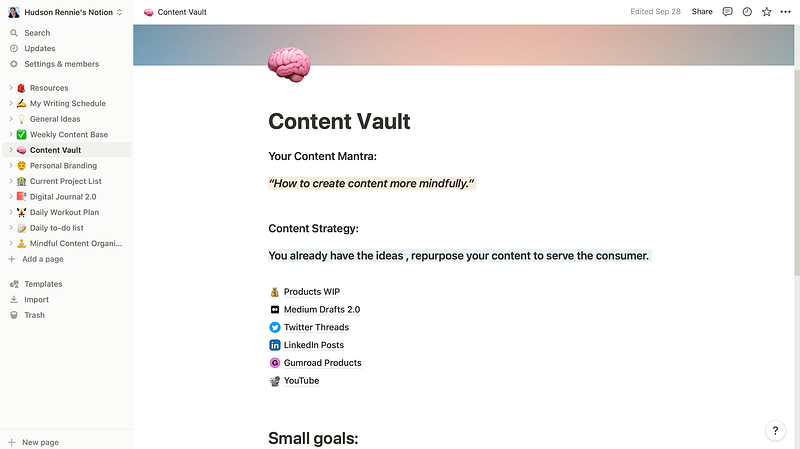
As an added bonus, what you look at on a daily basis becomes imprinted in your mind. It’s the science behind manifestation.
And, as if I hadn’t summarized “Moonwalking with Einstein” enough:
“The brain best remembers things that are repeated, rhythmic, rhyming, structured, and above all easily visualized.”
5. Remember to forget
I like to think of ideas as butterflies that float through the air and land on you every so often.
It’s important to have a net handy to capture them — and to keep your net empty, for new ones.
Lisa Genova is a neuroscientist who specializes in the art of forgetting:
“We tend to vinilize forgetting. But it’s a normal part of how our brain functions… we need to forget in order to remember.”
Humans are instinctively reactive creatures — and our base emotions often tempt us into holding onto too much information.
Fear of forgetting is a byproduct of modern culture.
Our brains are wired to only remember 3–5 pieces of information at a time. It’s called your working memory. Everything else is filtered through our subconscious. What’s important (i.e. anything that could help us survive or kill us), we remember.
Anything else, we forget.
But now, with so much information being pumped into us every day, it’s hard for our brains to process it all.
From (you guessed it) “Moonwalking with Einstein”:
“It is forgetting, not remembering, that is the essence of what makes us human. To make sense of the world, we must filter it.”
After storing ideas, remember to forget about them. You never know when a new batch of butterflies will come floating by.
If you remember anything, remember this.
I’ve been writing online for long enough to understand that there’s a high possibility you’ve skim-read up until this part.
I get it — it’s natural.
And, if you’ve read all the way to this point, I sincerely hope it’s been a valuable time investment thus far.
That said, this last practice is almost solely responsible for how mentally cleansing or cluttered my life is.
At the beginning of my week, I spend one-day batch-writing as much content as possible. Usually, I can manage to write:
- My week’s worth of Tweets
- My LinkedIn posts
- 1–2 article drafts
This helps me enter the week with a clear mind — open to receiving creative ideas and engaging with others mindfully. In other words:
- Creation
- Comments
On Mondays, I schedule all of my Tweets for the week using Twitter’s native Tweet scheduler:
👉 Here’s a quick tutorial on how.
As for LinkedIn posts and articles, I like to give myself a solid outline but put on the finishing touches, the day of.
This helps me plan ahead while remaining present.
Final thoughts: being mindful starts with being mind-empty.
I began this article with a secret, so I’ll end it with it a not-so-secret — social media isn’t going anywhere.
And if you’ve chosen a life of content creation, you must learn to embrace it — at least at first. To find calm amidst a storm, you must enter it willingly.
To summarize — create mass content mindfully by:
- Doing less, but better
- Using your brain for thinking — not storing ideas
- Keeping your content close — everywhere (and all at once)
- Creating acronyms to save mental space
- Storing everything on one page (see the big picture)
- Forgetting in order to remember
Finally, lead with passion — your greatest productivity hack.
Post note: I generally don’t write about writing as I have in this article. Instead, I prefer to share what I’ve learned about writing and creation on my YouTube channel.
👉 I’d love for you to subscribe, here.
Hi, I’m Hudson. I hope you enjoyed this story. If you did, consider becoming a Medium member. For $5 a month you’ll get unlimited access to stories like this one. Plus, you’ll be helping support me as a writer, as I will receive a portion of your membership fee at no extra cost to you. Click here to get started. (+1,000 karma points). ❤️🙏


