
I Make $1,000+ Per Month Writing Articles On Medium. I Hope This Helps You Do The Same.
3 years of learning condensed into 5 practical habits.

Back in 2019, I set out to fulfill my lifelong dream of becoming a writer.
I set up my Medium account, cracked my knuckles and prepared to go viral. I wrote my first article… crickets. Another… dead silence.
It wasn’t until August 2021, that I began getting the hang of things. After previously never having broken $10 in a month, my earnings shot up to $521.
→ Then, down to $236.
→ Then, back up to $1,000.
→ And, back down to $172.
After 3 years of roller-coaster payouts, I’ve finally learned what works and what doesn’t.
Most of all, I’ve learned that the effort involved in earning $10, $100, or $1,000+ per month is all the same. It comes down to focusing your energy on the habits that contribute to the greatest results.
I believe every writer’s journey and words are unique. So, this is not a lesson plan on how to niche down. Or, what words to use to go viral.
Instead, it’s a collection of 5 practical habits that have allowed me to develop as a writer while earning enough to continue doing what I love.
It’s exactly what I wish I would’ve had when I first started. I hope you too, will pay it forward in the future.
Life’s funny sometimes.
Last week, I shared that I don’t love writing about writing.
And the sentiment remains — I much prefer highlighting interesting stories and condensing life’s mysteries into little bumper stickers.
It’s why I started a YouTube channel — to share what I’ve learned without becoming a cog in the how-much-I-make-on-Medium wheel. So, this week, I sat down to film a video on the very topic you’re currently reading.
👉 You can watch the video, here.
But, shortly after turning on my camera to record, I realized that it’s much easier for me to think when I’ve written my ideas down.
A true catch-22.
So, as I had already written a video script, it would be a shame not to share it in written form as well — where it can help writers just like you.
Here are 5 habits responsible for any success I’ve found on Medium.
I truly believe habits are the key to success.
In anything you do.
There’s tons of advice out there on how to write better articles, what words to use, and hacks to grow your account.
Personally, I’ve never found any of these helpful because I believe writing is entirely personal. Some writers are data-driven. Others, write poetry or highlight the comedy in life.
When it comes to writing— there’s no one size fits all approach.
Instead of getting hung up on the “right” or “wrong” way to do things, I believe in creating structures that allow you to grow — to become the best you, you can be.
This is why I always prioritize flexible habits over rigid pieces of information.
Let’s get into it.
Habit #1: headlines
Headlines are the most important aspect of writing online. They’re the door that opens up the possibility for your words to be read.
You can construct the most amazing piece of writing in the world, but without an intriguing headline, no one will read it.
There’s tons of advice out there on how to write amazing headlines. Some of the most common being:
- Evoke emotion
- Use power words
- Tell the reader why they should read your writing
Personally, these weren’t helpful to me at the beginning of my writing journey.
This is because I didn’t know how to evoke emotion. I didn’t know what words were powerful. And I had no idea why anyone should read my writing.
To be 100% honest, the day I started writing online was also the day I began reading online.
It took me a long time to understand what people were looking for.
And, like most things in my life, I’ve always preferred to learn by doing. I didn’t begin to understand what headlines worked for me until I started prioritizing practice.
Here are 3 practical habits that allowed me to practice writing headlines and develop my own style:
👉 Writing on multiple platforms
👉 Using viral headlines as molds
👉 Analyzing and playing around with different styles
**I’ve linked and timestamped each of the habits above, to bring you to the correct part of the video.
Everyone has a unique style — and different headlines work better for different people.
So, maximize the number of reps you get and you’ll find yourself intuitively understanding what works for you.
Habit #2: publications
“Should you be submitting to publications?”
It’s the age-old question of Medium writers.
For me, the answer is yes. I’m someone who learns best by doing — but unfortunately, that can be a long and confusing road. Although tough at first, building a routine of submitting to publications gave me answers to questions I could have spent a lifetime searching for.
If you find the right publication, they will provide you with:
- Feedback
- A larger audience
- Help hold you accountable
Medium is unlike other writing platforms as many of its readers are writers themselves. This creates a collaborative community, but also creates a unique style of writing.
Publications can tell you exactly what works (and what doesn’t work) on Medium.
Some of my favourite publications in terms of their feedback are:
These publications get me the most eyeballs when I post with them:
- Illumination (controversial takes or ‘odd’ topics)
- In Fitness And In Health (diet, exercise, wellness)
- Better Marketing (business and marketing)
And here are 2 publications that will accept you as a writer, even if you have 0 followers:
👉 **I’ve added the submission guidelines to all of these to the description of this video.
If you’re struggling to gain views, and you’re not sure why, submitting to publications is a great way to get an objective point of view on your writing.
Habit #3: consistency
This word accounts for 90% of the current advice on social media, behind ‘motivation’ and ‘passion’.
And it’s true — consistency is one of the most powerful habits you can develop. It’s also the one habit that all social media algorithms on the internet reward.
But what so many people leave out is, ‘how’.
You can’t simply force yourself to do something long-term. And trying to, is a surefire way to burn out. So, my strategy for remaining consistent online has always been to:
- Lead with passion
- Remain mindful
- Focus on the journey
All of these make the habit of consistency enjoyable and rewarding. Something we’re all wired to want more of.
To see consistent growth on Medium, I recommend posting 2–4 times per week. Personally, 3 has been the sweet spot for me. Not too much, not too little.
Medium’s algorithm prioritizes users that are active on their platform, because let’s be frank, that’s Medium’s goal. They built the platform, they want you to use it.
Here’s how all social media algorithms work:
Think of a social media algorithm like a fire.
Content is kindling.
The more kindling you put on the fire, the hotter it burns.
Medium wants to set the world on fire — in the most beautiful way possible. So, feed the algorithm solid, sustainable, and consistent content to have your stories be pushed out to more readers.
Flaky, clickbait kindling looks nice on the outside but doesn’t burn for very long. And wet, heavy pieces of writing have potential, but need time to dry out first. Aim to create the best possible type of kindling, consistently, and your fire will burn hotter for longer.
**I’ll touch on a few ways to create ideal kindling in habit #5.
That said, we’re all busy. And pushing yourself to write too much takes the fun out of it.
Plus, let’s be honest, 90% of Medium writers write as a side hustle — and time is a valuable commodity. So, here are a few ways to remain consistent without burning out…
Write short-form articles to:
1. Practice writing headlines
2. Learn to convey ideas succinctly
3. Remain in the algorithm’s favour
A short-form article, is anything written in under 150 words (headline, image description, everything).
👉 I’ve added the submission guidelines to 2 short-form publications in the description of this video.
Repurposing content is another great way to maximize consistency without spending too much energy.
For example, If you’d like to publish 3 times per week, try this:
- Write 1 long-form article (800–1200 words)
- Write 2 short-form articles (outlining key points from the long-form article)
Lastly, start publishing at 80%.
This means once you’ve got your article to being pretty good (about an 8/10), publish it. This doesn’t mean overlooking spelling or formatting, but understanding that articles, just like life, will never be perfect.
Start publishing them when they get to pretty good.
This is also a great way to overcome publishing anxiety. You’ll find that what you deem to be an unfinished product often turns out to be your best-performing work.
Habit #4: engagement.
Here’s the truth about Medium — it’s a social media platform.
As much as we would all love to publish our amazing stories and have them be seen by thousands of readers, that’s just not the case. Especially when you first start.
The best way to gain readers for your stories is to engage with other writers on the platform.
If you think back to the fire analogy (above), posting without engaging with others is like dropping a log onto a fire and walking away.
It may catch fire, but it also may roll off the side and slowly fizzle out — even if it had the potential to go viral.
Engaging with others on the platform is like stoking your fire. It puts your content in position to potentially erupt into a burst of viral flames.
It’s important to create a routine of engagement around your posting schedule.
Here’s my routine:
Every time I post, I go back to my previous article and:
- Respond to every comment
- Go to the profiles of as many commenters as I can and engage with their latest story
**If you don’t have the time or energy to spread engagement to every commenter, aim for a minimum of 5.
Engaging, just like anything, is a skill you’ll develop over time. When I first started writing on Medium, it felt exhausting to engage with 5 people. Now, I sometimes respond and engage with 20–30+ at a time depending on how well my stories are performing.
Here’s how you should be engaging:
On Medium, there’s an unwritten hierarchy of engagement:
- 50X claps (good)
- Highlights (better)
- Comments (best)
Try to do all 3.
This has you show up on the users’ notification screen multiple times. Those little hits of dopamine add up and they’ll be more likely to remember you — and engage with your content.
Over time, you’ll build a network of writers who regularly engage with your articles— and you, theirs. This alone won’t make your stories go viral, but it positions them in the right spot to do so.
If you have zero comments on your previous article, do this:
Steal engagement from articles that have more.
Search for an article in your niche. You can do this by:
- Searching for a topic you write about
- Finding a random article from your homepage
The article isn’t important — just try to find one that was published within the last 3 months and has a few comments on it.
Use the commenters as your base for engagement.
**This will ensure you find commenters who are active on the platform. And, regularly leave comments on posts. This makes a big impact on your income.
Lastly, prioritize authentic engagement above all else.
Writing generic comments like “nice” or “great post” may get others to engage with your articles, but you won’t build real relationships. The best way to grow on Medium is to build a base of readers who genuinely enjoy your stories.
If you take the time to leave thoughtful, authentic comments, others will be more likely to do the same.
Since Medium pays based on member read time, this directly impacts your earnings.
If you look at the 2 articles below, you’ll see that not all views were created equal:
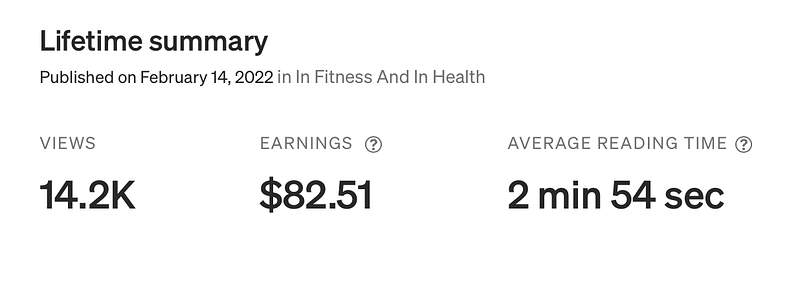
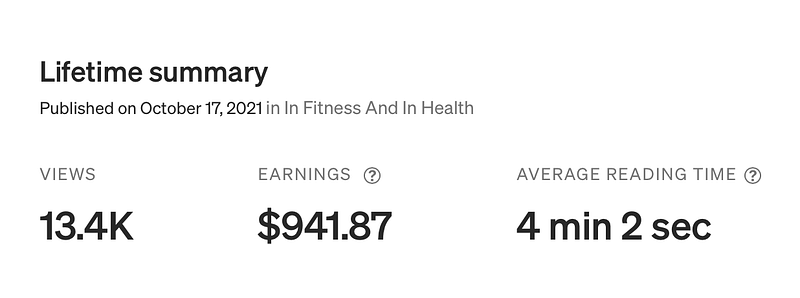
** The biggest factor that affects your Medium earnings is the total read time from paying Medium members. 💡
One of the best ways to increase read time, is by formatting specifically for Medium readers. Which brings us to our last habit.
#5. Formatting
Medium has a unique aesthetic, and thus, the need for unique formatting.
Personally, I love Medium’s look. It’s one of the main reasons why I’ve chosen to write on Medium compared to other platforms.
And formatting, is the second most important aspect of any article — after the headline.
Here are 3 quick and dirty tips to make your articles instantly more readable…
1. The top-down approach:
When I edit or re-read articles, I like to use what I call “the top-down approach”.
This means, after I’ve written my first draft, I read the article from start to finish as I edit.
This naturally forces me to focus more energy on the top portions of the article, which are the most important for capturing readers’ attention. The two most important parts of any article are:
- The headline
- The intro
Together, these tell the reader what they can expect and why they should stick around. They get the reader through the door — the rest of your story keeps them sticking around.
2. The 3-scroll rule:
The internet is full of subtle cues.
And one of the best ways to get readers to stick around is to entice them to continue reading. I use what I call “the 3-scroll rule” to subconsciously attract readers’ eyes to continue moving down the page.
To do this, never let a reader scroll more than 3 times without seeing a change in formatting. This could be:
- A new heading
- Subheading
- A quote
- Bullet points
- A numbered list
Lastly, the most basic and essential formatting tip I can offer…
3. The 5-line rule:
Here’s the truth about the internet — it’s full of skimmers.
People skim first, to see if your story is worth reading. Then, if they deem it worthy, they read it. Large chunks of text overwhelm readers and cause them to exit your story. Creating lots of white space on the page lets your words stick out.
It’s the same psychology the Apple retail store uses— everything is displayed on a white background so it stands out. You can create more white space by doing this:
As a rule of thumb, never have any paragraphs exceed 5 lines (on a desktop computer).
This will help your articles be more skimmable, and thus, more readable.
Lastly, optimize for mobile. Before hitting publish, send yourself a draft link and open it up on your phone. Scroll through your article and make sure it is easy to skim on mobile. Most readers read articles on their phones.
Final thoughts: thanks for reading (and watching)
I’m at a crossroads in my writing journey.
My goal is to become the best writer I can — but I also remember how hard it was when I first started. And lately, I’ve felt a pull to share what I’ve learned with newer writers.
So, I hope this article helps expedite your writing journey.
Although I can’t promise I’ll continue writing in-depth tutorials like this one, on Medium, I can promise this:
I will continue sharing what I’ve learned, on YouTube.
My final advice is to enjoy the process. If your goal is to make money doing something you love, make sure you love it, first.
Focus on the journey and the destination will take care of itself.
Happy writing! :)
Hi, I’m Hudson. I hope you enjoyed this story. If you did, consider becoming a Medium member. For $5 a month you’ll get unlimited access to stories like this one. Plus, you’ll be helping support me as a writer, as I will receive a portion of your membership fee at no extra cost to you. Click here to get started. (+1,000 karma points). ❤️🙏


