BUSINESS
How to Reinvent Your Business Before it Collapses
Pay attention to those S-curves

Successful companies don't sit by and wait for markets to stall. No. The best companies never sit idle until their growth stagnates before taking action.
Top leaders make their next business move way before this happens. They see success as a warning sign, as such, they innovate during times of prosperity. Always one step ahead.
“The arrogance of success is to think that what we did yesterday is good enough for tomorrow” — William Pollard, Physicist, Director of Nuclear Studies
Leaders are not in the business of Energy, Telecoms, IT, SaaS, eCommerce, retail, Banking … I could go on … the fact is:
Leaders are in the business of innovation.
This article highlights key points from the research undertaken by Paul Nunes and Tim Breene, leaders at Accenture’s High-Performance Business Research.
What is the S-Curve?
It’s basically your business lifecycle. A road that innovative high performers often probe and test to map out a new path, as illustrated by Nunes and Breene in the image below.
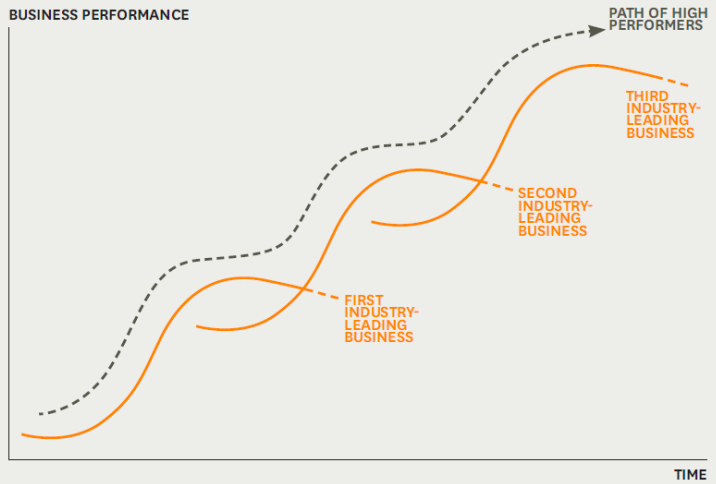
The fact is, high performers, think strategically before disaster strikes. Their skill reflects what Tidd & Bessant proposed in 2009, a four-stage process:
- Search
- Select
- Implement
- Capture
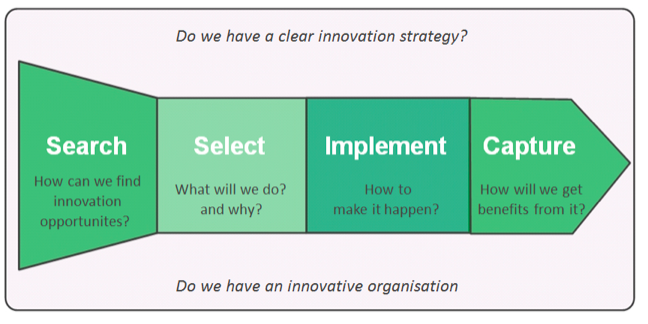
High performers are constantly observing, searching and selecting from the world around them, a typical growth mindset trait.
They’re paranoid.
“Success breeds complacency. Complacency breeds failure. Only the paranoid survive.” — Andrew Grove (Co-founder Intel Corporations)
Managing and communicating this process is another skill that top leaders and high performers perfect, discussed in the article below.
Hidden Competition Curve
These business performers also focus on finding “hidden S curves”, trying to anticipate or predict changes in consumer needs, creating the next level of competition. They are Anticiparory leaders.
Think of Netflix, Google, Amazon or Airbnb for example.
- Hidden Capabilities Curve — Create distinctive capabilities, developing offerings to “climb the financial S curve”. Example: Wal-Mart.
- Hidden Talent Curve — Sourcing ‘serious’ talent to bring on board while retaining talent. For example, “Apple identifies key talent in universities like MIT and brings them to their organization” (Nunes et al, 2011).
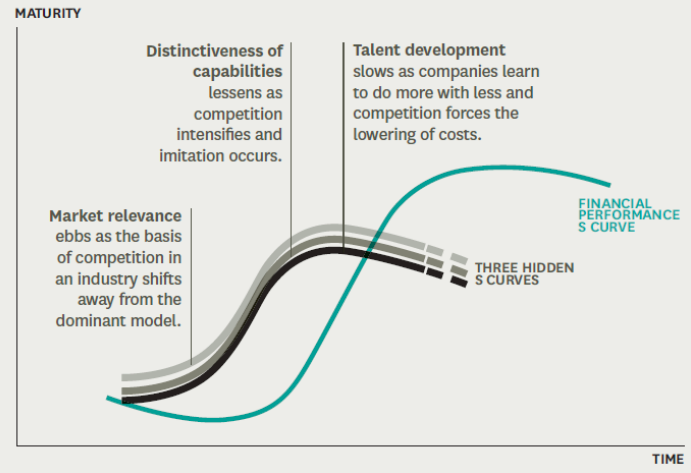
Clearly “high performers have already begun the reinvention process” long before a market decline is underway (Nunes et al, 2011).
“High performers recognize that a key to building the capabilities necessary to jump to a new financial S curve is the early injection of new leadership blood and a continual shake-up of the top team.” — Nunes & Breene
New blood reinvigorates organizational thinking, a typical trait that startups and entrepreneurs demonstrate — market niche explorers.
Final Thoughts
To conclude, Paul Nunes and Tim Breene left us with key behaviors that successful leaders share, as follows:
- They balance short-term and long-term thinking
- They scan the market to prepare for challenges ahead
- They hire the best talent, new-blood based on cultural fit
- They encourage follower autonomy, allowing employees room to grow
“The leader-follower dynamic is complex, as followers often play multiple roles in their relationship to leaders. Positive followers often help set the standards and formulate the culture and policies of the group.” — Warren Bennis, The Art of Followership
Companies battered during an economic downturn must take on business reinvention now. “Retrenchment, belt-tightening, and a redoubled focus on selling” is not the answer. It’s a knee-jerk reaction. (Nunes et al, 2011).
Economic slowdowns “call for increased preparation to jump the S-curve for two major reasons” because:
- Recessions result in “downward pressures on revenue growth.”
- Reduced “sales and increased discounting” squash revenue growth S-curves, “so companies have even less money to invest in new initiatives than” before (Nunes et al, 2011).
Reinventing your business before a recession is an ideal strategy, but it’s never too late. Even during a recession. So pay attention to those S-curves!
References
- Nunes, P., Breene, T., 2011. Reinvent Your Business Before It’S Too Late. [online] Harvard Business Review. Available at: https://hbr.org [Accessed 15 April 2020].
- Nunes, P. and Breene, T., 2010. Jumping The S-Curve. [online] Accenture.com. Available at: https://www.accenture.com [Accessed 17 April 2020].