
How To Protect Yourself From Another Sociopath
It’s not just about learning how to spot one: it’s about understanding what it is about you that makes you so attractive to them.
*name changed at the request of the interviewee
“When someone suggested a friend I’d known for many years exhibited signs of having an antisocial personality disorder (ASPD) I felt naive and gullible,” says Brandon Greenwauld*, a 36-year-old accountant from the Mid-West.
“Why did others know about this stuff and I didn’t? My immediate thought was to take two practical steps: find out as much as I could about ASPDs, and then tell the world to avoid this person. Only now did I realize how much of my life he had controlled for so long.”
“The second step is what I did first and that was a mistake. You can’t tell the world to avoid someone. It’s not your place to. And doing so allows that person to continue controlling your life. So instead I began the research. After three months of reading books and websites, the last ten years of my life suddenly made sense.”
Blame game
Brandon smiles. “It was like a revelation. I felt great because I now understood the sociopathic character traits this man had exhibited, and how they explained so much about his behavior and attitude towards me. Relieved now I had this wisdom, I thought I could blame all my unhappiness and emotional turmoil squarely at his feet. He was to blame. He caused it. All those books and websites said so. I could now get on with living my life, properly this time.”
“Except I couldn’t.”
Brandon shuffles uncomfortably in his chair. “I was angry. Angry with him, yes, but, as time wore on, I realized I was also angry with myself. It was only when I finally understood this, that, strangely perhaps, my accountancy training kicked in.”
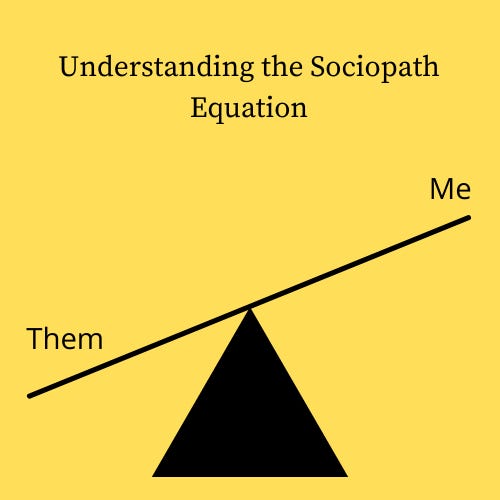
“I’ve always been good with numbers, you see, perhaps more so than with people. All mathematicians tell you that you have to evaluate both sides of an equation to fully understand it. That’s where I was going wrong. To move forward mentally, emotionally, practically, and positively, I needed to learn more about myself.”
“I’d learned everything there was to know about the psychology that motivated my ex-mate, so I fully understood his side of the equation. But what about my side of the equation? What was it about me, that allowed him to control so much of my life?”
Them against us
Brandon’s journey is understandable. Historically, the term sociopath described people who manipulated, exploited, or violated the rights of others for their own gain. Search the term online and over thirty million results will be returned, with many describing the top characteristics of these people for others to watch out for.
“My initial thoughts during the early stages of my research were ‘it’s them against us’,” says Brandon.
Today, the understanding of sociopathy is growing and psychologists now diagnose these people as falling somewhere along an antisocial behavior disorder spectrum, depending upon the number of antisocial personality characteristics they display.
Psychologists continue to investigate why people exhibit such characteristics and debate how best, or whether it is even possible, to help them. In the meantime, those left in the destructive wake of these people, like Brandon, have to begin rebuilding their lives. That’s easier said than done.
According to Donna Andersen, author of the book Red Flags of Love Fraud and its associated blog and website, the first step is to make the decision that you’re going to recover. And this doesn’t just happen. It takes hard work and determination because involvement with sociopaths can cause incredible amounts of damage — psychological, emotional, physical, financial, and spiritual. Rebuilding is a process, and it will take as long as it takes.
Brandon agrees. “I didn’t realize it would be such hard work. Once I understood everything about sociopathic behavior I thought I could move on. Armed with this knowledge, I knew what to look out for, therefore, I couldn’t be so stupid again, could I? That’s how I thought I could protect myself from people like this in the future.”
Targeted and groomed
In The Sociopath Next Door, Dr. Martha Stout estimates that one in 25 of the American population might have an anti-social personality disorder. Some fellow psychologists think this is a conservative figure, whilst others feel it is an over-estimation. Whatever the true statistic is, the disorder affects both men and women so anyone can find themselves involved with such people. In fact, rather than being involved, Dr. Stout suggests sociopaths target people. Target might seem dramatic, but Brandon believes he was targeted and groomed.
“I’d recently moved to the area and was looking to connect and integrate into my new community. It was a small town kinda place. The kind where everyone spots a new face within minutes. This person lived in the same neighborhood and turned up on my doorstep to welcome me to the area with a few bottles of beer and an invitation to come over for a chat one night. He was warm and friendly. We kept bumping into each other at bars and social gatherings — easily done in a small town — and the friendship grew from there. He was completely charming. One of those guys that everyone in town knew.”
Charm is a key characteristic. As Martha Stout writes in The Sociopath Next Door, “Most of the victims I have known in my work have reported that their initial involvement with a sociopathic person, and their continued association even though she or he caused them pain, was a direct result of how charming she or he could be.”
“I now realize,” says Brandon, “that I fell for this charm easily. In fact, I wanted to be charmed. I was keen to make new friends, after all. He was giving me what I wanted. He was easy to talk to and easy to confide in.”
Other antisocial personality disorder character traits include a pretentious sense of self. These people believe they have better rights than others. They lie, obsessively, telling huge untruths alongside smaller lies. Some psychologists believe these people are incapable of telling the truth. They become bored quickly and can react angrily, for no reason at all, simply in order to create some excitement. They can be unreliable, act irresponsibly, lack empathy, and often have no life plan.
“When you meet new people, you don’t expect them to lie,” says Brandon. “Or rather, it never crossed my mind that they would have any reason to. So whilst some of the things he told me made him sound interesting, they were also plausible. However, I now appreciate that this is because I am more willing to accept what people tell me. My default position is to trust others. Having this general trust in people means I don’t question what I’m told as much as I should do.”
Pity play
It’s this trusting nature that sociopaths seek out in others. “The best clue is,” Dr. Stout continues in her book, “of all things, the pity play. The most reliable sign, the most universal behavior of unscrupulous people is not directed, as one might imagine, at our fearfulness. It is, perversely, an appeal to our sympathy.”
For Brandon, this was the key to recovery. “I fell for the pity,” he says, “and that’s down to who I am. He always sought pity. He’d been seriously ill a few years ago, which had cost him his job and subsequently his savings. His life was always worse than anyone else’s. He was always fighting the authorities for services he believed he had a right to, because, he claimed, they did little to support him.”
“I, like many others, offered him solutions, yet he never acted upon them. Of course, had he done so, then he couldn’t have sought the pity he constantly craved. The pity play made him the center of attention.”
“I’m sympathetic. I’m a listener. I like helping people. I like to think of myself as one of those mates you can rely on. Be there, night and day for a buddy. That’s why he latched on to me,” says Brandon.
New Equation
At this point, he smiles. “I discovered a new equation. Niceness equals the benefit of the doubt.” His smile broadens to a grin. “If you’re nice you’re naturally more inclined to give people the benefit of the doubt. If I had a dollar every time someone told me I’m a nice guy I wouldn’t need to be an accountant!”
He chuckles. “I always laughed it off, joking that being the nice guy was boring. It’s the exciting people that others want to be around. However, this whole experience has taught me two things: I should be proud of my niceness, but I must remember it makes me vulnerable, too.”
Niceness is a vulnerability unscrupulous people will abuse. Nice people feel guilty about thinking the worst of someone, even if deep down they sense something is wrong.
“There were times when my gut instinct told me something wasn’t quite right, but my niceness always pushed it to one side,” Brandon recalls. “He’d snap at me, without justification. He’d somehow manipulate things so I paid for everything. He volunteered my services to others, without asking me first.”
“My gut instinct told me to speak up, but then my niceness would kick in. His pity-seeking tales suggested his life was far worse than mine. So why should I berate him for what was, as I understood them, quite minor points compared with the problems he had to deal with on a daily basis? That’s why I remained quiet.”
Gentle, quiet, nice people are out of their comfort zone when conflict arises, so many do whatever they can to avoid it. The sociopath knows this and exploits it.
The future
The best way to change things is to make a complete break. You can’t reason with a sociopath. Cut all ties.
It’s not easy, as Donna Andersen explains in her book. You have to sever all ties because if you don’t every contact is an opportunity for them to draw you back in. And a sociopath enjoys that sort of psychological game. (Because that’s all you are to them. A game.)
Cutting all contact will allow you to process the emotional pain, grief, anger, and disappointment of everything that happened. It’s like peeling the onion. As you release some pain, more will rise to take its place. Keep going.
At the same time, you must do whatever you can to take care of yourself and be good to yourself. Eat well. Get exercise. Commit to yourself and you can recover. You won’t be the same as you were before the involvement. Sociopaths always leave scars. But, with the right support, you have the opportunity to be better. You can turn the experience into one of wisdom, compassion, and growth.
Brandon nods. “Whilst it was important for me to learn about these people, taking the next step was vital. I had to use the experience to learn more about myself.”
“To understand an equation you need to comprehend both sides. And I do now. First, I focussed on him. But to move on, I needed to focus on myself. I’m a wiser person. I have a better understanding of who I am and why I make the choices I do. I now know what my vulnerabilities are and how to protect myself from them.”
“I’ve learned to trust my gut instinct and to act upon it. I used to think of that friendship as a troubling time of my life. Now, I see it as the time that enabled me to learn more about who I am. I’ve moved on. As Napoleon Hill once said, ‘Every negative event contains within it the seed of an equal or greater benefit.’ Now there’s an equation I can identify with.”