
How To Progress In The Journey Of Mastering Calisthenics
4 simple pieces of advice that will make your calisthenics journey easier.
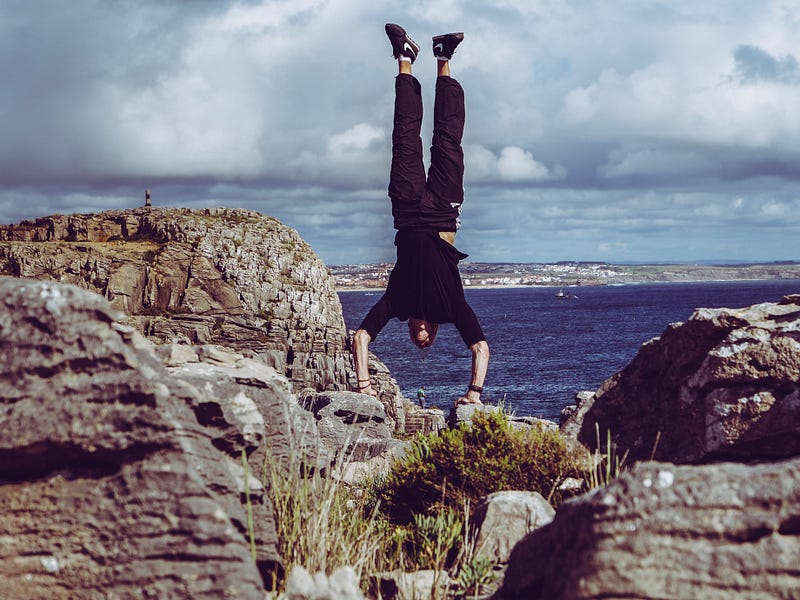
Not everyone in fitness would want to learn calisthenic skills but everyone into calisthenics definitely wants to learn at least some of those intriguing skills like the muscle-up, handstand, flags, levers, or the beast, the planche.
I have also learned some of the calisthenic skills like the dragon flag, the L-sit, skills mostly based on the core strength, and currently working on handstand and building up my straight arm strength to train for some advanced skills like the human flag and front and back lever.
With myself involved in strength and skill training, I think I can provide some valuable insights from my journey to make things simpler and help you progress in your calisthenics journey a lot faster than I did.
With that said, let’s get to business.
Master the basics
The most important aspect of any type of training. If you can’t do at least 10 shoulder taps, how will you do a single pike press? and if you still try to do it with a sloppy form, you are definitely on the path of ruining your body.
First and foremost, you must get to know which muscles are involved, feel them working, gather strength in that region, then proceed to higher levels.
What does any skill comprise? Pushing, pulling, balancing, or a combination of them, right? So master the pushing and pulling exercise before heading to any skill, i.e., get your push-ups, dips, pull-ups, and rows right. Why these four? Because they are the fundamental movement patterns, i.e., horizontal and vertical push and pull, respectively.
If you can perform these four exercises in perfect form, i.e., all your body in a straight line, you are good to take your workout to next level and practice difficult variations like pike press, handstands, archer push-ups and pull-ups, and so on.
Core is king
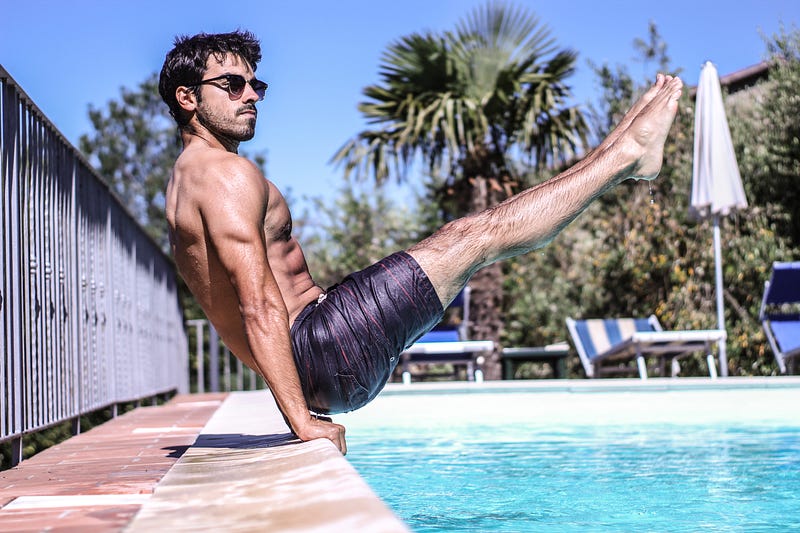
We know that balance is also a crucial part of basics. And what in the entire body is responsible for your balance and stability? Your core. A strong core will help you stay upright and maintain the straight line perfectly.
Our core is used extensively in almost every skill. Be it planche, front or back lever, any flag, or even the simple movements like push-ups and pull-ups. A strong core can easily stabilize your body during the movement and help you achieve your max strength during your training.
A weak core is a home to most of the major fails
And if you think only six-packs mean a strong core, then my friend, you are wrong. A strong core will definitely lead to a six-pack ab if you are at a low-fat level but it’s not vice versa.
Six-pack ab is just a part of the whole. Your obliques contribute to the core, your glutes and hip flexors contribute to the core too. In fact, there are two types of obliques, internal obliques and external obliques.
Train with weights and resistance bands
In calisthenics, with a lot of compound movements, there’s always a chance that you miss out on some small muscle groups. For example, your lateral delts often remain undertrained during your workout. Weighted isolation is one of the best ways to increase strength in such a region.
Training calisthenic movements with a weighted overload is also a good idea. For example, my favorite, weighted pull-ups, its benefits might astonish you. Moreover, once you have the strength to lift a heavyweight, like around 20% or above of your body weight, you will feel no weight during normal pull-ups, at least for a few reps. At least I feel like I am high on something when I drop off all the external weights and perform normal pull-ups.
Similarly, resistance bands can also make exercise challenging, but more than that, the biggest advantage of training with bands is to feel those movements that you otherwise can’t. What does that mean? You can make things easier using resistance bands.
If the sole purpose of resistance band is resistance, why not use it to our advantage i.e., resist the gravity?
You can make any movement easier using resistance bands like if you’re training for muscle-ups, you can use bands to get yourself above the bar. And if the assistance is just enough for you to hold the right form, you can use it to strengthen the required region too.
It’s a journey, treat it as a journey

You won’t learn any skill in a few days. Some of them even take as long as a year or two to master. For some, planche may even take a few years to master.
It’s completely a game of levers. Starting with tucked holds, lengthening the lever be opening up the body, and finally performing with a straight body. It all just can’t happen in a few days. You need to put in constant effort for a long period of time.
Master the easier variations, level up, move to a difficult variation, master it, move to a harder one, and so on at your own pace. That’s what the journey of mastering calisthenic skill really is.
The Takeaway
- Basics first.
- Your core stabilizes your body and lets you achieve your max strength, train it effectively to progress faster.
- Make exercise difficult by using weights and use resistance bands to make things harder or easier.
- It’s a journey, it will take time.
So those were the 4 pieces of advice that may help you progress faster in your calisthenics journey. I hope this was helpful, and you enjoyed reading it.
Thanks for reading!!
If you liked it, you may also like…

You just read another post from In Fitness And In Health: a health and fitness community dedicated to sharing knowledge, lessons, and suggestions to living happier, healthier lives.
If you’d like to join our newsletter and receive more stories like this one, tap here.