
How To Present Past Projects In A Data Science Behavioral Interview
Data Science interview processes can vary depending on the company and industry domain you are applying to. Typically, they start with a behavioral interview with the Hiring Manager or an HR member followed by a technical interview with the team leader and then a coding test and another technical interview with your future team members.
This process can vary from one company to another, however, a common first step in the hiring process is the behavioral interview. You can know more about the hiring process of data science in this article:
A behavioral interview is a job interviewing technique where candidates are asked to describe past performance and behavior to determine whether they are suitable for a position. The main goal is to know the type of person you are and to see whether you will be a fit with the company culture, core values, and team members and whether you will satisfy their vision and goals or not.
In the previous two articles of this series :
- What To Expect In A Data Science Behavioral Interview
- How To Introduce Yourself In A Data Science Behavioral Interview
I discussed what is a data science behavioral interview and what to expect in it and how to answer the first and the most common question in a behavioral interview which introduces yourself or tells me more about yourself. You can have a look and explore them before start reading this article:
Another common question that you will be asked during a behavioral interview is to represent or talk about an interesting, impactful project you did in the past, whether it is a side project, a project with your previous company, a freelancing project, or a portfolio project.
It is important to structure your project beforehand to be organized, keep the recruiter engaged, and get the most out of this opportunity. A common structure to reach these goals is to start with the goals and the impact of the project, then the challenges both technical and non-technical ones and end your presentation with interesting findings and insights you got out of this project.

Table of Content:
- How To Structure Your Project? 1.1. Start with Goal & Impact 1.2. Overview of The Project Outline 1.3. Discuss Challenges 1.4. Share Interesting Findings
- How To Make Your Project Sounds Interesting? 2.1. Refine Your Project To Sound More Interesting 2.2. Remove Useless Details 2.3. Prepare for Follow-up Questions 2.4. Engage the Interviewer
- How To Give Presentations Effectively? 3.1. Focus on Your Role 3.2. Present Your Best Project 3.3. Prepare for Follow-up Questions 3.4. Be a Good Listener
If you want to study Data Science and Machine Learning for free, check out these resources:
- Free interactive roadmaps to learn Data Science and Machine Learning by yourself. Start here: https://aigents.co/learn/roadmaps/intro
- The search engine for Data Science learning resources (FREE). Bookmark your favorite resources, mark articles as complete and add study notes. https://aigents.co/learn
- Want to learn Data Science from scratch with the support of a mentor and a learning community? Join this Study Circle for free: https://community.aigents.co/spaces/9010170/
If you would like to start a career in data science & AI and you do not know how. I offer data science mentoring sessions and long-term career mentoring:
- Long-term mentoring: https://lnkd.in/dtdUYBrM
- Mentoring sessions: https://lnkd.in/dXeg3KPW
Join the Medium membership program for only 5 $ to continue learning without limits. I’ll receive a small portion of your membership fee if you use the following link, at no extra cost to you.
1. How To Structure Your Project?
To be able to present your projects effectively and in an engaging way, you should have its structure before the interview and know exactly what you will focus on and what details you will need to cover, and what you would just ignore. In this section of the article, I will discuss how to structure your projects effectively so that they leave a good impression and make you a potential candidate for the company:

1.1. Start with Goal & Impact
The first aspect of the project you should start with is the project goals and impact. Summarizing the goal and the motivation behind the project in one then you can provide more context in the next sentence. After that, you can talk about its impact on the business or your previous company for example: What did you/ your company achieve through this project?

Starting with the goal of the project and the impact this project has whether it is on the company or the business or people's life will show that you have a goal-oriented mindset and you understand the importance of data science in the business context and will also keep the recruiters engaged with you throughout the rest of the presentation.
Also to keep the recruiter engaged you can ask him whether he would like more information about the context of the project and more technical details or to complete describing the project challenges.
1.2. Overview of The Project Outline
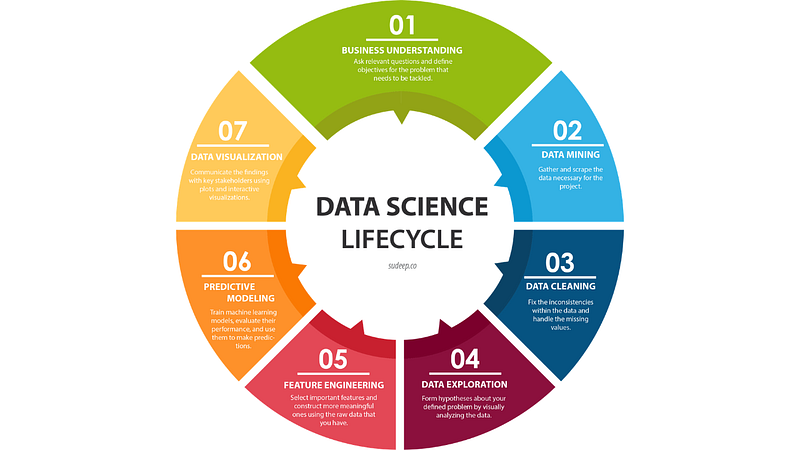
The second aspect of the project you should focus on is providing a technical overview of the project. I always like to follow the general data science project life cycle when I present my projects which include the important steps of a data science project and discuss your approach in each of these steps:
- Clarifying the problem and constraints
- Data collection
- Data cleaning
- Data exploration
- Feature engineering
- Modeling
- Model deployment
You can find more information about the data science life cycle in these two articles:
1.3. Discuss Challenges
The next thing you should mention is the faced challenges while working on this project. This is important as it shows how you can solve potential problems while working on a project which shows that you are a qualified candidate that can solve these problems. It is important to focus on both kinds of challenges both technical and nontechnical challenges.

There are two main types of challenges you should focus on:
- Technical challenges: All practical challenges and problems related to data science. Examples of technical challenges are defining success metrics, obtaining data, dealing with a big dataset, pre-processing the data, training, and modeling the data.
- Nontechnical challenges: Problems related to project management, coordination, and leadership. Examples of nontechnical challenges are objections from other teams, dealing with underperformance teammates, delivering projects on time, and communicating with non-technical audiences.
After finishing ask the recruiter if he would like to hear more or to further discuss the challenges you mentioned. If not and you still have time you can go to the last step and share interesting findings from your project.
1.4. Share Interesting Findings

The final step is to share interesting findings and how you managed to achieve the project goals. This is important to conclude your presentation with as it shows that you can achieve the project goals and work on an end-to-end project. Also, you can share what you have learned from working on the project.
2. How To Make Your Project Sounds Interesting?
Having your project structured in this way will keep the recruiter engaged with you in all the details and will lead to a better project presentation that shows your qualification for the job without missing any important detail. However, what you will do if you do not have an interesting project?

In this section, I will discuss four tips to make your project sounds more interesting and to keep the interviewer engaged.
2.1. Refine Your Project To Sound More Interesting
One of the important tasks to do before the interview is to refine the project to sound interesting and to be able to tell a good story it. Even if your project is important and impactful, the way you tell it is very important. This might require adding or subtracting details depending on the interviewer's background and experience and depending on the project and its context. Also, try to make it a story as this always attracts human attention and makes anything sounds more interesting.
2.2. Remove Useless Details
Although giving too many details might show that you have good hand on, and technical skills and you might think it shows your passion for the field and the work. However, it might prevent the interviewer to follow up with you and make him lose interest especially if he does not enough technical background.
This will also give the impression that you have weak communication skills which is a critical skill for data scientists. You should focus more on your contributions and highlight your role in the project, if it is an individual project then focus on the three mentioned points above: the goal and impact, the challenges, and the interesting findings. Also, remember that you do not have to follow the timeline of the project as happened while working on it. Summarize and make a good story out of it.
2.3. Prepare for Follow-up Questions
Usually, the interviewer will have to follow-up questions regarding your project, especially if you were able to grab his attention. Preparing your answers for expected follow-up questions is very important as not being able to answer them will leave a bad impression on you.
2.4. Engage the Interviewer
Avoid talking nonstop for a long time, this will let him to lose interest as he will not be able to follow up. To keep him engaged make sure to take pauses and ask him if he has any questions or comments. Also, it is important to prepare your project description based on the interviewer. Typically, the recruiter tells you beforehand who will be interviewing you so you can be prepared. If the interviewer is a technical manager or team leader then it will be good to share more technical details, but if he is an HR member then it is better to focus on the impact and the challenges and how you overcome them and the cooperation with the team and more nontechnical details.
3. How To Give Presentations Effectively?
Communication and presentation skills are essential skills for data scientists, as you will have to report insights from data and ideas to stakeholders, marketers, and others who will have different backgrounds, therefore it is important to emphasize these skills during the interview. That’s why many companies ask potential candidates to give presentations during interviewing for data science positions to make sure that they have this skill at the required level.

In this presentation, you have to show not only your presentation and communication skills but also your sales skills and how you can sell your ideas and convince the stakeholders with them. This is important, especially for senior-level data science positions.
3.1. Focus on Your Role
Focus on your role and your contributions to the project. Use metrics and numbers to show this, especially the ones related to the business such as how much your work has increased the revenue or increased customer retention by how many percent. If the project you worked on has no direct business metrics to report, you can formulate its impact to be understood by a non-technical audience for example your work improved team efficiency by building or improving a data pipeline.
In addition to that, you should avoid the details that do not show your impact on the business. For example, you have improved the model performance with a certain percentage is a good impact, but you have to translate this to business impact. Try to stick to metrics that are clear to someone without a technical background.
3.2. Present Your Best Project
This tip seems to be obvious, but it is important to understand what best work means in this context. The best project here means the project that you can show most of the required skills for this position. It is not necessarily the most successful project, the biggest project, or the most complicated project from a technical perspective, but it should be the project with the most challenges, as it can show how you can solve problems and overcome different technical and non-technical challenges.
Examples of these challenges could be in defining and understanding the business problem, collecting suitable data for the project, working with large datasets, having difficulty with model training and deployment, working with an underperformance team member, having difficulty communicating your ideas, and having strict deadlines.
3.3. Prepare for Follow-up Questions
Commonly, the audience will have to follow-up questions regarding your presentation, therefore it is important to prepare for expected technical questions as not being able to answer these questions is a red flag you need to avoid. Therefore, make sure that you are comfortable with all the technical details of the project you plan to present. You can expect questions similar to the following:
- How did you convert categorical variables and why did you have chosen this method
- Did you have long-tailed distribution and how did you handle it
- Did you need to be concerned about overfitting when you use this tree-based model?
3.4. Be a Good Listener
It is important to show openness to suggestions, questions, and criticism. Take your time and make sure to understand their inquiries and answer them and do not be offended by different opinions or points of view from yours. Do not be offended by other critics as this will show that you will not be a good coworker, instead admit the limitation and mistakes and discuss how could they be improved and avoided in a future project. You should balance confidence and capability and value different opinions and perspectives.
Loved the article? Become a Medium member to continue learning without limits. I’ll receive a small portion of your membership fee if you use the following link, at no extra cost to you.
Thanks for reading! If you like the article make sure to clap (up to 50!) and connect with me on LinkedIn and follow me on Medium to stay updated with my new articles.