
How to Plan a Trip in 3 Easy Steps
Planning a trip doesn’t have to be stressful
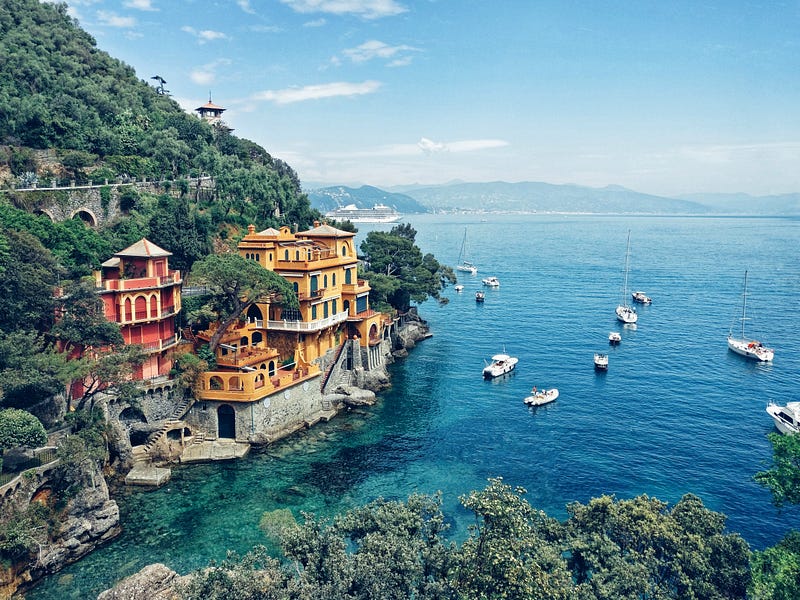
I traveled a lot as a child. And I never realized the time and effort it took my parents to plan these trips.
As an adult, I had to learn how to plan a trip for myself. And, at first, I found it incredibly stressful. I never knew where to start. I always felt like I was forgetting something. I got my dates confused and booked things on the wrong days.
Recently, I moved to Europe temporarily. And I decided to make the most of our time here. That means visiting a lot of new places and, therefore, planning a lot of trips.
I have found ways to make that process a lot less stressful. Here’s how.
Get inspired and make an itinerary
You have a destination in mind. It’s probably a place you’ve never been to before. Therefore, the first step is to get inspired.
Talk to someone who has been there before or lives in that place to get tips on what to do and what to see.
Read books or blog posts.
Decide what type of holiday you want. Do you want to spend your time sunbathing on beautiful beaches? Do you want to eat incredible local food? Are you more interested in nature or cities? Do you like shopping or museums? Do you want to explore or relax? Or a mix of both?
Once you have decided what you want and done your research, you’ll have a list of things you want to see. Use that as the basis of your itinerary.
Use a map to figure out what order you should do things in based on their distance relative to one another.
Personally, I like to use Google Drive to plan my trips.
My itineraries start as a rough draft on Google Docs. It looks a little bit like that:
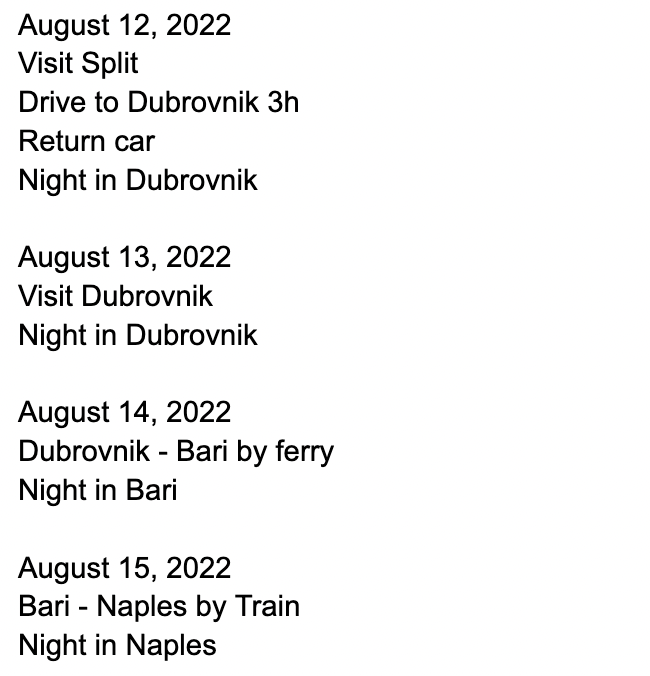
Day by day, I cover where we will be, how we will get there, any activities we might do, and where we are sleeping.
This allows me to have a reference I can always go back to when I am booking transportation and accommodations.
Once I have this rough itinerary, I can proceed to the next step.
Book transportation
Once I have determined where we will go and on what days, I book transportation.
It’s important to book transportation before anything. You don’t want to find yourself in the situation of having booked a hotel, a show, or an activity only to find that the only flight available arrives one day later.
For example, if we go back to the itinerary screenshot above, I had planned on us taking a ferry between Dubrovnik and Bari on August 14 and spending the night in Bari. I had briefly checked the ferry website to find that ferries typically ran during the day and arrived late in the evening in Bari. That plan, therefore, made sense.
However, when I looked at the specific date I was interested in, I found that no ferry ran that day. I was only able to get one the next day and it is a night ferry, which means that we do not need to spend the night in Bari and we can take the train to Naples directly the next morning when we arrive.
If I had booked my hotel in Bari before having booked transportation, I would have had to cancel, which is not always possible. And, even when it is, it can often be a hassle.
Booking transportation can be as easy as booking a flight or train to and from your destination. It can involve renting a car. Or, if you are going on a multi-stop trip like I am, you may need to book flights, trains, ferries, and rent cars throughout your trip.
Your itinerary helps you stay organized and remember which dates you need transportation to where.
Once you have all your transportation booked, you can move on to booking accommodations.
Book accommodations
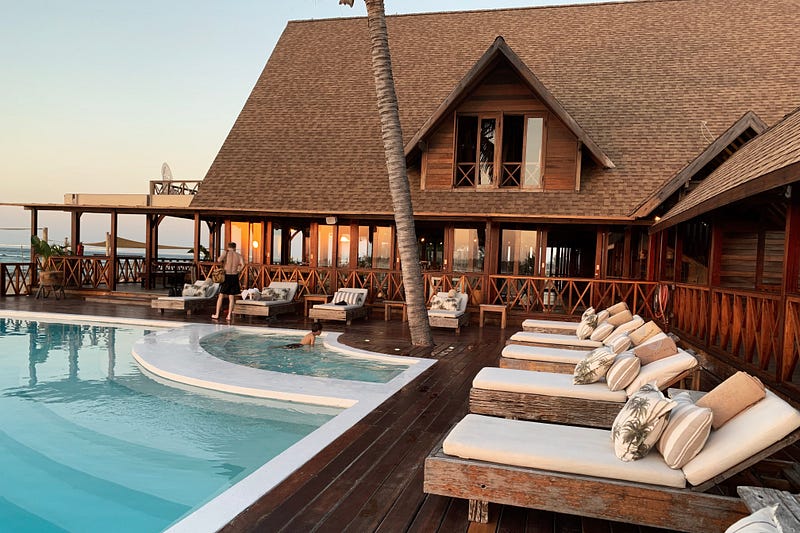
The second most important thing after how you are going to get places is where you are going to stay when you get there.
Depending on the type of trip you are taking, there is a great variety of accommodations to choose from, from campsites to luxury resorts, log cabins to medieval castles.
You can choose to book hotels, Airbnbs, bed&breakfasts, or any number of types of accommodation. Most websites provide customer feedback to help you with your choice.
I like using travel guides, such as Lonely Planet, to decide where to sleep. I often find the number of choices overwhelming. A travel guide will give you a smaller list of recommended places to stay, which might make the process easier.
When I have all my transportation and accommodation booked, I build a more detailed itinerary. It allows me to keep track of everything, including my budget and specific timings.
Here is what it looks like at this point:
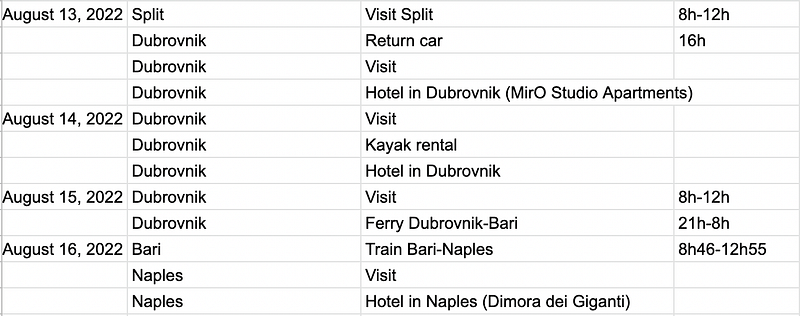
It includes dates, locations, hotel names, train/flight timings, costs, whether things have been booked/paid and sometimes links to websites (for the kayak rental for example).
Book restaurants/attractions
Once you have all your essentials booked, you can start getting into the finer details of your trip.
I personally prefer not to have a strict itinerary once I get to my destination. I want to allow myself time to walk around, to get lost, to discover hidden restaurants.
Therefore, I do not book too many things before getting there. Having strict timings can make holidays stressful and much less enjoyable.
However, there are things that you probably absolutely want to do, whether that is visiting a particular historical site, eating at a restaurant recommended by a friend, or seeing a show.
In that case, it is important to have those things booked in advance and to include them in your itinerary so that you organize the rest of your visit around these things.
This should be the last part of your planning though. As I mentioned at the start of this article, it would be a mistake to reserve a table at a restaurant before having booked your flight or hotel, only to discover that there are no flights that day or that all the hotels in that part of town are fully booked.
Final thoughts
I understand that planning a trip can seem overwhelming. There are a lot of things to think about.
However, if you break it down into distinct steps and follow a logical flow, you are sure to succeed.
First, get inspired and build your itinerary. Decide where you want to go and in what order. Write it down.
Then book your transportation. Book your flights, buy your train tickets, rent your car. Figure out how you are going to get from place to place.
The next step is accommodation. Book hotels, Airbnbs, or campsites to make sure you have a place to sleep every night during your trip.
And finally, the fun part. Reserve all the activities you want to do while you are there. The walking tours. The musicals. The museum visits.
But remember to leave yourself some time to relax and explore without pressure.
Happy traveling.


