
This is How to Outline a Learning Plan
for Home Educating parents registering or planning the next year
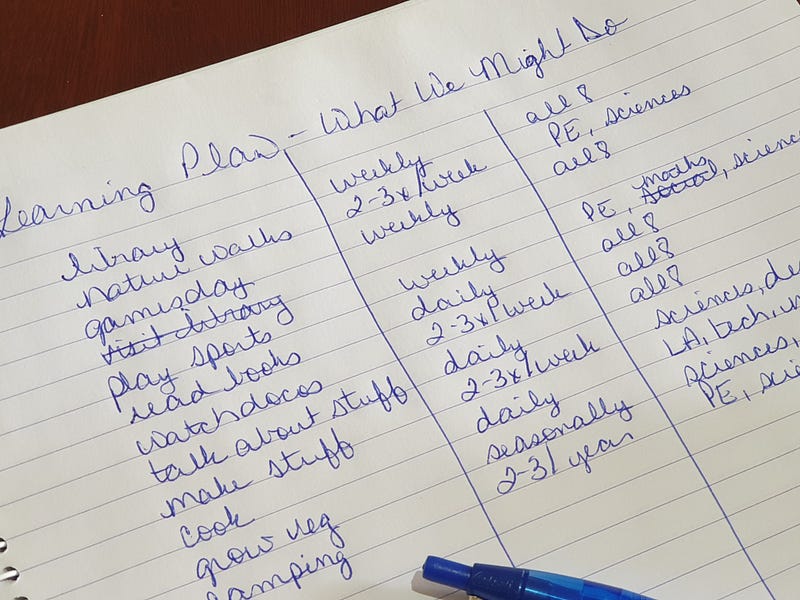
To outline a learning plan for submitting with the registration form here in Victoria, a purchased curriculum is not needed. Save the money and follow these steps which can be adapted for any age children and their interests.
Start at the Very Beginning
. . . by making a list of all the activities you are already envisioning will fill days. Include everything. Dream big! Include the kids. Attach no judgement or budget restraints. Have fun! These might include:
Nature walks Rock pools Beach Park play Cycling Gardening Reading aloud Museum Painting Colouring Paper crafts Knitting Independent reading Discussions Documentaries Journaling Library Table games Cooking and even… workbooks!
After that . . .
. . . draw a line all the way down the page. Next to each of these activities, write how often you think each activity will happen— daily, weekly, monthly, once, twice, etc. This is not a commitment but just a vision of how it might go.
And finally . . .
. . . draw another top to bottom line. In this last column, assign KLAs (Key Learning Areas or Subjects, described at the bottom) to each activity. Like this:
Library — all 8
Nature walks — science, PE, maths (tracking steps), English (updating nature log with notes about listening to frogs), art (made a diorama of nature scape). HESS (Discussion of settlers choosing a location to live based on access to the river for food, water, and eventually trade.) We have never done all of these after one nature walk. I am just showing the possibilities.
Knitting — art, design
Reading aloud — all 8
And there you have it — a good outline for writing a learning plan or plan for the next year of home education.
For those writing a learning plan to submit to the VRQA, they are looking for 3–5 opportunities for learning in each KLA.
There are sample learning plans on both the VRQA and Home Education Network websites.
This outline is a priceless tool for planning to start home education or the next year of home education. It can be an inspiration piece when the flow of ideas has run dry. And by comparing it year to year, it is easy to see how our children’s interests change over time, how they are growing and developing.
KLA = Key Learning Areas
English, Maths, Sciences, HESS (social sciences), LOTE (other languages, cultures), art & music, design & technology, PE & health
Previous article: Australian Homeschooling Summit 2022
Next article: Curriculum Selection in Home Education