
How to Massively Accelerate Your Learning & Master Complex Skills Fast — Lessons from an ER Doctor
To get big results, you have to leave your comfort zone.

Doctors at hospitals have a hard job. Between assessing patients, administering medication, stitching up wounds, tons of paperwork, and the occasional emergency call, there isn’t much time or room for mistakes.
Often, you don’t have more than a couple of seconds to decide what the right course of action is. This can be especially overwhelming when you’re the new guy who doesn’t have much practical experience.
My roommate was in that exact situation a couple of months ago when he became a doctor at a nearby hospital. He got thrown into cold water and had to learn how to swim quickly. Fast forward a couple of months and he is doing an exceptional job and getting praise from his boss who is known to use it more sparingly than the pope uses the f-word in public.
Being able to learn fast is a great skill to have, even if you aren’t an emergency room doctor.
Do you want to master a skill fast or become exceptionally good at something?
Did you start a new job or have taken on a side hustle only to realize that there are tons of things nobody prepared you for and now you have to master them quickly?
Do you wish that there was a way to cut down the learning curve and massively accelerate your progress?
Do you want to take your skills and learning to the next level?
Then you’ve come to the right place.
First things first: Massive learning always requires you to step out of your comfort zone and as such, it will make you uncomfortable as hell.
It is going to involve a ton of work and nothing will get rid of that for you. Anyone who claims that you can achieve mastery without putting in the work is a liar. Period.
But besides working hard, you also have to work smart. You can spend many hours doing insignificant stuff without having much to show for it — wasted time.
That is why I want to show you the principles that have helped my roommate to learn fast and thorough, surpassing his colleagues with flying colors. And to round it off, I’m going to sprinkle some tips from bestselling authors and my humble self on top.
Mindset First: Be Humble
If you think you know everything, you can’t learn anything.
— Dan Levitin, 4x NY Times bestselling author & leading neuroscientist
This is the crucial first step you have to take. You have to adjust your mindset. You have to accept the fact that you aren’t as smart as you think you are and might be wrong about things that you thought you were right about. Tough titty, I know. But you won’t be able to learn and improve if you think you already know everything and can do anything.
Look at it this way. When you start out, you have what I like to call beginner’s bonus. Nobody expects you to deliver perfect results. Nobody will wring your neck when you mess up. You usually have someone to supervise you and correct your mistakes. When my roommate started out, he didn’t have to run the whole ward on his own on the first day. When I started writing, very few people read my work and saw what I did.
Make use of this. When you’re getting started, you have to work to learn and improve — not to produce perfect results.
Challenge Yourself as Much as You Can — and Then Some More
How long do you think will it take you to become fluent in a new language? Half a year? A year? Two years?
Scott H. Young, the bestselling author of Ultralearning, tells the story of Benny Lewis, a globetrotter who has managed to reach fluency levels in more than ten languages in about three months each. This includes a level C1 certificate (second-highest level) in German, arguably one of the harder languages to learn.
His secret? “Always have a challenge.” He starts speaking to strangers on the first day of arrival in a foreign country, using a couple of previously memorized phrases. He doesn’t care about wrong intonation or pronunciation or if people understand him or not. He just does it. And as soon as he gets comfortable with a couple of phrases like asking for directions, it’s off to the next challenge.
Uncomfortable? As hell. Massive Learning? You bet.
When I started, I had no idea how to write. But I challenged myself to jump into the cold water and do it, even though the results were less than perfect (often even less than good). As soon as I figured out how to structure a post, I challenged myself to play around with different formats. How-Tos, philosophical pieces, listicles, relationship advice, and book reviews. Each one was a new challenge.
The bigger the challenge, the bigger the potential for improvement.
Yes, it will suck in the beginning. No, you won’t feel very good about your first results.
But if you want to skyrocket your learnings, you have to take on the hard challenges. Do what makes you uncomfortable. Do what you can’t do. That’s what you have to learn, after all.
Seek out Honest Feedback & Review Yourself
How do famous comedians find out which jokes are funny and which ones fall flat?
They seek out direct and honest feedback. They go to small clubs and comedy cellars unannounced, where they practice new jokes they’ve written. There’s nothing more honest and direct than the crowd’s reaction. If people laugh, the joke’s good. If they don’t, go figure.
When I started writing, I sent out many article drafts to friends, asking them for feedback. When my roommate started his job, he spent a lot of time with his colleagues talking about how he did and what he should improve.
But not only did we seek out feedback from other people, but we also spent hours reflecting our days and performance. We analyzed what we did well and where we had room for improvement. We learned from our mistakes. And as a result, our learning curve became steeper and steeper.
There are two things you have to keep in mind.
First, regularly ask for feedback on your own. Don’t make the mistake of assuming that everything goes well just because nobody tells you that you messed up. Ask for feedback. Ask people where you can improve or what they like about your work. Encourage them to be honest because you want to learn. They will gladly take the time.
Second, review yourself on a regular basis. Working and getting feedback is like collecting tons of data. But to make use of it, you have to analyze it. You have to not only find out what doesn’t work but also why it doesn’t and how you can improve. That is why regular review sessions are so important. I do this on a daily and weekly basis — every night, I journal, and every Sunday, I sit down and look at my weekly performance. What went right, what went wrong, why it turned out the way it did, and how I can improve. Reviewing yourself won’t take much time but will save you from repeating your mistakes and show you where your weak points are.
Deliberate Practice: Drill down on Your Weak Points
A chain is only as strong as its weakest link.
If you ask for feedback and put yourself up for review, you will notice one thing: You have weak points. Don’t worry, we all do. The problem with weak points is that no matter how great you are at the hundreds of other things, your weak points will always hold you back.
If you’re a great writer but suck at formatting and headlines as I did, that will stick out like a sore thumb. If you can’t force yourself to be concise and get lost in longwinded examples all the time, you will lose your reader no matter how great your content and message are.
If you’re a great doctor but completely lack social skills — aka my roommate’s boss — you will make your patients uncomfortable and anxious, no matter if you can cure their illness or not. People won’t like to work with you even though you might be the best in your field.
This is what the whole concept of deliberate practice rests on. If you want to accelerate your learning curve, there is no point in practicing over and over what you’re already good at. Instead, you have to find the essential skills you need to master but struggle with right now. That’s where feedback and reviews come in — you will quickly find out what your weak point is.
Then, drill down on that sucker like BP looking for oil in the Gulf of Mexico. Practice, practice, practice. When I wanted to improve my headline game, I forced myself to first read through lots of headlines of popular articles, figure out what made them good, and then write at least five different headlines for every article I wrote. Was it hard? Yes. Did I want to go back to the things I was better at and that were more fun to do? For sure. But did I see a massive improvement compared to when I started out? You bet.
Your weak points are usually the hardest to work on. But they contain the most potential for learning and improvement.
So drill down on them until they aren’t your weak points anymore.
Don’t Get Stuck at Plateaus
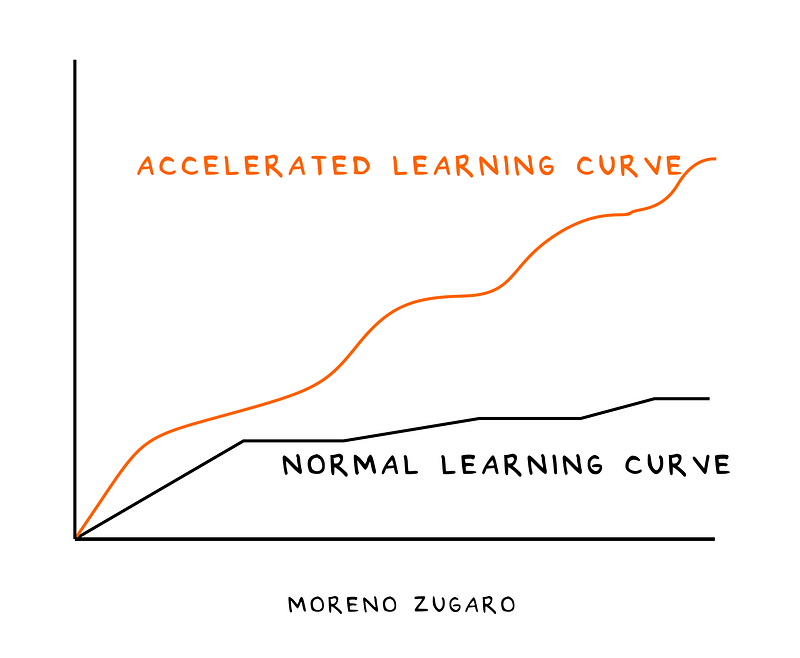
Any learning curve has multiple levels to it. One project can only teach you so much. One challenge will only get you so far. At one point, you will encounter a plateau where there is nothing left to learn for you.
If you want to see massive improvements and learn faster than anybody else, you can’t get stuck at these plateaus.
Once you get stuck, you start to revert back into non-learner mode. Your mindset goes back to “I know everything.” You stop being curious and asking for feedback. You don’t pay attention to your weak points anymore. You get comfortable. And once you stop moving, it will be a lot harder to get back into gear. Don’t lose your momentum.
Instead, look for the next level of learning. Another project, another challenge, another way to apply your skills and learn about the ones you haven’t mastered yet.
My roommate was working in a rather quiet ward for his first few weeks. As he started to get comfortable and reached his first learning plateau, he was put into the emergency room. Mind you, this is Corona time. People flooded into the ER like shoppers into a Walmart on a Black Friday. The first few days he felt like he was hit by a truck when his shift was over — but his learning skyrocketed. He learned more things in the first few days than his old position could have taught him in months.
Comfort is the enemy of progress. There is nothing wrong with slowing down for a bit to regenerate. But if you want to learn something fast and become outstanding at it, you can’t allow yourself to plateau. Jump to the next level and always keep your momentum.
Think for Yourself, Challenge Everything, and Ask Why
Any fool can know. The point is to understand.
― Albert Einstein
In his bestselling book The Psychology of Persuasion, Robert Cialdini tells the story of a nurse who put drops used to alleviate earaches into a patient’s rectum instead of his ears. The reason? The doctor had written a note saying to administer the medicine into the patient’s right ear — abbreviated with “r.ear”.
Moral of the story? If you want to become good at your job, think for yourself and challenge everything. This will not only uncover many mistakes before they are made, but it will also give you an excellent opportunity to apply your knowledge and get practical learning.
But the most important thing is that you cultivate an understanding of why something is the way it is instead of mindlessly executing. We’ve already got computers for that — beep, beep, file deleted.
If you want to rise to the top, you have to understand why things are the way they are and if there is a better way to do them.
I’m taking a wild guess here, but I bet that if you told a kid to put eardrops into someone’s bum because they have an earache, the kid would have objected. He would have asked you why in the world you’d want the drops there. Do you know why? Because kids are curious. They often torture their parents with endless why chains because they want to understand why something is the way it is. That is why kids are amongst the fastest learners.
Be curious like a kid. Challenge the status quo. Ask why.
Be Smart About Your Learning
Tell me and I forget, teach me and I may remember, involve me and I learn.
― Benjamin Franklin
In psychology, there is a concept known as the levels of processing model. It states that “shallow processing leads to a fragile memory trace that is susceptible to rapid decay. Deep processing results in a more durable memory trace.”
To put it short: The more you engage with something, the better you will remember it.
In this sense, Benjamin Franklin was ahead of his time. He realized what most schooling systems, teachers, professors, and tons of people with aspiring career and learning goals haven’t.
Improving your learning and mastery of a skill takes a lot of active work and involvement.
Yes, you can take the easy route and passively consume information, hoping for about 10% of it to stick in the best case. You can stay in your comfort zone and waste your potential. You can dodge the punches and avoid feedback because admitting your mistakes is hard.
Or, you can do what it takes to accelerate your learning curve and rise above the rest. Nobody said that it’s going to be easy — but if you want extraordinary results, that’s the way to go.
The power of active learning isn’t limited to skills — with a little bit of effort, you can also retain much more from the books you read: