
How to Live Without Fear in Terrifying Times
Fear is natural. It’s how you react to it that counts.
It seems now like a dream.
But it happened just like this.
I was walking along a dusty trail with my brother. On our left, a broad river rolled boulders toward the sea, the water blue-green and glacial, arching its back on its way through the valley.
Tall trees rose between us and the water, with denser forest on the other side of the trail. Nothing more than a cart track, a bare thread of baked mud where flies hovered in patches of dappled light.
The valley had eyes. You could feel them everywhere. Gray granite mountains frowned down on all sides, crowned by glaciers, carved by streams. Biting flies drew blood from burned skin.
September’s sun was strong enough to drive spikes into hardened earth, like the railroad workers who never quite made it here. A silent stream of sweat rolled down my neck as we walked.
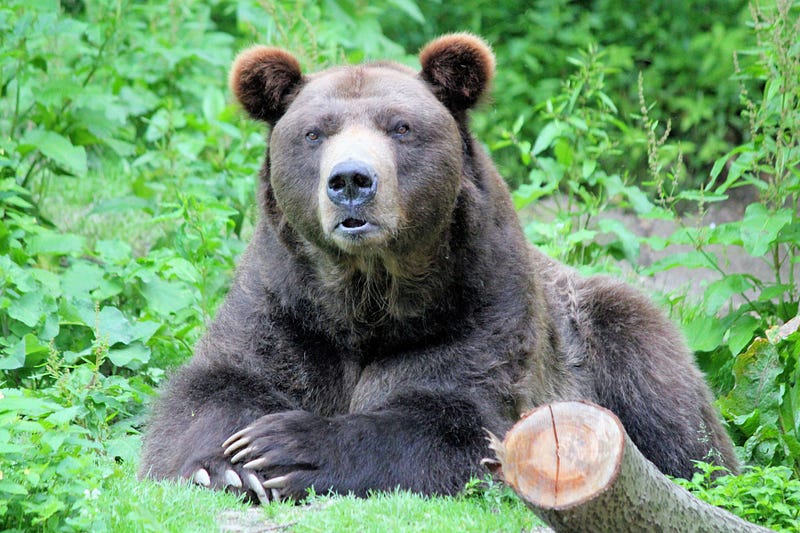
Monsters lurked in the forest. That’s not a metaphor. We had spent the day before watching grizzly bears hook salmon out of the river and tear them to shreds on the shore.
Huge coastal bears, fat and bristling and aggressive with the approach of winter. There’s a beauty in power and in terror, in the low growl and the sudden charge. But it’s the kind of beauty that is best seen from far away.
So when something snorted loudly in the shade of the riverside trees, several thoughts occurred to me at once.
That was loud. A big animal made that sound.
That’s a bear.
There’s no one else around for miles.
We stopped. Tiny curls of dust rose from the road, the first stray licks of smoke from two rubbed sticks. Slowly, slowly, we both turned our heads toward the river without making a sound.
Under the trees, their bulky bodies hidden by the brightness of the sun and the depth of the shadows it cast, lay two cows.
In this valley swarming with predators, cattle are allowed to roam free. It’s safer than keeping them in a pen. The cows watched us with the bland disinterest of their species, broad jaws working as their ears flicked at flies. My heart hammered in my chest. For a second, only a second, I had been fairly confident that I was about to die.
At least I didn’t panic.
Fear is powerful.
It doesn’t listen to reason. And while it’s reason that built the roads and the vaccines and the satellites, it’s fear that made us want to do it in the first place.
The fear of being conquered. Of being forgotten. Of falling short of the still unreached potential of what we are. They say fear’s a man’s best friend. It’s kept us alive this long.
Bears kill about six people per year. Not many, when there’s seven billion of us. Statistically, even in a valley infested with them, I was unlikely to be attacked. But the heart doesn’t read statistics.
Most people don’t need to fear bears. Most people never see one. The fears our ancestors left us, of serpents and spirits and storms, have not gone away. We’ve just reshaped them into something more appropriate to our surroundings.
Maybe you’ll get fired. Maybe you’ll never have kids. Maybe everyone you love will leave you, and the final fatal moments of your life will be nothing more than an anecdote for some disinterested lab tech who will forget your name even as he hooks a tag onto your cold dead toe.
Fear is a part of who we are. It can’t be eliminated. Courage is not the absence of fear, but the capacity to deal with it and still act rationally.
Luckily, that’s something you can learn.
I can’t find the reference now.
Many years ago, I remember listening to a radio interview with a very courageous woman. Her job was to train the military on how to deal with their understandable fears. Not to ignore them. Not to suppress them. But to feel them and still be able to function efficiently.
She was in Afghanistan when the helicopter she was riding in was shot down. She was captured by the Taliban. That’s a terrifying experience for anyone, but doubly so for a woman. But of course, she knew how to deal with her fears.
I can’t remember her name. But I remember what she said. At least in broad strokes. In any situation, she said, you visualize the worst-case scenario and the best-case scenario. Then you discount them both.
Almost nothing in life is as bad as it could be, or as good as we wish it was. Ninety-nine times out of a hundred, events fall somewhere in the middle.
When what I thought was a rampaging grizzly bear surprised me in the forest, the worst-case scenario was that it would spend a long time killing both me and my brother, quickly incapacitating us but leaving us conscious while it ate our faces and genitals. Unlikely.
The best-case scenario, that it would lead us to buried treasure in some hidden forest cave, was also far-fetched. The reality was that there never was a bear. Even if there had been, a thousand possible outcomes existed between the extremes of good and bad.
Another aspect of dealing with fear is to face it.
Fear is like many other emotions in that it grows in the dark. The attempt to avoid it is often the cause of more suffering than the emotion itself. So often, our fears turn out to be not nearly as terrifying as they first appeared.
That doesn’t mean you go charging into every patch of darkness like a D&D character with loaded dice. Panic is never helpful, and if your fears are the kind that can be postponed, take some time when you need it. Try to find something to distract yourself, something comforting.
But eventually, you’re going to need to face your fears. Look into them directly, without evasion and without self-criticism. Your fears, rational or not, are your own. They don’t make you weak. They don’t define you in any way. They just exist. And when you remove the anxiety of trying to avoid them, you’ll find that half the suffering they cause disappears with it.
Focus on what you can do.
As far as we can tell, lions never wish for wings. And eagles don’t long for the airless caverns of the ocean. There is no bigger waste of energy than hoping for the impossible or wishing the world was other than it is. You can’t control the universe. And even if you could, you wouldn’t want to.
Events are beyond your control, but what lies within your power is your reaction to those events. You may feel nervous, afraid, anxious, or downright terrified. But they are only feelings. Don’t mistake the lens you look through for the reality. None of us see anything more than a tiny fraction of the light.
Find meaning.
One of the profoundest things I ever heard was from Joseph Campbell. “Life has no meaning,” he said. “Each of us has meaning and we bring it to life. It is a waste to be asking the question when you are the answer.”
Looked at from this perspective, life becomes an adventure that we choose for ourselves. A sense of purpose can push through what would otherwise be intolerable fear. People risk death at the summits of mountains or in the cold desert of space because they have a purpose that drives them. If you have a why, you can endure any how. And fear is absolutely powerless against passion and purpose.
The fear of physical harm is immediate and visceral.
The fear of failure is far foggier. It hangs over us like a cloud, making what light there is seem diffuse and watery, robbing us of the highlights as well as the shadows. But in our outrageously comfortable societies, it’s a far more common fear than the terror of a wild animal.
If you let it, fear will control your life. It’s always safer to stay in a cage than to venture outside. The dreary reality you know will always seem preferable to the chiaroscuro possibilities of the unknown.
That’s perfectly natural. It’s the way we’re made. From the point of view of the selfish genes that rule our monkey brains, as long as we stay alive to reproduce, our personal happiness and sense of fulfillment count for absolutely nothing. If you’re still alive, still putting food in your belly, it’s better to stay where you are, no matter how you feel about it.
But you are more than a vehicle for your DNA. For all our faults and failings, the most remarkable thing about our species is our ability to choose for ourselves, outside the dictates of biology.
There is no worse reason to do anything than fear. The decisions it prompts are almost always wrong. And even when they are not, the right decision made for the wrong reasons can still be a mistake.
Fear exists to keep you alive. And it’s a useful tool in many situations. But it’s no way to live your life. The only way to live up to your full potential, to live a life that’s worthy of being lived, is to overcome the fear that tells you not to try.