
Grizzly Bears and the Last Great Wilderness
Magic and mystery in the forests of British Columbia
“Hey, bear.”
A man who lived in the valley taught us to do that. In these dark forests, most bear attacks happen when people come on the animals by surprise. Formidable creatures that they are, grizzly bears are smart enough to know that humans mean trouble. Generally, if they know people are around, they’ll keep their distance.
“Hey, bear.”
And so as we climbed along the trail, we kept repeating the words like a mantra. From time to time, we’d clap our hands, the sound making a sharp report like a gunshot that bounced back from the silent trees.
Even in the full sunlight that made a thin river of sweat trickle down my back, the darkness under the trees was thick and threatening. And the rushing of the turquoise river in the canyon below our feet was all we could hear besides ourselves.
There were no other people for miles around. And it was the lasting wildness of the place that drew us here. The valley may have been settled for thousands of years, but the frowning mountains and the forbidding forests seem to resist the human touch.
“Hey, bear.”
The silver creek ran through the forest, winding its way over smooth rocks as it raced toward the canyon below. Beneath the thick carpet of moss that had been growing for centuries on the rocks, we started to see shapes. Curved lines. Indentations. The trail led us on, into the woods, and the patterns became more and more obvious. Soon, every rock became a work of art.
“Hey, bear.”
The faces of animals and of humans and of creatures somewhere in between grinned at us. The contours of the carvings were filled with the brown fuzz of last year’s dropped pine needles. But the carvings looked as fresh and clear as though they been done yesterday. They hadn’t.
It’s difficult to date petroglyphs, the carvings on the rocks made by the ancestors of the people who still live in the valley. Certainly, they predate the arrival of Europeans. Dating carried out on rock art elsewhere on Canada’s mountainous West Coast has suggested that some carvings could be at least 3000 years old.
The First Nations people who still live in the area maintain that the art of their ancestors is older even than that, older than the pyramids, going back as much as 10,000 years.
“Hey, bear.”
What’s more certain is that this is sacred space. The ancestors didn’t carry their stone-working tools up the steep hill for the exercise.
They came because they felt something in the song of the river and the light of the sun through the trees. Some place where the forces of nature were especially powerful, especially profound. And you can still feel that today, while the deep-carved eyes of the stone creatures watch you from every angle.
I’m not a superstitious person. There’s no need to believe in any world beyond this one when this one is more than enough. In all its beauty and majesty and terror, the single life we are granted is more than enough to fill our hearts.
And standing in that haunted forest, listening to the river rushing below and vigilant for the presence of predators, you feel as alive as you ever will.
We came to the Bella Coola Valley to see bears.
Every fall, salmon swim up from the sea, making their way laboriously against the current of the rivers as they seek out the specific creek where they themselves were born.
It’s one of those commonplace miracles, a feat of navigation that we still don’t fully understand. But the salmon make the long journey in their millions, to spawn and then die on the gravel beds of the sparkling rivers all along this rugged coast. Their life’s task accomplished, the salmon die easily, glassy eyes staring up at the sky, their sleek bodies failing them at last.
And it’s this colossal sacrifice that forms the basis of the entire ecosystem of the forest. The bears and the eagles and the gulls and the seals grow fat on the nutritious bodies of the dying fish.
Even the trees absorb the corpses. It’s the nitrogen the fish bring back with them from the open ocean that makes the forests here so tall, so bursting with life.
No wonder the people who carved the figures on the rocks saw the salmon as the master animal and revered it for its life-giving power. When they caught the first salmon of the season, they gave it a feast to honor it that could last for days.
The days of the celebration allowed thousands of salmon to reach their spawning grounds and lay eggs they would hatch the following spring, ensuring the continuity of this critical food source. The meaning behind the ritual. The science behind the symbol.
Small villages cluster along the single road that runs through the valley toward the sea.
At night, from above, the dim lights might resemble a trail of stars, outshone by the blazing constellations that hang above them. Everything here dwarfs human scale. The mountains are both remote and close at hand, the rocky crown of the valley that seems almost to be breathing down your neck.
The waterfalls are some of the highest in the country. The trees are giants. And the wildlife is dangerous. Stepping into the forest here without the appropriate respect for its true nature can get you killed.
We parked our car in the small pullout between the road and the river, where the few tourists who make the long journey to the valley gathered to watch the bears. Wildlife watching requires patience. And while we waited, the black flies drew blood wherever they bit us, immune to the most potent bug spray we could find. But when a grizzly bear appeared, we forgot all about the flies.
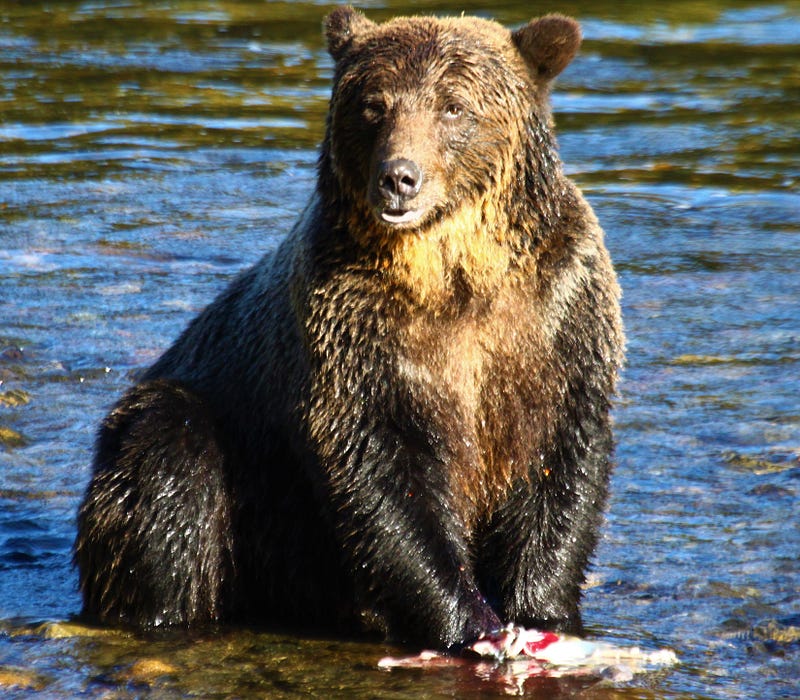
Being looked in the eye by a wild grizzly bear is an experience that’s hard to put into words.
You can see it sizing you up. There’s an intelligence there, but one that is completely alien to us. Animals occupy a world fundamentally different from ours.
And no matter how much we study them and learn about them, there remains something unknowable about the creatures we share our planet with. Wild animals are dangerous partly because they are unpredictable. But then, the same could be said for humans too.
We all stepped back, cameras clicking, as we made space for the bear to pass. Small by grizzly standards, she was still more than a match for any of us. She stood barely 30 feet away from the group, her flanks heaving as she panted in the slightly breathless way that bears do.
Her head turned, her brown eyes moving down the line of people watching her without the slightest trace of fear. Once, grizzly bears shared these forests with sabertooth cats, powerful predators that specialized in hunting humans. It’s possible that the grizzly bear’s specific mix of aggressive and defensive behavior, the bluff charges that can precede an attack, were developed as a defense against these vanished monsters. The giant cats are gone, but the bears don’t know that.
But hunting humans didn’t turn out so well for the sabertooth cats. Now, the only thing a grizzly need to fear in the darkness beneath the trees is another grizzly. And us.
In the grassy meadows cleared of trees by the backbreaking labor of hardy pioneers 100 years ago, ancient cabins rot and sag.
These old homesteads were part of the settling of one of the last true frontier areas of the continent, a wilderness that was never fully tamed. I’ve been to many beautiful places, and Canada abounds in mountains and rivers and ocean inlets, and wildlife too.
But the Bella Coola Valley doesn’t feel like anywhere else I’ve been. It’s wilder. It’s grander. And try as I might, I can’t seem to get away from that tricky word again: sacred.
In the language of the indigenous people of the Bella Coola Valley, nan is the word for the grizzly bear.
And language has a way of clinging on in the names we use to describe the world around us, even when we don’t fully understand what we’re saying. When modern people say London, for example, they don’t mean fast-flowing river, even if that’s where the name comes from.
As we followed the trail to the ancient rock art, nervously calling out to the unseen predators that might have been around the next bend, I found myself thinking about ritual.
We teach our children to do the things that kept us alive, and these sensible behaviors become preserved and codified as religious practices. In the hot climate of the Middle East, without modern food preservation technology, eating pork was a risky proposition, and so Islam and Judaism both prohibit it where other religions don’t.
You clap and you sing as you move through the forest to appease the invisible powers and ward off danger. And in a thousand years, after all the bears are gone, maybe we’ll still be calling out to them without knowing why.
Hey, bear.

This story is published in Writers on the Run. If you’re interested in submitting your travel stories please visit our submission guidelines.


