
This City Will Teach You How to Say Goodbye
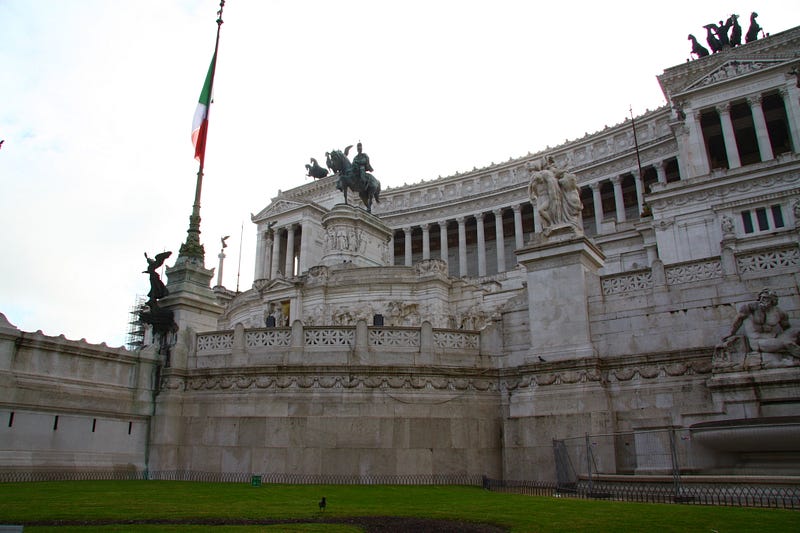
Some things, if you watch them long enough, make you start to think that you can see the true nature of everything. The ocean. An open fire. Crowds are like this too. Sit on the cool marble steps in December sunshine by the monument to Vittorio Emanuele, and you run a real risk of thinking that you’ve discovered something.
It’s all here. Everything human is in this square, its edges softened into beauty by the ineluctable weight of time. You can travel the world and never leave your sunny spot. Two girls chatter together in German. A family squabble in weary Romanian. Two young men share a joke in Urdu before splitting up to work the crowd from one side to another, selling frail plastic poles for phones.
Every empire ends, that’s Rome’s most obvious lesson. As though I were in any danger of founding a dynasty. If you go a little while not hearing your own language, you can pick it out at 100 meters, even when it’s the most widely spoken language on earth. For now. All empires end. The next gadget these itinerant hawkers shill might take its name from Mandarin or Hindi.
There is a busker just over there, in the shadow of the massive wedding cake monument. The type with a speaker. He’s good, and has drawn a crowd. The songs are in English, but everyone can sing along. The Beatles. Bob Marley. Phil Collins. Music is our oldest language, the mother of all the rest.
You can hear it all here. You can read people’s faces. There is no need to share a word in common. We all say the same things, but they sound different when we open our mouths. The busker’s bass drifts across the square; the police have closed the road between the monument and the Colosseum. You feel you could love people at this distance, their hungers and smiles and the differing fashions of all the world.
Just let me keep them at that distance. Don’t let them come any closer than that. Get too close, and they will pull you into the swamp, where life is a wall against the encroaching sea, doomed to failure. Get too far away, and you’re barking orders, posturing and preening on the balcony while the crowd roars. Where you stand determines what you see. Kids chase pigeons around here like they do anywhere else, and before there were pigeons, they chased cats. There were always cats. They are older than Rome, and they’ll outlast it.
It would be nice, wouldn’t it, in the sun, to be meeting someone here? Feeling the welcoming warmth in your chest while you wait, losing the endless ticking of the clock’s minute hand to the blaring of the car horns and the sound of a guitar. It needn’t be a lover, though that would be nice too. To raise your head at the sound of high heels rapping on the picturesque cobblestones, a smile forming as you watch her approach, surprised and delighted all over again at just how fucking good she looks.
But it could just as easily be a friend, a lonely friend with a violin and an attic room. It could be that cousin you’re no longer close with. It doesn’t matter. The meeting is the best part. It gets worse from there.
It’s a characteristic of a life like mine that’s I’m always saying goodbye. People and places are seen only in passing, the edges fuzzy like the telephone poles that whizz by in the train window, their wires sloped black bars for unwritten music.
And it’s in the nature of goodbyes that not all will come off the way you imagine. Even fewer the way you hope. You don’t get past a certain age without knowing the terror of that phone call, the one that tells you that another part of your life has slipped below the waves forever.
Compared to that, this is nothing. A holiday snap. A wish-you-were-here with a cruel question mark added, aimed with the sharp edge of time’s arrow at the person I will one day be. The first word I ever spoke is a mystery lost to time, like the recipe for Roman concrete. Most probably, it was mama, or some variation on that.
The first word any of us learn, though, ought to be goodbye. We will need to use it again and again. A recurring theme in the symphony, a minor key chord progression we will be forced to return to again and again.
Rome can’t help but be beautiful. In its decrepitude, citizens burned the statues of marble gods to make lime and repair their drafty hovels. Ruined aqueducts poured out fresh mountain water into a fetid swamp. But now the buildings founded on the ruins are ruins themselves, and therefore ancient and precious and beautiful under the bright sun.
Distance makes it all ravishing, all of it, like the young couple fighting in Piazza Del Popolo under the shadow of a 4000-year-old Egyptian obelisk dragged into the present from a different world. Even the garish parade of luxury boutiques and claustrophobic souvenir stores can’t rob the red walls and smooth black cobbles of their shabby charm.
There are people in this world who can’t see a beautiful thing without wanting to own it. I’m not immune. To fear is to be human, and to build walls against those fears, real or not, is the most human thing of all. For every bridge, there’s a border. The airports are swarming with armed police. I bought a place in Vancouver because of the way the sun looks on the mountains and the way the sea moves. I hoped, once the paperwork was signed, that I’d have a foothold at last. Something they could never take from me.
But the mountains were there long before my overpriced condo. And the sea will look the same long after I’m gone. What is most precious, most beautiful, most essential to human life is that which cannot be owned. To own a thing is to slowly destroy it.
I’ve said goodbye to Rome again and again. I won’t do it today. There’s nowhere else I’d rather be with the day stretching out in front of me, empty of all but promise. A wild sea between me and the city isn’t enough to make me forget.
But it’s precisely this, the need to leave, that fuels the beauty. It’s this that keeps the heart alive. The thousand tiny injuries that make the muscle stronger. Memory is a nice place to visit, but the past is just another way of thinking about the present.
Like Dante’s Inferno, the way out is the way through. The beauty of Rome is the destruction, the faded glory, the radiant residue that owes nothing to shifting sands and everything to fleeing time. This, it must be said, is all beauty. That which moves and breathes and dances must die and be reborn. And only that which moves and dies is worthy of love.
The world is vanishing from us day by day. Visions of glory fade in eyes that replace themselves cell by cell with inferior copies. To the worst part of yourself, this is horror. The meaninglessness and absurdity of a transient life. The impossibility of death to the dull part of our brains that can’t believe in a world without us.
Rome holds a deeper truth. The shattered monuments and ruined statues promise that a thing becomes beautiful, not because it endures, but because it changes, yet still maintains some kernel of itself. A single day that lasted forever would soon become a hell without limits. Give me the dance of falling leaves and shifting forms, while my gray ghost wanders Rome’s eternal streets eternally. One more quiet story among the infinite stories of the dancing world.

This story is published in Writers on the Run. If you’re interested in submitting your travel stories please visit our submission guidelines.