
How to Learn Faster And 10x Better
Many people don’t know how to learn.
Perhaps, they think that just sitting passively in front of a display and listening to someone speak is learning indeed.
Yes, in some way, that’s a degree of learning, but it’s of low-quality one.
If you can’t explain in a simple way, you need to learn more!
The learning skill is crucial, and investing some time of the day is very productive.
”Give me six hours to chop down a tree, and I will spend the first four sharpening the ax.” — Abraham Lincoln
Learning faster is mostly about the mindset. When you want to learn more quickly, you can learn more in the same amount of time or less.
Learning is a discipline. It’s kind of like working out. It can be difficult, exhausting, and sometimes progress is slower than you’d like.
Learning starts with your attitude! Just like physical fitness, improving your brain for learning can be difficult. Go into it with a positive attitude and accept that there will be times when you want to give up, but don’t let yourself do it.
That’s why learning how to learn is one of the most critical skills for all of us!
By focusing better, you learn faster. By thinking smaller, you focus better.
I would like to share some strategies for learning faster and 10x better, based on evidence-based research:
Hack the 10,000-hour rule
It states that you need 10,000 hours of “deliberate practice” to reach master-level potential.
For instance, as Gladwell mentioned in “Outliers,” The Beatles got their 10,000 hours playing 8 hours a day, 7 days a week, in German clubs before writing their first album.
Still, the question is whether you really must spend 10000 hours to feel like you master it. Hours are just limits we set ourselves up to accomplish something. And then on to new and better things.
I was a terrible writer when I started blogging first in 2017. One of my first posts had only got 350 words in total.
But I kept writing…
Now I’ve written around 100 posts and started publishing new articles almost every other day!
Imagine if you will try to improve 1% a day at whatever you are trying to learn…
This seems like a very small number — just 1%. But 1% a day, compounded, is 3800% per year: 1.01 ^ 365 = 37.8
That’s definitely 38 times better than where you started in just one year!
As you see, the only thing you should do it’s “just start” challenging yourself a little bit each day to expand your knowledge and skills. Because it’s high-rewarding at the end: 1% a day = 3800% a year.
Collect information from multiple ways
Engaging in the process of learning increases one’s capacity to learn faster.
Each time a person participates in any endeavor, a certain number of neurons are activated. When the action or information is repeated, these same neurons respond again.
”The more regions of the brain that store data about a subject, the more interconnection there is. This redundancy means students will have more opportunities to pull up all of those related bits of data from their multiple storage areas in response to a single cue. This cross-referencing of data means we have learned, rather than just memorized.” — Dr. Judy Willis, M.D. M.Ed.
The more times one repeats an action/practice or recalls the information, the more dendrites sprout to connect new memories to old. The more efficiently the brain retrieves that memory or repeats that action.
Another way to represent that may be the pyramid of learning by NTL:
- 10% of the knowledge can be learned through reading;
- 20% of the knowledge can be learned through listening and watching;
- 50% of the knowledge can be learned through demonstration;
- 70% of the knowledge can be learned through practice after learning;
- 90% of the knowledge can be learned by using it immediately after learning.
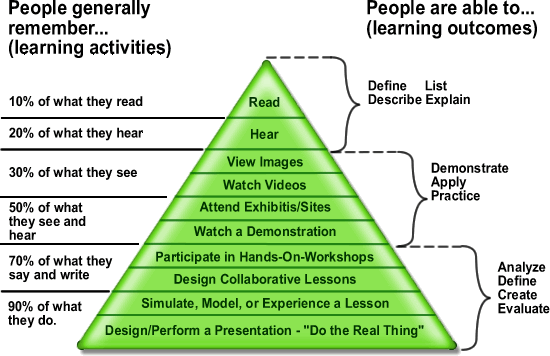
This model emphasizes that teaching information to others is the most effective way to learn it yourself and the best way to make sure the information has been stored successfully in the long-term memory.
So as an example, suppose you learn to speak Spanish. You could combine many different methods of learning to make it more effective, including:
- Flashcards
- Writing exercises
- Youtube videos
- Audio exercises
- Using an app like Duolingo
- Practicing with someone in person or online
Obviously, it seems that the immersion learning method is the most effective one!
My tip: when you read, to maximize what you learn: immediately after reading a book, write down “ten things I learned.” Else, you won’t remember more than 1 or 2 things at best from the book.
Only by putting the learning things into practice we can consolidate the learning reflection and strengthen the learning effect.
Like learning to play hockey, no one will become a good player through professional books. It’s necessary to be also on the hockey field to get in touch and practice hockey skills in the game.
There is no learning without practice.
Write more, less type
Even if you are quicker at typing, writing with pen on paper is the best way to go when taking notes.
Despite oodles of distraction online, researchers found that people who type while learning, process the information at a shallower level compared to those who use a pen and paper instead.
For example, a student who takes notes by hand also listens more actively and can identify essential concepts from out-coming information. For them taking notes on a laptop would lead to mindless transcription, as well as an opportunity for distraction, such as an app notification.
Hand-writing, it’s about 10–20% more effective in developing your neural networks. This introduces tactile stimulation, visual processing (through imagination) and increases activation in prefrontal regions involved in executive function.
Take a study nap
Without energy, you can’t learn.
We learn new things when awake, collect further information, and strengthen these memories. Sleep is a process of creative memory.
The stimulation and learning knowledge we get when awake will be strengthened in sleep. Scientists believe that the human brain can change the structure and organization, that is, the brain’s plasticity.
Through sleep rest state, we let the brain learn new knowledge and new information processing and strengthening, forming knowledge memory.
If you’re like me, you enjoy not only sleeping, but taking a good nap too.
Mostly “power naps,” which take about 20–30 minutes and will help you get back to work right away. The performance ability of a person highly depends on it. This is because this amount of sleep does not yet reach the deeper stages of a sleep cycle, and it should be easy to get up and work again.
Naps bring a lot to the table, but you don’t want to overdo it.
Just remember that a good nap should leave you more productive and ready to tackle the second half of your day.
Find a mentor
Why do you insist on understanding how things work lonely on your own when there are experts on every possible subject all over the world?
Find people who love what you love and spend as much time talking about this shared area as you can.
A good mentor will be someone willing to help you develop a plan for your success, analyze your mistakes and hold you accountable for your progress.
If I decide to learn a new skill, I will spend my time reading 15–30 books on a topic I’m interested in, watching 50+ videos, participating in the topic-related forums, and, if necessary, also taking certain courses.
For instance, when I wanted to learn how to be a better public speaker, I joined a Toastmasters club. That helped me learn faster from more advanced speakers, prepare and perform my own speeches, get constructive feedback, and support the club community.
When I wanted to learn about investing, I started reading books and watching videos on finance and investment. Next, I could find and spoke with 10s of other experienced individual investors.
Mentors are basically those people who regularly give their opinions (or advice), which directly impacts us or a decision we will make.
The challenge is to find the right mentor for your goals, and later, know that you’re guided in the right direction by the mentor.
Invest in your learning
You will always value it more when you have paid for it versus getting it for free.
Unfortunately, many people don’t appreciate that much free knowledge and don’t hurry up to learn from it. Hence, you won’t maximize the value you might receive from that.
”Ultimately, there’s one investment that supersedes all others: Invest in yourself.” — Warren Buffett
I believe that investing in yourself: your education and skills are the best gifts you can give yourself. You need to provide value in order to receive value back.
Second, investing money only in yourself doesn’t mean spending just on books, courses, coaching. The real purpose of this should be to make everything easier.
For example, you could invest in your home setup, gadgets that will ease your learning, or a place where you prefer studying (home, library, co-working, etc.)
Learning itself doesn’t have to be a chore, and the right investment can make it much diversified.
Final Thoughts
Learning is the best thing we can ever experience!
When we are growing mentally and physically, it makes us feel alive. It gives us a sense of accomplishment. It provides us with a sense of momentum. It makes us passionate about new things and experiences.
The more we can relate new concepts to ideas that we already understand, the faster we’ll learn the new information.
By finding ways to fit new information in with preexisting knowledge, we fundamentally understand it better and recall it more accurately. When you connect the new to the old, you give yourself mental “hooks” to hang the new knowledge.
Learning new things is a huge part of life. It takes time, and time is precious. To speed up the process, it’s vital to use multiple ways to learn something. Because the more resources you use, the faster you’ll learn.
Thank you for reading!
Now I’m curious what are your tips for learning new skills quickly? Please, share your experiences with me in the comments below.
Check out some of my popular articles:


