
How to Know if Your Family is Cursed
And how to counteract the spell
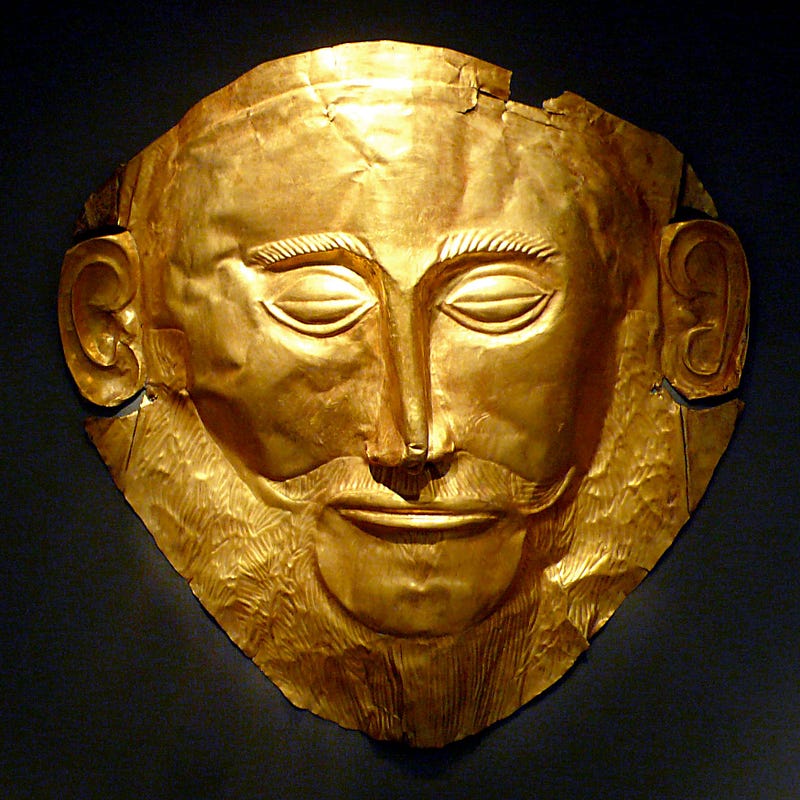
When I got breast cancer, just like my mother who died of it at age 55, and when my son got bipolar disorder, just like my father who died of a heart condition at age 60, I had to wonder: is my family cursed? Are the sins of my ancestors being visited upon me? Is there any way to stop the spread to future generations?
The historic precedent
Family curses have been known and described throughout history. In Western culture, perhaps the original cursed family was the House of Agamemnon. Agamemnon led the Greek forces against Troy in the famous Trojan War that became the theme of both the Illiad and the Odyssey, our foundational books, written down sometime between 600 and 800BC, when writing was just being invented. I say “perhaps” because all we have is written history, and who knows? There may have been other families with worse curses whose stories were sung in prehistoric times. But they’d have to be pretty spectacular tragedies to beat the House of Agamemnon.
Agamemnon won the Trojan war, but that wasn’t the end of his story. When he got home to Mycenae, his wife Clytemnestra was waiting with her lover Aegisthus, who also happened to be Agamemnon’s cousin. They welcomed the hero home — he’d been gone 10 long years! — brought him to a palace for a celebratory dinner, then slaughtered him and his men while they ate.
Agamemnon tells Odysseus of the indignity of his death in Book 11 of the Odyssey, when Odysseus visits the underworld. He’s ashamed that he was denied a hero’s death on the battlefield.
Aegisthus hatched my doom and my destruction, he killed me, he with my own accursed wife… he invited me to his palace, sat me down to feast then cut me down as a man cuts down some ox at the trough! So I died — a wretched ignominious death — and round me all my comrades killed, no mercy, one after another, just like white-tusked boars butchered in some rich lord of power’s halls for a wedding, banquet or groaning public feast You in your day have witnessed hundreds slaughtered killed in single combat or killed in pitched battle, true, but if you’d laid eyes on this it would have wrenched your heart — how we sprawled by the mixing-bowl and loaded tables there, throughout the palace, the whole floor awash with blood. But the death-cry of Cassandra, Priam’s daughter — the most pitiful thing I heard! My treacherous queen, Clytemnestra, killed her over my body, yes, and I, lifting my fists, beat them down on the ground, dying, dying, writhing around the sword. But she, that whore, she turned her back on me, well on my way to Death — she even lacked the heart to seal my eyes with her hand or close my jaws.
So, There’s nothing more deadly, bestial than a woman set on works like these — what a monstrous thing she plotted, slaughtered her own lawful husband! Why, I expected, at least, some welcome home from all my children, all my household slaves when I came sailing back again…But she — the queen hell-bent on outrage — bathes in shame not only herself but the whole breed of womankind, even the honest ones to come, forever down the years!
— Robert Fagles translation
You might think that poor Agamemnon had done nothing to deserve his fate. But, no. He’d done a lot.
Clytemnestra was righteously pissed because he’d sacrificed their daughter Iphigenia to get wind to take his fleet to Troy. The way he did it was particularly foul. He told her he’d arranged a marriage for her with the sexiest man alive, Achilles. So when she came down to the beach for the wedding, she was arrayed as a bride. Then her father killed her instead.
And that woman Clytemnestra murdered over Agamemnon’s body, Cassandra? She was one of many “prizes” he’d taken in the war. Considering she was a Trojan, daughter of the Trojan king, and had been warning her fellow citizens not to accept the Trojan Horse inside their walls or confront death and destruction, and considering Agamemnon had organized the murder of her entire family and every person in her town, I doubt she was a willing companion.
But if he’d done all those bad things that deserved retribution, doesn’t that denature the family curse theory? Nope. Because people from his family had been committing horrible crimes for generations.
First there was Tantalus, son of Zeus and a nymph, who cut up his child Pelops, put him in a stew, and fed that to the gods in a test of their omniscience. His punishment, from whence we get the word “tantalize,” was to stand forever in a pool of water with a bunch of grapes hanging over his head, but when he bent to drink, the water receded, and when he stretched to grab a grape, the branch pulled away. So the things he most desired — food and drink — were forever out of reach.
Pelops, resurrected by the gods, murdered someone who cursed the family, and incest, cannibalism, filicide, adultery, and general mayhem followed them down through the generations culminating in Orestes, Agamemnon’s son, who killed his own mother to avenge his father’s death and then finally broke the curse in a trial by jury whose split vote was decided in his favor by the goddess Athena.
So, yeah. That happened.
But back to Agamemnon’s perspective. I have to laugh when he says that there’s nothing more treacherous than a wife who will murder her husband, and that her act will besmirch all women for generations to come. So, murdering your own child (for good weather), collecting a bevy of sex slaves, and bringing the most prestigious one home to have dinner with your wife isn’t in the same ballpark? Right. Reminds me of the completely bananas besmirching of Eve’s reputation, when her big, bad sin was bringing knowledge to humankind, plus the temerity to question authority.
There are plenty of families throughout history who have had so much bad luck that it seems their family must be cursed. And as far as I’m concerned, that’s as good an explanation as any. But others disagree.
The Modern Equivalent
To my daughter the scientist, a more rational explanation is that there is a genetic component that can carry “curses” like breast cancer and bipolar disorder from one generation to the next. Okay. I buy that. We all know alcoholism runs in families, and drug addiction, and other ills. I’m not sure there’s a gene responsible for cannibalism or murdering members of your family, but curses aren’t as spectacular as they were in Agamemnon’s time, when gods still roamed the earth with outsized appetites for drama, often intervening in the affairs of humankind, stirring up trouble for their own amusement.
But even when I accept the scientific explanation, I still have to wonder why one family would carry and pass on those genes to their children while another wouldn’t. Could it be they are cursed?
If we follow a strictly scientific, evolutionary model, then families with genes that cause debilitating diseases wouldn’t proliferate — they’d die out. Does the fact this isn’t happening mean these diseases have an unknown evolutionary benefit? Does tragedy confer some reward which we aren’t aware of? Or is my timeline just too short? Maybe my bloodline will die out, eventually. Or maybe, like Orestes, we will somehow manage to expiate the family curse before it does. But how?
Of Mice and Cherry Blossoms
One of the things that stuck with me about the Jill Soloway TV series Transparent was the gay daughter’s description of an experiment in epigenetics in which it was shown that one generation’s tragedy can be passed on to the next, and the next after that.
Mice were given minor foot shocks while the scent of cherry blossoms was piped into their cages until they learned to associate the scent with pain. The next generation of mice, and the one after that, had an aversion to the smell of cherry blossoms, even though they’d never experienced the shocks. As reported in this story by the BBC, the implications are significant.
The consequences of passing down the effects of trauma are huge, even if they are subtly altered between generations. It would change the way we view our lives in the context of our parents’ experience, influencing our physiology and even our mental health.
In the series, Ari Pferfferman uses the experiment to suggest that troubles she and her family are going through are related to trauma experienced by their Jewish ancestors during the Holocaust.
Unlike evolutionary genetics, in which it takes generations for a change to take hold, epigenetics involves chemical markers controlling the expression of genes — rather than the genes themselves — that can create changes in just a single generation.
This sounds more like the mythological definition of a family curse, in that what happens to one person effects her progeny.

I’ve often wondered about whether some kind of epigenetic effect altered my son’s genes in my womb, making him more susceptible to bipolar disorder. Because while I was pregnant, at 31, my good friend Jeff Savage died. My mom had died when I was 20, my dad when I was 25, and this third death while I was heavily pregnant literally brought me to my knees. I remember being physically overwhelmed by a tsunami of grief, and worrying even while I was wailing how this might be affecting the child within.
My daughter, I’m sure, would not see a connection. There’s no direct line between great unhappiness during pregnancy and bipolar disorder in offspring. But I’m wondering if there’s an indirect line that we just don’t see yet. Because something bad happened to me when I was pregnant. And something bad subsequently happened to my gestating child. And there’s no test you can take to say if you have bipolar. And science doesn’t have all the answers. In fact, when it comes to mental illness, it has next to none.
A Surprising Recovery
I have a sister who has been depressed for most of her life. For long stretches of her marriage to a pretty wonderful man, she stayed up all night watching television and took naps during the day. She managed to hold down jobs to earn money needed, but couldn’t be convinced to go out and have fun, to do things with the family, to cook meals or go camping. She spent most of her time reading or watching television on the couch. Eventually, the children grew up, the couple was divorced, and my sister continued her sedentary routine unimpeded.
Then about five years ago, something happened. She woke up. She grew cheerful. She planned fun vacations and encouraged us sisters to come along. She got out of the house now and then and began a few new activities. She still spent a lot of time watching TV and reading, but she also started brewing kombucha and trying out new recipes in the kitchen. She smiled and laughed.
So one day I asked her, what happened to you? Why are you happy now?
She said she owed it to a show she had seen. It featured two sisters who had been horribly molested by their father. When they grew up, one became a hopeless drug addict and the other was basically fine. As she watched the show, she realized what made the difference. The broken sister was always dwelling in the past. The functional sister was always looking to the future.
My own sister realized that she was like the broken sister, always dwelling on and feeling remorse about the past. So since the day she had the realization, she’s been consciously wrenching her attention around to the future. She still lapses, of course. And there can be a kind of voluptuous satisfaction in regret, in the dramatic tragedy of it all, and in the excuse it gives you to spend a lot of time lying passively on the couch. I know, because I’ve experienced the paradoxical reward of misery myself. But whenever she notices herself falling into old patterns of morose retrospection, she forcefully pulls her attention back into the present or, even better, the future. She’s become very good at planning international vacations months or even years in advance.
It’s also worth mentioning that keeping your mind in the present is the recommendation of at least two major religions: Buddhism and Taoism, as well as the meditative practice called mindfulness.
“To live in the present moment is a miracle. The miracle is not to walk on water. The miracle is to walk on the green earth in the present moment, to appreciate the peace and beauty that are available now.” — Thich Nhat Hanh
The Secret Sauce of Curse Removal
So that forms the basis of my rehabilitation theory. The way to remove a family curse is to stop dwelling on it. Because reliving your tragedies over and over is probably having some kind of multi-generational effect — making it even more significant than it needs to be, keeping it alive, deepening those neural pathways in the regret center of your brain, and teaching your children that’s how one ought to live.
Yes, I’m aware I haven’t touched on the nature vs.nurture question. Are succeeding generations actually inheriting the family curse, or are they learning it from their parents? It’s my contention that it doesn’t matter. The important thing is, once you’ve felt the appropriate grief for the tragic occurrence (because repressing grief just opens another can of worms), then devote your effort to moving past it. Wrench your attention off the past and face it front.
Just think about it, if Orestes had just let it go when his mother murdered his father, he wouldn’t have murdered his mother in retribution and thereby brought the wrath of the Furies down on his own head. An eye for an eye makes the whole world blind, and all that.
By not dwelling on the past, you will reduce the juice surrounding the family’s generational problems and lessen their impact.
I’ve been trying this out in my own life and finding that it works. Take my son with bipolar. He has multiple needs which I’ve always rushed to fulfill, because I was dwelling in the tragic interpretation of his illness: that it was passed down from my father through me to him in a kind of family curse which I’m responsible for.
But what if it’s not a family curse? What if it’s just the luck of the draw? In that case, it’s not really my responsibility. It might not even be tragic. And in that case, he can take care of his own damn problems! And he doesn’t need my constant solicitude making the situation more fraught.
But that last bit sounds a lot like the start of another story about co-dependency, so I’ll end with this:
It’s most likely that your family is not cursed. But if it is, you can break the spell. Just train your mind to stop dwelling on the curse and look forward. Teach your children by example. It may seem small medicine in the face of big problems, but as long as the gods have abandoned humankind, and Athena is no longer around to run interference for her favorite pets, our minds are all we’ve got. Our minds are the author of all we are and see, and they’re powerful creators.
So go ahead, use the best and only tool you have to break your family curse.
For further reading…
Besides writing about women and mental illness and voodoo and politics and books and movies on Medium, I’ve published two novels here: Thirsty Work and Count All This. Check them out! If you need a membership for access, use my referral link and make me happy. And if you’re a writer with a passion for equality, submit to Fourth Wave.


