
Stop Drowning in Your Own Self Regard
Take your eyes off your navel and look up and out
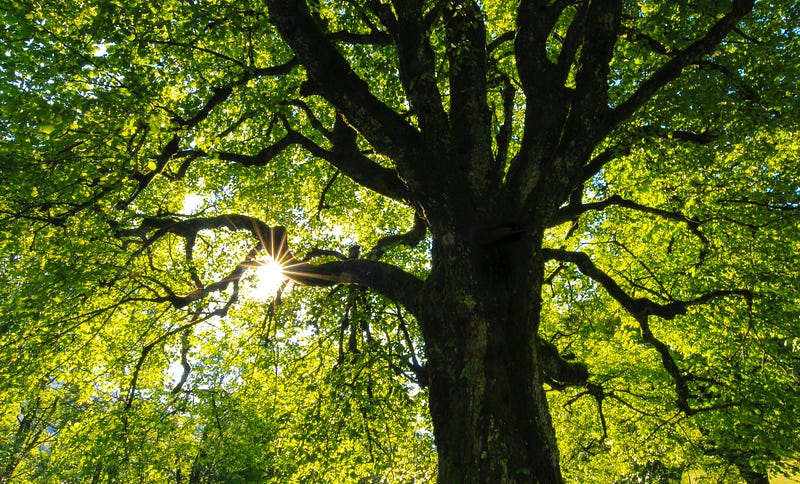
When I was growing up, there was a big, beautiful oak tree outside my bedroom window in Stockton. She had a broad gray trunk with deeply grooved bark which told stories of her history. I thought of her as a sentient being, who loved and protected me with thick branches that stretched over my roof. I communed with her nightly, and even wrote a short story about her titled “She,” which has long since been lost. After I grew up and moved away, I considered my personification of this “inanimate” object to be childish and foolish. But 50 years later, I’ve changed my mind.
The catalyst was Richard Powers’ book The Overstory, which won the Pulitzer Prize for Fiction in 2019. It follows nine characters as each develops love for a particular tree. Later, many of the characters come together to protect an old-growth forest in the Pacific Northwest.
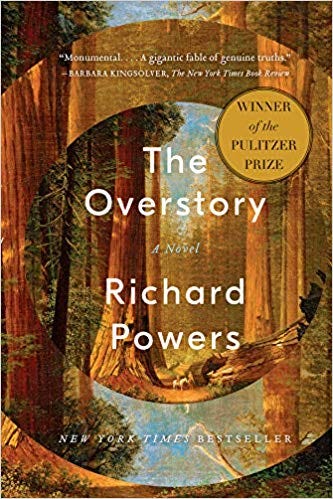
Writing the book changed Powers’ life. He quit his teaching job at Stanford and moved to the Great Smoky Mountains in Tennessee to be closer to the beautiful forest he discovered there while doing research for his book. It also brought on what he called a “religious conversion” in this interview in the Guardian.
But it wasn’t about seeing God. It was about seeing how all living things are connected, and understanding that humans are not necessarily more valuable than trees.
Powers thinks our lack of this insight makes us, quite literally, ill. “Every form of mental despair and terror and incapacity in modern life seems to be related in some way to this complete alienation from everything else alive,” he told the reporter in the Guardian story. “We’re deeply, existentially lonely.”
That rings true for me. I see deep, existential loneliness in the mass shooters that manifest mostly in American culture, where seven percent of all adults are clinically depressed and one in five endures a period of mental illness every year. I see it in my family and friends. I see it in myself. I see it everywhere I look.
Just scanning the headlines on Medium is exhausting: how to find love, make money, forgive your parents, accept your body, endure your boss, reclaim your time, enjoy sex, take psychedelics and meet God — every story a flag of self absorption and dissatisfaction with the status quo.
How can human beings address our deep, existential loneliness? Perhaps by taking a break from our habitual “me, me, me” focus and giving some thought to “them.” By turning our gaze outward, away from our navels, to the natural world that surrounds us.
“Every form of mental despair and terror and incapacity in modern life seems to be related in some way to this complete alienation from everything else alive. We’re deeply, existentially lonely.”
Proponents of shinrinyoku or “forest bathing” understand. Developed in Japan in the ‘80s and recently gaining notice in the U.S., advocates see a connection between spending time under the protective canopy of trees and physical and mental health.
Forest bathers are asked to put away their phones, forget about their schedules and projects and worries, and walk slowly and aimlessly through a forest, noticing colors and patterns, sounds, breezes, birds, perhaps even lying down on the ground to look up at the sky through the trees.
But what if you live in a big city, like I do? There are trees in parks, and growing out of sidewalks. Earlier this month, I huddled under a big Bottlebrush on my streetcorner during a surprise downpour while waiting for the bus. Thanks to that tree, which I patted affectionately when I left, I didn’t show up at my appointment dripping wet.
Trees are growing all around me in San Francisco. But it was only after reading The Overstory that I began to look closely at them, and make contact with a hand on a trunk as I passed. Benefits have been rippling out ever since.
When I went to visit my sister in the Santa Cruz Mountains, I asked her to identify the trees growing in the forest surrounding her house. I could recognize the redwoods, with their thready bark and straight, tall bodies, but what about the others? We took a lovely walk together while she pointed out madrone, with its broad, sturdy leaves and purple-red, peeling bark; Douglas Fir, which looks like a Christmas tree; and tan oak, a scrappy, scruffy cousin of the big tree that grew outside our childhood home.
When I noticed bright orange tree removal notices hanging on seven tall, beautiful trees I pause under every weekend while leading tours of North Beach, I sent a letter of protest. That led to meeting neighbors who felt the same and making new friends, two of whom came to my apartment to share cake on my birthday.
While working to save those seven trees, I met my district supervisor over coffee at Cafe Trieste; passed a pleasant morning with my often cantankerous adult son, creating a map of empty tree basins in the neighborhood; watched happily as that map resulted in 20 new tree plantings; met people from the Bureau of Urban Forestry and Friends of the Urban Forest, and learned the difference between the two; spoke up at meetings at City Hall; gathered signatures on petitions, which led to meeting more neighbors; and met a Chronicle reporter while spreading the word.
Each step I took in support of the trees enmeshed me deeper in my community.
How can we escape our deep, existential loneliness? Perhaps by taking a break from our habitual “me, me, me” focus and giving some thought to “them.” By turning our gaze outward, away from our navels, to the natural world.
I also learned to identify several species that are common in San Francisco: first came the ficus I was trying to save (they’re still standing; the appeal hearing is scheduled soon), with their smooth, gray trunks and dense green canopies topping sturdy fingers reaching towards the sky; then olive, with their tiny, fluttery, finger-shaped leaves; ginko, which has thrived on the planet since the dinosaurs, with their flat, fan-shaped leaves; sycamore, which always reminds me of an old Mamas and Papas song (Stars shining bright above you / Night breezes seem to whisper I love you / Birds singing in the sycamore tree /Dream a little dream of me…) with their mottled bark that looks like puzzle pieces; and hornbeam: disappointing bare sticks in winter, then flush with a frothy effusion of green leaves in summer.
I also became aware of the many things trees do for us while we’re busy gazing at our navels, creating the very air we breathe, for starters. They also provide shelter from the weather; filter the air; filter the water; fight erosion; fight climate change by banking carbon dioxide; slow traffic; provide habitat for birds, insects and animals; beautify the neighborhood; increase property values; and improve mental and physical health.
Besides providing benefits for humans, trees have value of their own. Some (redwoods) are the tallest living organisms on the planet. Some (giant sequoias) have the most biomass. Some live to be 1,000 or even 2,000 years old. Methuselah in California’s Inyo National Forest, was considered the oldest living tree at 4,851 years until another bristlecone pine in the area was discovered to be over 5,000 years old.
And trees live in community. They communicate with each other via scents on the air, warning of coming insect invasions or other blights, and giving time to deploy defense mechanisms; they support each other and share nutrients through an inter-tangled root system underground that can extend as far as five miles in any direction; and some even clone themselves.
In The Overstory, Powers’ characters all come to love trees. But everyone isn’t transformed willingly. Here’s a man who hoped to uncover corruption in a group of eco-warriors, but finds himself falling under their spell instead. When he returns home, he’s disgruntled to realize how much he has changed.
“He tries to read a novel, something about privileged people having trouble getting along with each other in exotic locations. He throws it against the wall. Something has broken in him. His appetite for human self regard is dead.”
And here he is, later, recalling the night he spent on a platform built high in a old-growth redwood with a character modeled on real-life Julia Butterfly Hill, who lived in a tree named “Luna” for two years in the ’90s and ultimately prevented her from being cut down.
“He walks half a block, propelled by a tremendous wave that feeds on itself, jetting out refuse behind it: bubbles, genocides, crusades, manias from the pyramids to pet rocks — the desperate delusions of culture from which, for one brief night, high up above the Earth, he once awakened.”
That’s the trick, isn’t it? Waking up from the desperate delusions of our culture, from the unrelenting messages that accost us daily, striving to convince us we need more, more, more, and that humans are the only things that matter on the planet?
But deep down in our core, in our equivalent of heartwood, we know better.
We know we aren’t the only ones at this party, and that focusing exclusively on human beings is bad for everyone’s health. So we try to shift the focus. It may be tricky, but it’s not impossible. One way that works is to notice the trees that are growing all around us — to really see them, touch them, smell them, thank them.
I think of my big, beautiful oak tree, which is still growing outside my childhood home these short 50 years later. I think She’d be glad to know I’ve come back under her sway.
For further reading…
My writing is free to readers who follow my links from Twitter, Facebook, and LinkedIn, but if you’d like to read more, click here to join Medium for $5 a month and they’ll give me some of that money. (Yes!) For an email when I publish a new story, click here. Find more stories about Religion & Spirituality on this List, and about Women and Feminism over here. And for more of the good stuff, follow Fourth Wave, where we’re changing the world for the better, one story at a time. Got one of your own? Submit to the Wave!