avatarThe PyCoach

Free AI web copilot to create summaries, insights and extended knowledge, download it at here

5020

Abstract

g your own database of new words.</p><p id="4f98">In the past, I used to write a journal named “The word of the day,” where I daily added a new word I learned on a notebook or the iPhone’s note app. However, as the list increased, I lost track of the words written earlier, so in the end, my journal became a mess.</p><p id="e5b2">This is why I switched to a simple database you might find on an Excel or Google spreadsheet. In my case, I use the <i>Notion</i> app to keep track of the new words I learn. A database becomes extremely useful once you added many new words because it’s searchable and has a sort and filter option to select words based on tags you previously defined.</p><p id="749d">This is how I add new words in Notion (it works the same on an Excel spreadsheet)</p><ol><li>Every time I find a new word, I highlight it on the e-book.</li><li>Once I finish reading, I go to the <i>notes/highlights </i>section of the book and copy and paste it into the database.</li><li>Then I add columns including the definition, tags, examples and word families.</li></ol><p id="226e">The final result looks like the picture below.</p><figure id="9448"><img src="https://cdn-images-1.readmedium.com/v2/resize:fit:800/1*AitqImtLvLPIDl0zv8SX4Q.png"><figcaption>Notion Database/table</figcaption></figure><p id="1ffa">I try to write the definition by using my own words, add a root reference and come up with examples representing a real-life use of the word (if it doesn’t have a real-life used, then for me, it’s not worth learning a word). The tag is up to you; I sometimes add the prefix and suffix of words as tags to study new words with similar meanings by filtering by tags. Word families help me learn 2 or more words instead of just 1. I explain more about this in the next section.</p><h1 id="c1ae">3. Learn multiple words when you’re supposed to learn 1 by studying prefixes, word families and a foreign language</h1><p id="e960">Here I’m not going to make you study Latin to improve your vocabulary (unless you want to). I’ve never studied Latin because it’s considered <a href="https://www.seeker.com/how-did-latin-become-a-dead-language-2008876974.html">a dead language</a>, so I wouldn’t find any native speaker to practice the language and memorize the vocabulary. However, Latin spread into different parts of Europe and evolved over a period of time to give birth to various Romance language<b>s</b>, so I think it’s a better idea to study Romance languages such as French, Spanish, Portuguese, Italian, or Romanian instead of Latin.</p><p id="b05e">Thanks to my knowledge of Spanish and Portuguese, I can recognize many English words. For example, the word <i>impoverishment</i> listed before in my database looks like the Spanish/Portuguese word <i>pobre </i>or the French word <i>pauvre. </i>The prefix <i>-in</i>, gives the meaning of “in” or “into,” so it's easy to come up with the meaning “into poverty.”</p><p id="af76">Now that we know how to learn multiple words by speaking a foreign language, I’d show you how to learn multiple words with something intrinsic to the English language — word families.</p><p id="67ea">Word families are groups of words that have a common pattern or meaning. Usually, they share a common base or root word with different prefixes and suffixes. Thanks to <a href="https://books.google.com.pe/books?hl=en&amp;lr=&amp;id=rloZhAkDoTsC&amp;oi=fnd&amp;pg=PA3&amp;dq=Nation,+I.+S.+P.+(2004).+A+study+of+the+most+frequent+word+families+in+the+British+National+Corpus.&amp;ots=aBqpmi-F8C&amp;sig=RLzd91qG7xRIU-x_bMGywXv5-kM&amp;redir_esc=y#v=onepage&amp;q=Nation%2C%20I.%20S.%20P.%20(2004).%20A%20study%20of%20the%20most%20frequent%20word%20families%20in%20the%20British%20National%20Corpus.&amp;f=false">a study of the most frequent word families in the British National Corpus</a>, there are available 28-word family lists ranked by level of difficulty.</p> <figure id="c88e"> <div> <div> <img class="ratio" src="http://placehold.it/16x9"> <iframe class="" src="https://cdn.embedly.com/widgets/media.html?src=https%3A%2F%2Fdatawrapper.dwcdn.net%2F7gMwR%2F1%2F&amp;display_name=Datawrapper&amp;url=https%3A%2F%2Fdatawrapper.dwcdn.net%2F7gMwR%2F1%2F&amp;key=a19fcc184b9711e1b4764040d3dc5c07&amp;type=text%2Fhtml&amp;schema=dwcdn" allowfullscreen="" frameborder="0" height="483" width="600"> </div> </div> </figure></iframe></div></div></figure><p id="e1e6">As an example, I created a searchable table that shows the base word and word family of English words “level 6”. If you just learned a new word<i>, </i>you can easily find its word families by typing the word in the table. For example, if you type <i>impoverishment, </i>the words <i>impoverish</i> and <i>impoverished</i> will show up. The difficulty of the word-family lists was determined with a corpus analysis, so the basic words (starting on level 1) are the most frequent words encountered in the corpus,

Options

while advanced words are the less frequent words.</p><p id="dc57"><i>If you want, I can add all the lists to the table above so you can search the word family of any word. Anyway, you can also find word family in the “nearby words” section of online dictionaries like Oxford.</i></p><figure id="3212"><img src="https://cdn-images-1.readmedium.com/v2/resize:fit:800/1*Qky3RBH2Xd7pSq46GA-iiQ.png"><figcaption>Oxford Dictionary</figcaption></figure><h1 id="7f8e">4. Watch TV shows with high vocabulary repetition</h1><p id="b88f">This last way to expand your vocabulary might surprise you, but yes, TV can help you increase your vocabulary (at least passive vocabulary).</p><p id="db7d"><a href="https://onlinelibrary.wiley.com/doi/abs/10.1111/j.1467-9922.2009.00509.x">Research</a> has shown that TV helps students learn new words in a foreign language thanks to word repetition. Basically, you hear a word in one episode, then you hear it more times in the TV show and then at least you are able to recognize that word the next time you hear it.</p><p id="4ca6">Previously I carried out a data analysis on the vocabulary used on <a href="https://towardsdatascience.com/the-best-netflix-movies-series-to-learn-english-according-to-data-science-dec7b047b164">Netflix shows</a> and <a href="https://towardsdatascience.com/the-best-disney-movies-to-learn-a-foreign-language-according-to-data-science-45e7fd084a78">Disney movies</a> based on the word families I talked about before. A common pattern I found is that documentaries are the content you need to watch if your native language is English and wish to increase your vocabulary.</p><div id="2d07" class="link-block"> <a href="https://towardsdatascience.com/the-best-disney-movies-to-learn-a-foreign-language-according-to-data-science-45e7fd084a78"> <div> <div> <h2>The Best Disney Movies to Learn a Foreign Language According to Data Science</h2> <div><h3>Using data to find which of the 300 Disney Plus movies analyzed are the best to learn a foreign language.</h3></div> <div><p>towardsdatascience.com</p></div> </div> <div> <div style="background-image: url(https://miro.readmedium.com/v2/resize:fit:320/1*22Blvp50EeEMcUNulcpGcw.jpeg)"></div> </div> </div> </a> </div><p id="a221">If you check the left side of the plot below, you’ll find the content that uses advanced vocabulary (most of them are documentaries). I usually recommend foreign language students to watch content from the right side because they mostly have a basic vocabulary, but since English is your native language, consider watching content with a vast vocabulary to learn words on Netflix.</p> <figure id="7123"> <div> <div> <img class="ratio" src="http://placehold.it/16x9"> <iframe class="" src="https://cdn.embedly.com/widgets/media.html?src=https%3A%2F%2Fdatawrapper.dwcdn.net%2FhWPS6%2F6%2F&amp;display_name=Datawrapper&amp;url=https%3A%2F%2Fdatawrapper.dwcdn.net%2FhWPS6%2F6%2F&amp;key=a19fcc184b9711e1b4764040d3dc5c07&amp;type=text%2Fhtml&amp;schema=dwcdn" allowfullscreen="" frameborder="0" height="500" width="700"> </div> </div> </figure></iframe></div></div></figure><p id="33f9">In case you’re learning a foreign language (especially if it’s a Romance language), then I have more good news for you — TV shows will help you learn tons of useful vocabulary. A few months ago, I carried out a data analysis to find <a href="https://towardsdatascience.com/the-simpsons-is-the-best-tv-show-to-increase-your-english-vocabulary-f433fe060a74">TV shows that will increase the chances of learning intermediate and advanced vocabulary</a> through word repetition, obtaining the following results.</p> <figure id="9133"> <div> <div> <img class="ratio" src="http://placehold.it/16x9"> <iframe class="" src="https://cdn.embedly.com/widgets/media.html?src=https%3A%2F%2Fdatawrapper.dwcdn.net%2FtoSIv%2F10%2F&amp;display_name=Datawrapper&amp;url=https%3A%2F%2Fdatawrapper.dwcdn.net%2FtoSIv%2F10%2F&amp;key=a19fcc184b9711e1b4764040d3dc5c07&amp;type=text%2Fhtml&amp;schema=dwcdn" allowfullscreen="" frameborder="0" height="500" width="700"> </div> </div> </figure></iframe></div></div></figure><p id="3244">The shows with more word repetition (y-axis) will help you learn more new words. Increase your vocabulary in a foreign language by watching those shows with more word repetition like <i>The Simpsons</i>.</p><p id="e047">Reading is not enough to become fluent in a foreign language. <a href="https://www.youtube.com/c/LearnLanguagesWithTV?sub_confirmation=1"><b>Join our YouTube channel with 1K+ subscribers to complement your language learning by watching shows & movies you love</b></a><b>.</b></p></article></body>

How to Improve Your Vocabulary Without Overusing The Dictionary

Or studying Latin.

Photo by Siora Photography on Unsplash

One of the biggest challenges I faced to improve my vocabulary was to find a way to learn new words without taking the fun out of reading. If you stop to look up a new word in your pocket dictionary frequently, you know what I’m talking about. It’s a nightmare! The worst part is when you end up forgetting most words you thought you’ve learned.

The Oxford English dictionary has around 600,000-word forms defined, but only 171,476 words are in current use. Learning all those words is still impractical; that’s why, in this article, I’ll show you 4 things I did to expand my passive and active vocabulary without overusing the dictionary or learning Latin.

The list covers different approaches such as building your database of new words, learning word families, watching TV shows with high vocabulary repetition, etc. You can use one or all of them since they work well together.

1. Read on an iPad/Kindle

To break the habit of checking the dictionary while reading a book, start reading e-books and stop carrying your pocket dictionary everywhere.

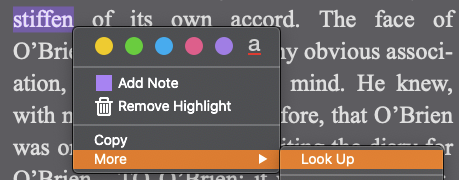
Why carrying a dictionary when you already have one inside the iBooks/Kindle app? If you come across a new word while reading an e-book, you only have to tap and select the Look up option. This feature will save immense time and help you stay focused while reading.
iBooks

Once you start looking up new words on an e-book, you might be tempted to do it every single time you come across a new word. However, it’s better to limit yourself to learn a certain number of words per page or chapter.

As a rule of thumb, I ask myself these 2 questions before looking up a word:

  • Do I understand the general meaning of the sentence? If you can understand the meaning of a word by context, then there’s no need to look it up.
  • Does the word keep popping up? If the word is used many times through the book, we can say it’s worth learning its definition.

In case you insist on reading printed books — and I can’t blame you for that! — I highly recommend using an online dictionary. Looking up words in an online dictionary is as fast as in an e-book. You only need to type the new word you encountered to get the definition. On top of that, it’s free, and it’ll be with you every time you carry a phone. Just don’t forget to ask yourself the two questions above to avoid overusing the online dictionary.

I‘ve been using online dictionaries to increase my vocabulary in languages such as Spanish, Portuguese and Russian, and the results are great. My personal choice for English is Oxford Dictionary since it’s fast and has a nice interface. If the language you want to expand your vocabulary is not your native language but a foreign language, keep in mind that there are other things you can do to learn new vocabulary in a foreign language. For example, flashcards are better than Duolingo when it comes to learning vocabulary in a foreign language. In this article, I explain why and in the article below I explain how I used flashcards to learn numerous words from the books A Guerra dos Tronos (Game of Thrones in Portuguese).

2. Build a database of new words

A dictionary is just a big database of words used in a language. Trying to learn all those words is impossible; that’s why, to stop overusing the dictionary, consider creating your own database of new words.

In the past, I used to write a journal named “The word of the day,” where I daily added a new word I learned on a notebook or the iPhone’s note app. However, as the list increased, I lost track of the words written earlier, so in the end, my journal became a mess.

This is why I switched to a simple database you might find on an Excel or Google spreadsheet. In my case, I use the Notion app to keep track of the new words I learn. A database becomes extremely useful once you added many new words because it’s searchable and has a sort and filter option to select words based on tags you previously defined.

This is how I add new words in Notion (it works the same on an Excel spreadsheet)

  1. Every time I find a new word, I highlight it on the e-book.
  2. Once I finish reading, I go to the notes/highlights section of the book and copy and paste it into the database.
  3. Then I add columns including the definition, tags, examples and word families.

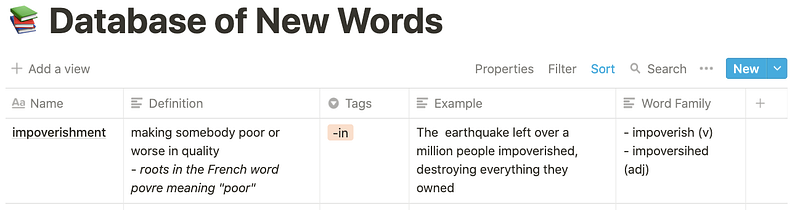
The final result looks like the picture below.
Notion Database/table

I try to write the definition by using my own words, add a root reference and come up with examples representing a real-life use of the word (if it doesn’t have a real-life used, then for me, it’s not worth learning a word). The tag is up to you; I sometimes add the prefix and suffix of words as tags to study new words with similar meanings by filtering by tags. Word families help me learn 2 or more words instead of just 1. I explain more about this in the next section.

3. Learn multiple words when you’re supposed to learn 1 by studying prefixes, word families and a foreign language

Here I’m not going to make you study Latin to improve your vocabulary (unless you want to). I’ve never studied Latin because it’s considered a dead language, so I wouldn’t find any native speaker to practice the language and memorize the vocabulary. However, Latin spread into different parts of Europe and evolved over a period of time to give birth to various Romance languages, so I think it’s a better idea to study Romance languages such as French, Spanish, Portuguese, Italian, or Romanian instead of Latin.

Thanks to my knowledge of Spanish and Portuguese, I can recognize many English words. For example, the word impoverishment listed before in my database looks like the Spanish/Portuguese word pobre or the French word pauvre. The prefix -in, gives the meaning of “in” or “into,” so it's easy to come up with the meaning “into poverty.”

Now that we know how to learn multiple words by speaking a foreign language, I’d show you how to learn multiple words with something intrinsic to the English language — word families.

Word families are groups of words that have a common pattern or meaning. Usually, they share a common base or root word with different prefixes and suffixes. Thanks to a study of the most frequent word families in the British National Corpus, there are available 28-word family lists ranked by level of difficulty.

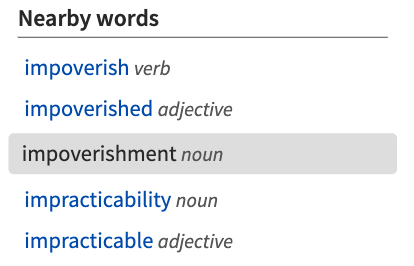
As an example, I created a searchable table that shows the base word and word family of English words “level 6”. If you just learned a new word, you can easily find its word families by typing the word in the table. For example, if you type impoverishment, the words impoverish and impoverished will show up. The difficulty of the word-family lists was determined with a corpus analysis, so the basic words (starting on level 1) are the most frequent words encountered in the corpus, while advanced words are the less frequent words.

If you want, I can add all the lists to the table above so you can search the word family of any word. Anyway, you can also find word family in the “nearby words” section of online dictionaries like Oxford.
Oxford Dictionary

4. Watch TV shows with high vocabulary repetition

This last way to expand your vocabulary might surprise you, but yes, TV can help you increase your vocabulary (at least passive vocabulary).

Research has shown that TV helps students learn new words in a foreign language thanks to word repetition. Basically, you hear a word in one episode, then you hear it more times in the TV show and then at least you are able to recognize that word the next time you hear it.

Previously I carried out a data analysis on the vocabulary used on Netflix shows and Disney movies based on the word families I talked about before. A common pattern I found is that documentaries are the content you need to watch if your native language is English and wish to increase your vocabulary.

If you check the left side of the plot below, you’ll find the content that uses advanced vocabulary (most of them are documentaries). I usually recommend foreign language students to watch content from the right side because they mostly have a basic vocabulary, but since English is your native language, consider watching content with a vast vocabulary to learn words on Netflix.

In case you’re learning a foreign language (especially if it’s a Romance language), then I have more good news for you — TV shows will help you learn tons of useful vocabulary. A few months ago, I carried out a data analysis to find TV shows that will increase the chances of learning intermediate and advanced vocabulary through word repetition, obtaining the following results.

The shows with more word repetition (y-axis) will help you learn more new words. Increase your vocabulary in a foreign language by watching those shows with more word repetition like The Simpsons.

Reading is not enough to become fluent in a foreign language. Join our YouTube channel with 1K+ subscribers to complement your language learning by watching shows & movies you love.

Education
Books
Creativity
Productivity
Technology
Recommended from ReadMedium