
How to Improve Your Language Skills by Journaling in a Foreign Language
I’ve done it for over 3 years.
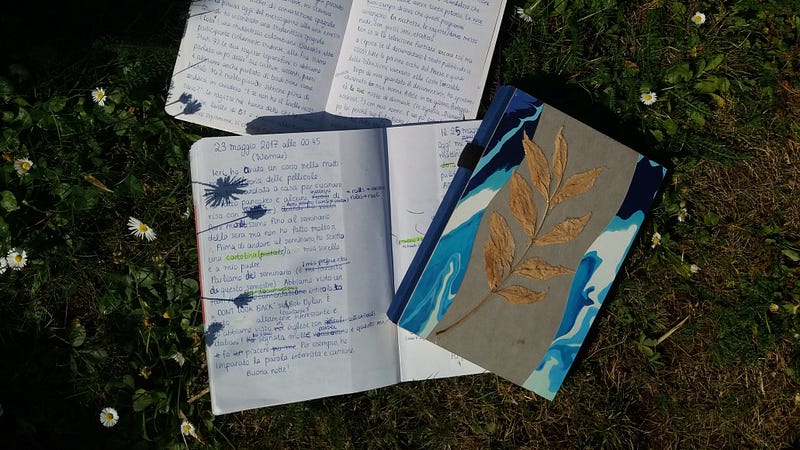
“Writing a diary in a foreign language?”, you might think. “I don’t even write one in my own mother tongue! Isn’t that for a thing for teenage schoolgirls?” No! Let me convince you that journaling is an amazing opportunity to make you more confident in any foreign language you are trying to learn.
How I got into journaling in Italian
The reason I started writing my diary in languages other than my mother tongue (German) was an Italian tandem partner that I had more than three years ago. She was an exchange student at my German university, and we would meet in the park and write down dialogues about ordering coffee and cooking pasta — first in German, then in Italian.
At some point, she came up with an idea:
“Let’s both start writing a diary in our respective target languages and then correct our entries when we meet next time!”
It sounded like a crazy idea to me since I had just started learning Italian. Nevertheless, I agreed and went to the nearest stationery shop where I bought a thin notebook, thinking that I wouldn’t keep up journaling for a long time. Ever since that day in May 2017, I’ve been filling diary after diary in Italian and other foreign languages (namely Spanish and Swedish).
Now just like me, you might be passionate about learning and improving one or several foreign languages, but you may have some qualms when it comes to writing a diary: What is the point of it, really? What if I really suck at that language because I’ve just started? And how do I know that I’m improving? I hope to deliver some answers from my personal experience and to make you as excited about this practice as I am.
“How high does my language level have to be when I’m starting out?”
Many people cling on to the misconception that they need a certain level in a foreign language to start doing specific things: talking to natives, reading a book, watching the news… I believe this attitude is a nuisance to progress — you do not have to be great at something when starting it, but who knows, it might be lots of fun and help you make great progress. If you free yourself from the fear of making mistakes or not understanding everything, you will adopt a very productive “Let’s try it out!”-attitude.
The same applies to journaling: There are very few prerequisites to starting out a diary in another language. You should know the alphabet of your target language and the most basic words. You might have heard of online lists with “The 100 [or more] most used words in language XY”. Knowing these words will be a big plus. They usually include the most common verbs (to go, to say, to write), prepositions (in, on, with), pronouns (you, me, I) and nouns (house, street, day). However, don’t exert too much pressure on yourself: Your first entry can be “Hello, I am learning language XY. Goodbye.” Even if you google half the words, it is a small success.
“Why should I journal in a foreign language?”
1 You will acquire vocabulary that is relevant to your own life. What you write about your personal life is of the biggest interest to you. You can look up words you don’t know and will, therefore, learn vocabulary that is related to your job or studies, your passions, your struggles, etc.
2 If you have no or not much experience with journaling, writing about what you do or feel might feel awkward in the beginning. I found that doing it in a different language gave me less of an awkward feeling — perhaps because the foreign language created a certain distance between myself and the words I had written.
3 Journaling can be done everywhere in the world, as long as you take your diary with you. It is a language practice that doesn’t depend on the country you live in, whether you have people to practice your target language with, or whether you have an internet connection. There’s no excuse! Pen and paper are sufficient.
4 Nobody will judge you. That will make you more confident because you won’t worry about making mistakes too much. If you write with that spirit, it will most likely transfer to speaking to natives and you’ll express yourself more freely. I also noticed that in every language, be it Italian or Swedish, my entries start out to be short and basic and become longer and longer over time, as I learn new words and feel more comfortable in that language. I start with what I do and after some time recount what I do and feel.
5 Journaling in another language is more secretive. I honestly like the idea that in my home country Germany, few people can immediately understand what I write, especially because I journal in different languages. Even though there are “photo translator” apps — trust me, they won’t be able to translate each and every sentence from a handwritten text correctly.
6 You might start thinking in your target language after some time. I sometimes do something and think about how I would write about it in my diary. Let’s say I’m on the train and think “So in Swedish, this would be ‘Jag sitter på tåget’ but in Italian, I would write ‘Sono sul treno’.”

“Do I have to write every day, and does it have to be super personal?”
Journaling comes with no predefined rules. I personally only journal when I feel like it, which sometimes happens to be on four days in a row, sometimes not at all for a whole month. The whole point of the diary is obviously to practice another language, so it’s useful to journal regularly, but nobody holds you accountable for it, so don’t feel pressured!
The content is entirely up to you. It can of course be a recall of your deepest sorrows and your best achievements, but it can as well be a description of your day or your thoughts about the city you live in or a movie you’ve watched. I recommend that you start every entry by the date, the place you’re at, the day of the week and perhaps the time.
You should know from experience that weekends don’t feel like labor days and that your thoughts in the late evening might not resemble those in the early morning. I sometimes also add the song I have in my head while writing.
Digital or handwritten?
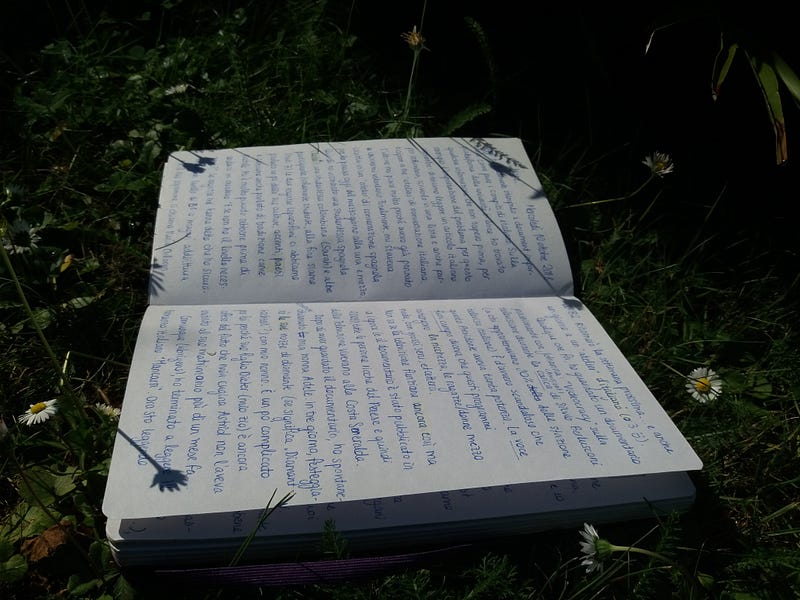
To me, a handwritten diary is a much better choice. It’s interesting to see how one’s own handwriting changes over time and it allows you to be more creative, for instance by drawing. Furthermore, most of us already spend a lot of time in front of screens.
The most important argument against a handwritten diary might be that no program like Word or Grammarly is there to correct your spelling mistakes. For me, that’s no problem because even if I make spelling mistakes, I will at some point learn the correct version and from then on write it correctly — I find that more genuine and it helps me be less perfectionist.
“How do I know when I make mistakes?”
Good question. The answer is: You will not know it unless you let a person with a much higher language command read and correct your entries. If you’re lucky, that could be your partner, a friend, or a language tandem partner. The danger of that: Once your language level is high enough, you’ll be able to write about such complex and deep emotions that you might prefer keeping the diary to yourself (my experience).
While my Italian tandem partner corrected my first entries in which I simply described that I went to university or baked a cake, I now sometimes write down pretty intimate things, which is why I would not share my diary with anybody anymore.
When I go over my old Italian entries, I sometimes correct my mistakes (not with a tip-ex, that would feel like cheating) and it makes me realize how much my language level has improved.
Keeping it to myself has another upside: Other than myself, nobody is there to laugh about silly mistakes or judge my innermost reflections.
“Is it a good idea to switch languages within my journal?”
In my diary, I switch between Italian, Spanish, Swedish, and rarely English. (This is not to brag about my language skills — I only know languages based on the Latin alphabet and they have a lot of similarities.) My point is: I started out journaling purely in Italian and gradually added entries in Spanish and Swedish.
It can help you to choose just two languages and to alternate between them for every other diary entry — I did this with Italian and Spanish for several months. This way, you make sure to practice both equally.
Lately, I’ve been “going with the flow” and starting every diary entry in the language that I feel like in that exact moment. It also happens that I switch the language in between one entry, but I find that more complicated, so I prefer to stick to just one at a time. I don’t recommend writing in several languages in which you consider yourself to be a complete beginner (just like I do not recommend learning several languages from scratch at the same time at all).
It’s your turn
Start experimenting and having fun with your personal diary! Feel free to draw, change colors, write down quotations, make a list of your future plans, write about the books you’ve read and the movies that have moved you to tears, the people that have changed your life and the places in your city which you like the most.
Nobody holds you accountable for your language progress — this diary can be your own project to look back on and forward to!
© Annika Erika 2020


