
How to Get Past the Feeling Your Story is Awful
Take a break then I’ll show you how to fix it
A reader emailed me about a story she wrote.
She said it was awful.
So I read it.
As it stood, her story wasn’t publishable.
It was dead.
It wasn’t a sudden death. Dying didn’t start with the first word or sentence. It was a slow terminal cancer that ate away at the heart of the story until it was too late.
So let me ask you, have you written a story or article that you felt was awful?
Before you reached the end of the story were you asking:
What happened?
Where did I go wrong?
As you wrote your story, you believed you were creating a masterpiece, a thing of beauty.
Instead, when you read the completed story, you felt you created a monster. A Frankenstein story patched together with parts dug from the graveyard of your mind.
When you finished reading, did one word come to mind?
Was it “awful”?
After reading my reader’s story, I emailed her:
Before you press the delete key to remove your story from the world, I have two questions for you.
What if you can fix it? What if you can bring the story to life?
If you will give me a few minutes, I’ll tell you what I do to get past the feeling my story is awful. And I’ll tell you how I fix it.
Before you do anything, take a break.
Take a 2-hour break
Some people say to wait until the next day or even a few days before you edit your story. If that’s what works for you, do it. For me, two hours away from the keyboard is all I need.
So here’s the deal. I pound out a story like a cookie monster eats cookies. I have one goal: get the thing written. So I munch away, gobbling down cookies as fast as I can, and there are crumbs scattered all around. By the time I’m done with my first draft, it’s a mess.
Once I’m done writing, I close the laptop, then grab my wife, and we go out. I need time away to reset my mind. Because I write in the afternoon, most of the time we go out for dinner.
Two hours later, I’m home and ready to fix my story.
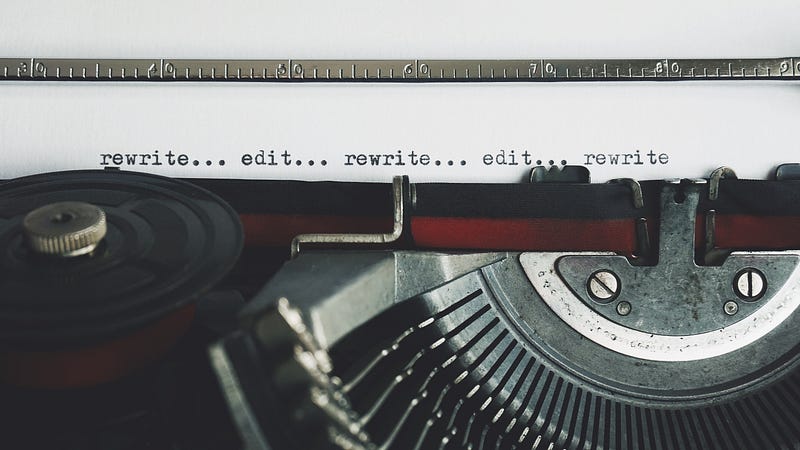
It starts with rewriting.
Rewrite #1 — Edit without mercy
I open the computer and start reading. What I thought was a great story while writing it is rough. But this is the first of 2 or 3 rewrites, so I know I’ll fix it.
Even with a 2-hour break, I find places in my story that have gone off the rails, other places it went into a ditch and don’t even know how it got there, and I’ll find a black hole or two that swallow parts of the story and make no sense.
At this stage, I don’t worry about grammar, spelling, or tone. This is a hammer, chisel, and saw work. It’s moving walls and squaring doors and making sure every room has a window. It’s getting the bathtub out of the living room and into the bathroom where it belongs.
This is hard work. And by the time I’m done, my story will lose a lot of weight. It is thinner and leaner. But this rewrite is the first step in getting the story right.
Before I forget, I write long. It’s a good practice to get into. I feel that if I have to add to a story, I’m cheating. I’m just padding. But if I write long, maybe 2000 words for a 1200 word story, I have plenty of room to cut. And believe me, I cut like Edward Scissorhands pruning a shrub.
Cutting isn’t cheating my readers. It is my way of appreciating their time by giving them the meat of my story without the fat.
Rewrite #2 — Fine-tune the story
In the first rewrite, the story gets manhandled and reorganized. And when it’s done, the story has transformed from something awful to something readable. It’s better, but it isn’t a finished story.
In my second rewrite, I work on passive voice and adverbs.
Silence the passive voice
I tutored college English for several years. While tutoring, I found passive writing is so common that it’s normal. I believe people are not confident in writing, so they adopt a timid style of writing. It’s called the passive voice. As a writer, use the active voice unless you are trying to make a stylistic effect.
As a general rule, the passive voice is weak writing. Let me give you an example:
My story is going to be edited by me tomorrow. (passive)
I’m editing my story tomorrow. (active)
The active voice is stronger and to the point. And it’s easy to understand. But there are times, for stylistic reasons, the passive voice is fine. So I won’t say never use the passive voice. But be sure you are using it on purpose.
As much as possible, write in the active voice.
If you want to read more about passive and active voice, click here for a great article that’s easy to read and doesn’t plow through the weeds.
Watch your adverbs
In case you don’t know what an adverb is, it is a modifier used with verbs, other adverbs, and adjectives. The easiest to identify and most used adverbs are those words that end in -ly.
A good example of an adverb is very. People use it all the time, and I hate it. Every time I hear it used, I cringe. “He is very brilliant.” No, he’s brilliant. Have you ever met a half brilliant person? “I am very exhausted.” Can you be a little exhausted or maybe half exhausted? Exhausted doesn’t need quantification.
Once I’ve rewritten my story, I copy and paste the entire story into ADVERBless (adverbless.com). It’s a free service and it will highlight all the adverbs in your story. I look at every adverb, then I decide if it adds to the strength and clarity of the sentence. If it doesn’t, I cut it.
You don’t have to change or delete all adverbs.
Here’s an example where an adverb is the right word to use.
In this story, I wrote the sentence, “Where did I go wrong.” The word “where” is an adverb, but using it makes sense because the sentence is a quote.
By now, your story is shining. It may not turn heads like an exorcism, but it is much better.
Now to take it from better to great.
Rewrite #3 — Read it again out loud
I’ll be honest. I don’t like reading my stories out loud. I always find something to change or fix.
And that’s why I do it.
By hearing your story, your ear will pick up sentences or paragraphs that don’t work. You’ll hear things and ask yourself what it is you are trying to communicate. And you’ll also hear where the story loses its flow, like a car running over a pothole.
If you have someone who will listen to your story, use that person. Mom, dad, wife or husband isn’t the best choice because they won’t always be honest. But I’ll use whoever will listen.
To recap what you’ve done so far.
- You’ve written a story and hate it. Kudos to you for getting it written. Don’t throw it away; you can fix it, even if it's awful.
- You took a break after the first draft. How long you took doesn’t matter, as long as it’s over 2 hours. I don’t have a scientific reason for a minimum of two hours; it’s what I recommend to my college students, and it worked for them.
- You did a major rewrite, working on it until you got the structure right.
- You did a grammar rewrite. You fixed the voice of your sentences and got rid of most or all your adverbs.
- You’ve read your story out loud to yourself and I hope someone else.
You have one last thing to do.
Send it to a publisher or publish it yourself.
Now get started on your next story!


