
9 Most Inspiring Quotes by Ancient Philosophers For Modern Writers
Amazing advice applicable to today’s writers

Because writing is a craft best done alone, a good quote is not only encouraging, it inspires.
I’ve assembled some of the best quotes about writing from ancient philosophers. From getting started writing something new to how to express yourself to the average reader to never quitting each quote covers one aspect of writing.
Even though these people lived thousands of years ago, their thoughts apply to today’s writers.

1. “Do not say a little in many words but a great deal in few.” — Pythagoras
Even though Pythagoras is famous for Pythagoras’s Theorem, he was also a philosopher. And although he lived thousands of years ago, his words hold true to this day. This quote reminds me to keep my writing tight and to the point.
How to apply it:
Print and tape this quote to your computer as a reminder to edit without mercy, then edit again.

2. “Our greatest glory is not in never failing, but in rising every time we fall.” — Confucius
There isn’t a writer who hasn’t failed and failed a lot.
- William Saroyan published his first short story after receiving thousands of rejections that made a stack 30 inches tall.
- Stephen King’s book Carrie received 30 rejections
- Margaret Mitchell received 38 rejections before published Gone with the Wind
This quote is a constant reminder that failure happens to everyone, but the true successes are those people that never quit.
How to apply:
A rejected story only means the editor didn’t accept it. Go back through the article and figure out why it failed. Fix it, then send it out again.
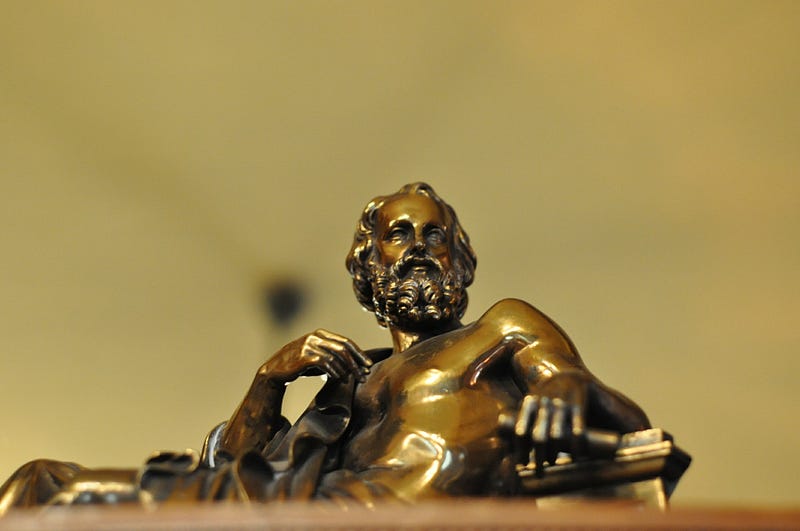
3. “The beginning is the most important part of the work.” — Plato
After you’ve written an impressive title, you’ll need an impressive beginning.
Stephen King’s book Cujo begins “Once upon a time, not so long ago, a monster came to the small town of Castle Rock, Maine.” The first sentence draws me into the story. I want to know more. Is this a fairy tale? What kind of monster came to the town? Why did it come to that town?
How to apply:
Start your story by creating a mini-mystery. Or begin with a powerful statement. Whether it’s fiction or non-fiction, a story or an article, the beginning must draw the reader into wanting to know more.
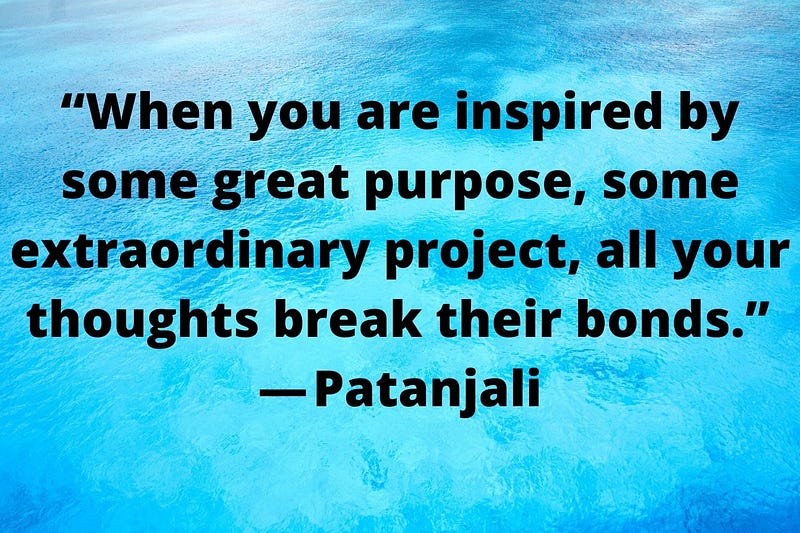
4. “When you are inspired by some great purpose, some extraordinary project, all your thoughts break their bonds.” — Patanjali
The two words that stand out are “inspired” and “purpose”. When a writer has an inspiration and a purpose, the article or story will write itself.
When I read about a writer who has struggled for hours trying to write a story, I wonder if the writing is being forced. Patanjali said that when inspiration combines with purpose a person’s thoughts will have no limits.
How to apply:
If you are struggling with a story, take a break to find out if you feel inspired to write it. If you don’t feel excited by what you are writing, set the story aside until you are ready to write it. In the meantime, work on something else.

5. “We are what we repeatedly do. Excellence then is not an act, but a habit.” — Aristotle
There is some dispute about Aristotle making this statement. But it is true.
If there is one thing that will make a better writer, it is writing every day until it becomes a habit.
Repetition isn’t unique to writing. Anyone considered good at what they do become that way by doing the same thing hundreds and thousands of times.
You don’t have to complete a story every day. But it’s important to write every day. This is the best way to hone your writing skills.
How to apply:
Started writing a new story or article. If you don’t have a story in mind, write a set of titles or a first paragraph. Be creative.
An excellent exercise is to write a description of something common, a garbage can, a water sprinkler, or a chair. Then write about whatever you’ve chosen so that the reader feels some emotion like dread, fear, happiness, or calm.

6. “Make the best use of what’s in your power and take the rest as it happens.” — Epictetus
Writers must accept that things don’t always go as planned.
I’m always surprised when a publisher doesn’t accept my work. I understand that’s part of this business, but I don’t like it.
I can control my writing by doing the best I can with my skills, but I can’t control how an editor or publisher will look at it.
You probably feel the same.
How to apply:
Every day find or do something that will improve your skills. Write a new story or article, read a book or article about writing, or practice your skills. If a story or article gets rejected or you received a critical comment, accept it, and move on.

7. “Embrace simplicity.” Lao Tzu
When writing, it is easy to get lost in the weeds.
Embracing simplicity can be anything from using the wrong punctuation to puffing up a story to reach 1000 words. Or writing walls of texts instead of breaking paragraphs into smaller pieces. Don’t use 100 words to say something that you could say in 20 or even 10 words.
How to apply:
Write sparingly by using only enough words to tell the tale. Break paragraphs into smaller pieces so the reader sees a lot of white and not a wall of text. And rely more on commas and periods than on colons and semicolons.

8. “He has half the deed is done who has made a beginning.” — Horace
Procrastination has ended a lot of stories before they got started.
This gets back to getting into a habit of writing. Sometimes it’s hard to sit down and start typing. But if you’ve developed a habit of writing daily, the task is easier. And once the words flow, the story grows.
How to apply:
This is another quote to post where you see it every day.
Start writing with a powerful statement or a question. Then build your opening around it. By the time you finish with the opening, the rest of the story will naturally unfold.
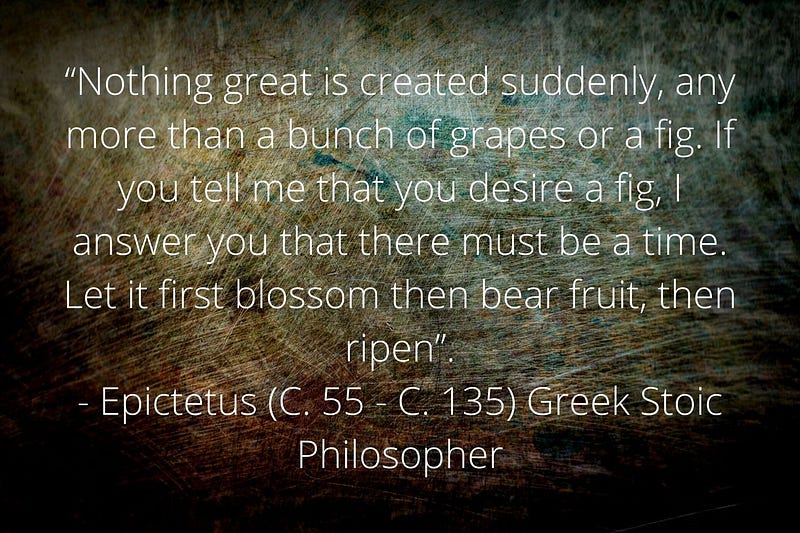
9. “Nothing great is created suddenly, any more than a bunch of grapes or a fig. If you tell me that you desire a fig, I answer you that there must be a time. Let it first blossom then bear fruit, then ripen.” — Epictetus
This quote sums up the writing process. Sometimes a story comes to us fully fleshed in a flash. Or at least that’s what we think. More than likely the story has been growing for some time in our subconscious mind.
Other times, we mull over an idea for months or years.
Either way, a story or article needs time to develop. You may start writing, then you find the idea fizzles. It doesn’t mean it’s a bad idea. What it needs is time to ripen, so save it.
How to apply:
Create a writer’s journal. In it write story ideas, impressions, or random thoughts.
If you get writer’s block, go through your journal. Something will stand out that demands you write it.


