avatarDesiree Driesenaar

Free AI web copilot to create summaries, insights and extended knowledge, download it at here

4853

Abstract

be action alright. It’s just that the right timing has everything to do with it. Flow. Authenticity. Being, just being. And then doing the right thing, guided by your inner wisdom.</p><p id="d029">In my opinion, you can only really understand the depth of these concepts if you stop the overthinking and start including your intuition. You have to feel through them.</p><p id="3336">And even then… It’s hard to grasp them fully as a non-Asian person.</p><p id="60ec">Therefore, I really like the effort Benjamin Hoff made with the ‘Tao of Pooh’. <a href="https://en.wikipedia.org/wiki/Tao">The Tao</a> is a complex, layered, and deep doctrine. The word Tao or Dao is the Chinese word for ‘way’, ‘path’ or ‘route’.</p><p id="7c2f">The book starts describing a painting. The Chinese vinegar tasters. Three wise men who taste from a bowl of vinegar.</p><div id="4dd1" class="link-block"> <a href="https://en.wikipedia.org/wiki/Vinegar_tasters"> <div> <div> <h2>Vinegar tasters</h2> <div><h3>The Vinegar Tasters (三酸圖; 'three sours'; 嘗醋翁; 'vinegar tasting old-men'; 嘗醋圖, 尝醋图) is a traditional subject in Chinese…</h3></div> <div><p>en.wikipedia.org</p></div> </div> <div> <div style="background-image: url(https://miro.readmedium.com/v2/resize:fit:320/0*ZcaQK5VLG_9m7hvP)"></div> </div> </div> </a> </div><p id="73e6">One of them is <a href="https://en.wikipedia.org/wiki/Confucius">Confucius</a>, the second is <a href="https://en.wikipedia.org/wiki/Gautama_Buddha">Buddha</a>, the third is <a href="https://en.wikipedia.org/wiki/Laozi">Lao-Tze</a>, writer of the book Tao Te Ching.</p><p id="53e1">Confucius reacts with a sour expression, Buddha looks bitter, and Lao-Tze has a smile on his face.</p><p id="cd7e"><b>For Confucius</b>, life was sour. He thought that the now was not in line with the past and we should have more respect for our ancestors.</p><p id="70f0"><b>For Buddha</b>, life on earth was bitter. Full of attachments and desires that brought suffering. And although the Buddhist monks found ways to deal with this suffering, their lives were still hindered by the bitter wind of day-to-day existence.</p><p id="f525"><b>According to Lao-Tze</b>, the natural harmony that existed between heaven and earth could be found by anyone. At any time. Anywhere.</p><p id="e96c">Lao-Tsu showed us that the laws of nature are influencing the planets, the birds in the woods, and the fish in the oceans. The more humans would disturb the natural balance made by the laws of nature, the more harmony would retract herself in the distance.</p><p id="65d1"><b>The more forceful our interventions, the more trouble will result.</b></p><blockquote id="c9d0"><p>So what does this have to do with vinegar? Why does Lao-Tze smile? Vinegar is always tasting horrible, isn’t it?</p></blockquote><p id="17d2">Well, the natural circumstances of life are represented by the vinegar.</p><p id="2d83">So, living in harmony with the laws of nature is the way. Every happening that might be perceived as negative by some, is turned to positive by the Taoists. Everything is a lesson. And learning is the path to wisdom.</p><p id="396e">In Tao, sourness and bitterness are a matter of the mind. The mind, rational thought, disrupts and doesn’t know any appreciation.</p><p id="2bd4">Life itself, when it’s understood and lived with purpose, is always sweet.</p><p id="9799"><i>By the way, this is the author’s interpretation. I find wisdom in all three. Tao, Confucianism, and Buddhism.</i></p><p id="421c">And then, just when you think it’s getting too difficult… When you want to grab your hair and grunt. Give up. Go do something useful instead of reading about all this inner wisdom nonsense…</p><figure id="74d5"><img src="https://cdn-images-1.readmedium.com/v2/resize:fit:800/1*Aklmju-l-kpQ9GWEaIgyKw.jpeg"><figcaption>Photo by <a href="https://unsplash.com/@gezerbatu?utm_source=unsplash&amp;utm_medium=referral&amp;utm_content=creditCopyText">Batu Gezer</a> on <a href="https://unsplash.com/s/photos/hands-in-hair?utm_source=unsplash&amp;utm_medium=referral&amp;utm_content=creditCopyText">Unsplash</a></figcaption></figure><p id="e65c">Tada… there’s Winnie the Pooh.</p><p id="29b1">A small, fat bear who potters about aimlessly, asks simple questions, sings silly songs and experiences adventures. Without any hint of gaining intellectual knowledge. Without losing his simple happiness.</p><p id="89b9">That’s the Tao of Pooh.</p><p id="38ad">Always living in the present moment. Today. This minute. This second. Feeling the wind in your hair. Hearing the birdsong. Tasting the apple.</p><p id="a3d6">Listening closely to what someone has to say instead of already formulating the answ

Options

er in your head. Caring. Creating. Living fully!</p><figure id="cde7"><img src="https://cdn-images-1.readmedium.com/v2/resize:fit:800/1*9e97HlXhETjcqo1H997LQw.jpeg"><figcaption>From the Tao of Pooh.</figcaption></figure><h2 id="0057">So what did I learn from this silly bear?</h2><p id="5824">Maybe it’s good to know a little about my background. I’ve always been surrounded by very rational people. I worked in business-like, sometimes also very intellectual, environments.</p><div id="8778" class="link-block"> <a href="https://readmedium.com/nature-me-and-others-fddd71910718"> <div> <div> <h2>Nature, Me, and Others</h2> <div><h3>Here’s my story, especially for Illumination readers, editors, and writers and the rest of my audience…</h3></div> <div><p>medium.com</p></div> </div> <div> <div style="background-image: url(https://miro.readmedium.com/v2/resize:fit:320/1*xM4d3Ngh-wmBuj2j6BZXvA.jpeg)"></div> </div> </div> </a> </div><p id="19a7">During my life, I had to learn how to fully include my heart and hands. There were so many fixed stories about myself and the world in my head.</p><p id="bdba">Being in the present moment started out as a concept for me. I could read about it in <a href="https://en.wikipedia.org/wiki/The_Power_of_Now">‘The Power of Now’ by Eckhart Tolle</a>, but I couldn’t feel it. Not really.</p><p id="7686">I made my life very difficult. Serious was my middle name. And ‘must’ was a strong word for me. I had to do and be a lot of things from myself. And in the meantime, the real wisdom couldn’t come through.</p><p id="943e">Until I broke the patterns.</p><p id="f6e9">Until I trained my bodily awareness and consciousness.</p><p id="8596">Pooh made me see that life was far simpler than I thought.</p><p id="494c">What if I just sang a song today? Laughed out loud? Smiled to a stranger? What if I would just take the time to smell the roses?</p><p id="7f45">I trained my brain to calm my frantic thoughts and my fierce emotions. I trained my body to feel the flow. That matters. It’s where real wisdom can be found.</p><p id="6b6a">My life looks more like Pooh’s now.</p><p id="14de"><i>Simple.</i></p><p id="774f"><i>Calm.</i></p><p id="45d8"><i>And so much fun!</i></p><p id="1482">I’ve never looked back!</p><p id="8781">If you want to connect, you can find me on <a href="https://www.linkedin.com/in/desireedriesenaar/">LinkedIn</a>. On <a href="https://www.facebook.com/desiree.driesenaar">Facebook</a>. Or somewhere smelling the roses…</p><p id="e2ed"><i>Thank you, Mike, for adding your wise energy to my words.</i></p><h2 id="9501">Further reading</h2><p id="0876">Grown curious about the other bits? On climate change? Systemic solutions? Love for Gaia? Here are some other stories.</p><div id="7480" class="link-block"> <a href="https://readmedium.com/climate-change-is-not-our-most-important-problem-9fca1a7067f3"> <div> <div> <h2>Climate Change Is Not Our Most Important Problem</h2> <div><h3>But is that relevant?</h3></div> <div><p>medium.com</p></div> </div> <div> <div style="background-image: url(https://miro.readmedium.com/v2/resize:fit:320/1*hFgRJKtCApXypq5XvlOjKQ.png)"></div> </div> </div> </a> </div><div id="5ab0" class="link-block"> <a href="https://readmedium.com/urgent-need-for-systemic-solutions-indonesia-is-sinking-a9e5e2566c82"> <div> <div> <h2>Urgent Need for Systemic Solutions — Indonesia Is Sinking!</h2> <div><h3>Systemic solutions to complex problems can be found! Use a machete and you’ll find clarity for water problems</h3></div> <div><p>medium.com</p></div> </div> <div> <div style="background-image: url(https://miro.readmedium.com/v2/resize:fit:320/1*rO_xsiz7B-IjNCC-WCUjvg.jpeg)"></div> </div> </div> </a> </div><div id="41ad" class="link-block"> <a href="https://readmedium.com/mother-nature-is-speaking-louder-and-louder-5d842da61899"> <div> <div> <h2>Mother Nature Is Speaking Louder and Louder</h2> <div><h3>And the women of the world are listening, and acting…</h3></div> <div><p>medium.com</p></div> </div> <div> <div style="background-image: url(https://miro.readmedium.com/v2/resize:fit:320/1*1YVArAL3M3udFc3J6-j9dQ.jpeg)"></div> </div> </div> </a> </div></article></body>

Life Lessons

How to Focus Fully on the Wisdom of a Simplistic Bear

What I learned from ‘The Tao of Pooh’ — a masterpiece of wisdom and ingenuity
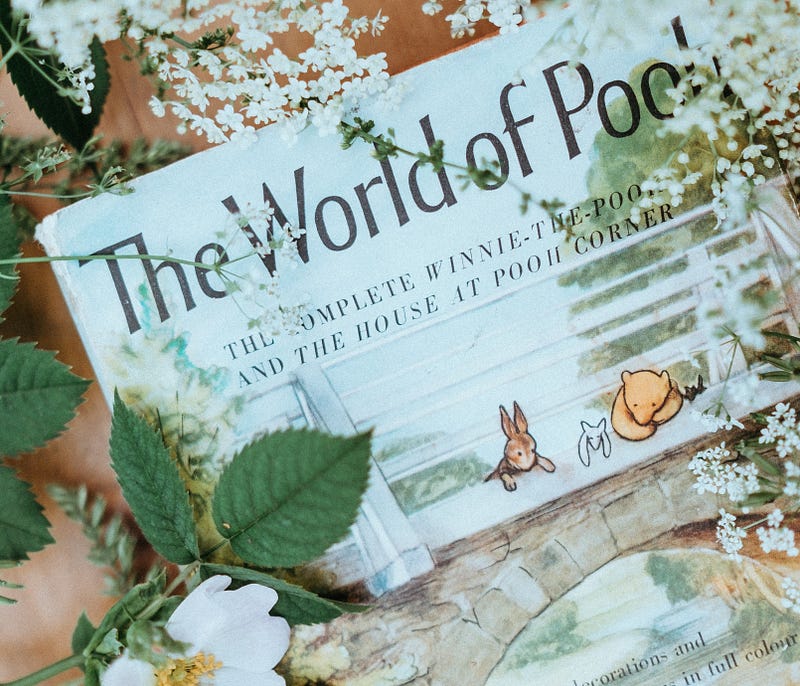
Photo by Annie Spratt on Unsplash

To be honest, I never thought I would write about a bear. Not even a Pooh bear. Although I love him to bits.

I write about climate change. The environment. And systemic solutions to the world’s greatest problems. I write for decisionmakers and entrepreneurs. For students and activists. For architects and designers. For changemakers.

So why write about a silly, fictional bear?

Maybe because these important solutions to great problems must be coming from awake, aware people? And doesn’t this awareness has to grow?

Word for word.

Thought for thought.

Feeling for feeling.

One step at a time…

Then I read this story by Amy Marley.

She writes about a kids’ movie, Kungfu Panda, and how it inspires us to grow as human beings.

I decided there and then that I’ll write about The Tao of Pooh. The book that’s been with me for years. The book I love and treasure. It’s this book by Benjamin Hoff.

Featuring A.A. Milne’s ‘Winnie the Pooh’ characters.

Pooh, Piglet, and Eeyore.

Tigger, Owl, and Rabbit.

Mine is a secondhand, Dutch version with beautiful illustrations by E.H. Shepard.

In our Western world, there’s a growing interest in Asian spirituality. Whereas the people in the east are looking towards the west for the wealth and riches of capitalism, we’re looking east for inner wisdom.

The more I try to understand the different flavors in this eastern spiritual diversity, the more I find it’s not easy to translate eastern wisdom for westerners.

We tend to flatten things. Make them tangible. And then less true.

Take a concept like the Japanese Wabi-Sabi

“Beauty that’s imperfect, impermanent, and incomplete”

We think that we can do anything. And as long as it’s decaying or imperfect, it’s Wabi-Sabi.

Well, no.

It should be beautiful alright. This concept of impermanence harbors the Golden Ratio and all other laws of nature. It’s just far more complex than we can grasp with our minds.

Or the Chinese Wu Wei

“Doing without doing, effortless action”

We think it’s kind of lazy. Doing nothing, Being laid back, and then things will come our way.

Well, no.

It should be action alright. It’s just that the right timing has everything to do with it. Flow. Authenticity. Being, just being. And then doing the right thing, guided by your inner wisdom.

In my opinion, you can only really understand the depth of these concepts if you stop the overthinking and start including your intuition. You have to feel through them.

And even then… It’s hard to grasp them fully as a non-Asian person.

Therefore, I really like the effort Benjamin Hoff made with the ‘Tao of Pooh’. The Tao is a complex, layered, and deep doctrine. The word Tao or Dao is the Chinese word for ‘way’, ‘path’ or ‘route’.

The book starts describing a painting. The Chinese vinegar tasters. Three wise men who taste from a bowl of vinegar.

One of them is Confucius, the second is Buddha, the third is Lao-Tze, writer of the book Tao Te Ching.

Confucius reacts with a sour expression, Buddha looks bitter, and Lao-Tze has a smile on his face.

For Confucius, life was sour. He thought that the now was not in line with the past and we should have more respect for our ancestors.

For Buddha, life on earth was bitter. Full of attachments and desires that brought suffering. And although the Buddhist monks found ways to deal with this suffering, their lives were still hindered by the bitter wind of day-to-day existence.

According to Lao-Tze, the natural harmony that existed between heaven and earth could be found by anyone. At any time. Anywhere.

Lao-Tsu showed us that the laws of nature are influencing the planets, the birds in the woods, and the fish in the oceans. The more humans would disturb the natural balance made by the laws of nature, the more harmony would retract herself in the distance.

The more forceful our interventions, the more trouble will result.

So what does this have to do with vinegar? Why does Lao-Tze smile? Vinegar is always tasting horrible, isn’t it?

Well, the natural circumstances of life are represented by the vinegar.

So, living in harmony with the laws of nature is the way. Every happening that might be perceived as negative by some, is turned to positive by the Taoists. Everything is a lesson. And learning is the path to wisdom.

In Tao, sourness and bitterness are a matter of the mind. The mind, rational thought, disrupts and doesn’t know any appreciation.

Life itself, when it’s understood and lived with purpose, is always sweet.

By the way, this is the author’s interpretation. I find wisdom in all three. Tao, Confucianism, and Buddhism.

And then, just when you think it’s getting too difficult… When you want to grab your hair and grunt. Give up. Go do something useful instead of reading about all this inner wisdom nonsense…

Photo by Batu Gezer on Unsplash

Tada… there’s Winnie the Pooh.

A small, fat bear who potters about aimlessly, asks simple questions, sings silly songs and experiences adventures. Without any hint of gaining intellectual knowledge. Without losing his simple happiness.

That’s the Tao of Pooh.

Always living in the present moment. Today. This minute. This second. Feeling the wind in your hair. Hearing the birdsong. Tasting the apple.

Listening closely to what someone has to say instead of already formulating the answer in your head. Caring. Creating. Living fully!

From the Tao of Pooh.

So what did I learn from this silly bear?

Maybe it’s good to know a little about my background. I’ve always been surrounded by very rational people. I worked in business-like, sometimes also very intellectual, environments.

During my life, I had to learn how to fully include my heart and hands. There were so many fixed stories about myself and the world in my head.

Being in the present moment started out as a concept for me. I could read about it in ‘The Power of Now’ by Eckhart Tolle, but I couldn’t feel it. Not really.

I made my life very difficult. Serious was my middle name. And ‘must’ was a strong word for me. I had to do and be a lot of things from myself. And in the meantime, the real wisdom couldn’t come through.

Until I broke the patterns.

Until I trained my bodily awareness and consciousness.

Pooh made me see that life was far simpler than I thought.

What if I just sang a song today? Laughed out loud? Smiled to a stranger? What if I would just take the time to smell the roses?

I trained my brain to calm my frantic thoughts and my fierce emotions. I trained my body to feel the flow. That matters. It’s where real wisdom can be found.

My life looks more like Pooh’s now.

Simple.

Calm.

And so much fun!

I’ve never looked back!

If you want to connect, you can find me on LinkedIn. On Facebook. Or somewhere smelling the roses…

Thank you, Mike, for adding your wise energy to my words.

Further reading

Grown curious about the other bits? On climate change? Systemic solutions? Love for Gaia? Here are some other stories.

Philosophy
Self Improvement
Personal Development
Life Lessons
Life
Recommended from ReadMedium