
How to escape competition (and build a business on your own terms)
A practical framework to build your unique selling proposition

“There is nothing to do in Finland,” they immediately say, reacting to our suggestion. “Why travel there when Europe offers so many cooler destinations like Rome or Paris?”
I want to convince them that Finland has many underestimated gems, including its beautiful nature. But it’s only their second time in Europe and they want to tick the popular spots off their bucket list first.
My wife and I recently moved back to Europe after spending five years in Singapore, and our long-distance calls with the friends we made in Asia often involve suggesting a European destination for our next reunion.
We could have proposed a slightly more “popular” spot, yes. After all, Finland doesn’t share the same reputation as its iconic European competitors.
This fact isn’t lost on the Finns. Indeed, one freezing evening in March 2010, dozens of marketing experts walked into the Sea Horse Restaurant in Helsinki to discuss how to make Finland a world-famous tourist destination.
The problem seemed obvious to everyone:
Finland was known as a rather quiet country.
As the experts spent the evening brainstorming their nation’s strengths, many marketable ideas came out. The country was popular for its educational system. Another strength was its renowned school of functional design. Nudity, someone jokingly proposed, could become a national theme as it would symbolize the honesty of Finns.
Later that year, the delegation finally issued the results of their hard work: The Country Brand Report, which listed a bunch of other themes they came up with that night.
Among the many, one theme stood out:
Silence.
“In the future, people will be prepared to pay for the experience of silence,” the report said. In an increasingly busy and loud world, silence was a resource — and Finland could market it just like its clean water.
The theme made perfect sense because the “quiet” wasn’t reserved to Finland’s natural areas; as a people, their nation valued silence, too.
Finns practiced silence in their everyday communication; lack of small talk or having silent pauses during conversations weren’t considered awkward — they were part of their well-established culture. “Silence is gold, talking is silver,” was one of their national sayings.
The next year, the Finnish Tourist Board kicked off the silence campaign with a series of photographs of lone figures in the wilderness, with the caption “Silence, Please.”
“Handmade in Finnish silence” soon became the new slogan of the Finnish watch company Rönkkö. Consultants continued to recommend other taglines that matched the campaign; “No talking, but action” was one proposed by Simon Anholt, an international country branding consultant.
Authentic, powerful marketing is about being yourself, not fooling people into believing you’re something you’re not.
Finland could have come up with an overpromising campaign like “Incredible Finland.” But they did not. They knew their problem, that Finland was known as a rather quiet country.
Instead of fooling people to think they are incredible, they chose to accept and live their truth.
“We decided, instead of saying that it’s really empty and really quiet and nobody is talking about anything here, let’s embrace it and make it a good thing,” shared Eva Kiviranta, VisitFinland.com’s social media manager.
“You can escape competition through authenticity, when you realize that no one can compete with you on being you.” — Naval Ravikant
Being yourself is good for business. The second day into their one-week trip in Eastern Finland’s wild nature, members of a visiting group were impressed with the overwhelming experience in Finnish silence — something that would not have been possible in their home city of Hong Kong. “The sound of raindrops,” shared one of them. “I had never heard the sound they make.”
The campaign’s success continues to inspire other brands even today. In spring this year, Burger King launched the world’s first 100% silent drive-thru in Helsinki where customers could order and pick up their food without any kind of verbal communication — the perfect Finnish UX.
Instead of battling it out in overly crowded tourism industry, Finland was able to escape competition and create its own lane through the distinctive personality it cultivated from what its nation valued in the first place.
But chances are you don’t have the budget to get dozens of marketing experts to brainstorm for you at Sea Horse Restaurant.
So how do you develop a unique selling proposition on your own?
Meet value-based marketing. When built upon the right framework, it’s what empowers you to build a business on your own terms.
And there is no other framework that nurtures it better than the one we’ll take a look at in a minute.
But let’s move away from the world of tourism for a moment and examine the business side of things.
Value-based marketing vs. feature-based marketing
The world of business isn’t much different than the world of tourism except that copying the features of a company is probably a lot easier than Finland copying Italy’s or France’s monuments.
“A company can’t ‘own’ its facts. If the company’s facts (speed, price, quality) are superior to the competition, any good competitor will duplicate them, or worse, improve upon them, as soon as possible. What a company can own, however, is a personality.”
— Marc Benioff, Salesforce founder
Call it a brand or the emotional connection between you and your customers — having a personality does wonders. Anyone can copy your features overnight, but they can never copy the YOU in your product.
Your facts and features still matter, yes. And no brilliant marketing campaign can save you long-term if you don’t have a sufficiently good product.
But a sufficiently good product (and talking about your features) is no longer sufficient to win in the post-Internet world where most of us are stuck on both ends:
- On the business end: Most verticals like software-as-a-service (SaaS) are about to reach peak competition where companies almost sell a commodity as the copycat competitors take over the market.
- On the customer end: A growing number of studies also suggest that today’s customers no longer perceive a difference between competitive products.
“Customers, generally speaking, see significantly less difference between us and the competition than we do ourselves. It’s not that they think most suppliers are particularly bad on brand, product, or service. It’s just that [customers] don’t think [suppliers are] particularly different.” — CEB
Shifting from feature-based to value-based marketing increases your chances of solving the trouble on both ends:
- Business end: Value-based marketing focuses on values which are difficult to emulate, not features which can be copied.
- Customer end: It equips you with a distinctive personality in a world where customers don’t perceive a difference between competitive products.
To shift from feature-based to value-based marketing…
… shift from starting with your WHAT to your WHY.
“People don’t buy WHAT you do, they buy WHY you do it.” — Simon Sinek
“Start with why” is a powerful framework introduced by the British-American author Simon Sinek.
Sinek challenges the traditional feature-based model, which begins with 1) WHAT the business sells, 2) continues to HOW they do it, and 3) finishes with WHY.
And he proposes to reverse the storytelling order and begin with the WHY.
The traditional model Sinek contrasts is still common among the businesses that end up hard selling by talking only about themselves (WHAT the business sells).
Starting with the WHY, on the other hand, starts with the values both you and your potential customers care about. Because people don’t buy what you do, they buy why you do it.
Apple’s legendary Think Different campaign from 1997 is probably still the best example of a company that starts with the WHY, not the WHAT.
Instead of talking about computer chips or processors, the campaign embraces inspiring values the misfits die for:
Here’s to the crazy ones. The misfits. The rebels. The troublemakers. The round pegs in the square holes. The ones who see things differently. They’re not fond of rules. And they have no respect for the status quo. You can quote them, disagree with them, glorify or vilify them. About the only thing you can’t do is ignore them. Because they change things. They push the human race forward. And while some may see them as the crazy ones, we see genius. Because the people who are crazy enough to think they can change the world, are the ones who do.
Behind the campaign is Apple’s message to the world, the message that explains WHY Apple does WHAT it does:
Everything we do, we believe in challenging the status quo and thinking differently. If you believe in why we do what we do, you are a misfit, too.
An exercise to apply the “start with why” framework to your business
Starting with WHAT can be dangerous. It was one of the mistakes I made in the early days of building my company, Growth Supply.
As a tiny storytelling studio, we were battling out in an overly competitive content marketing industry. And every time a potential client inquired about our services, I was starting the conversation with WHAT we do.
I ended up talking about the quality of our content or the background of our writers and editors. But none of those people cared about what we did, they cared about growing their own businesses.
There were many other content agencies out there and they didn’t perceive any difference if I kept talking about what we sell.
Discovering the “start with why” concept changed the game for us, especially when it came to escaping the competition with our unique proposition.
To apply the framework, I began with a humble brainstorming exercise on a piece of paper.
- On the left side: I listed our WHATs, i.e., the things I thought made us different (even though potential customers didn’t even perceive the difference or couldn’t care less).
- On the right side: I tried to explain WHY I genuinely believed we do WHAT we do, i.e., I matched every one of our WHATs with the WHY behind it.
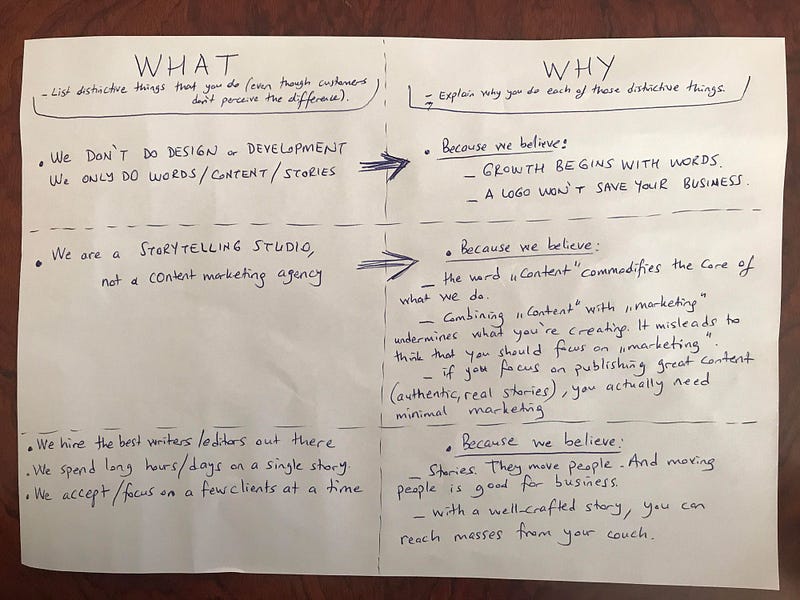
Look at all those WHATs I listed on the left. Why am I the only person who cares about them? I want to run up to those customers and shake them and yell at them that they should also care about what we do. But they don’t.
They care about the WHYs on the right side. They don’t buy what we do, they buy why we do it.
On the bright side, turning your WHATs into your WHYs brings crystal-clear direction to your business. It helps your team to finally understand what to talk or write about (from homepage copy to newsletters) across every customer touchpoint.
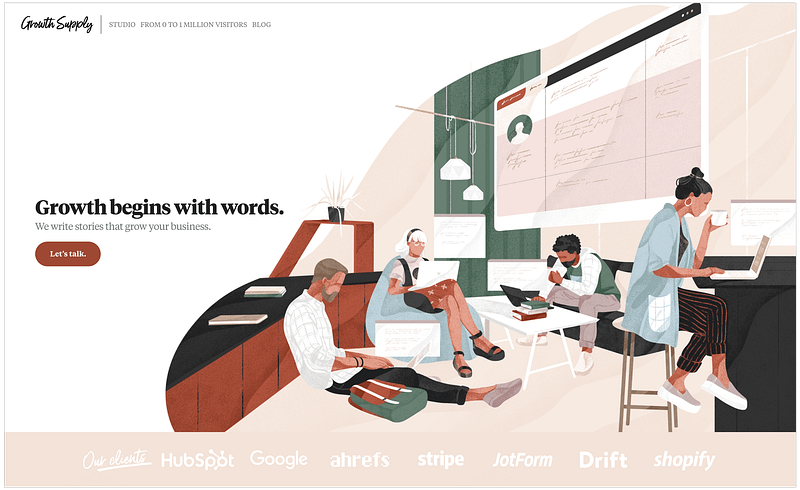
For instance, the first WHY you see on the right side of the brainstorming paper above is now the main tagline of our studio page. The second one later became the topic of one of our most popular blog posts.
Whether you’re a blogger, startup founder, or a freelancer — whatever it is that you do, I recommend taking a few minutes to follow a similar brainstorming exercise on a piece of paper.
Why do you do what you do?
- We believe that growth begins with words, not with a logo.
- Nike believes that if you have a body, you are an athlete.
- Patagonia believes that all life on earth is under the threat of extinction and it’s possible to build a business by doing something about it.
- Apple believes that people who are crazy enough to think they can change the world, are the ones who do.
Your WHYs are why you believe you do what you do.
And if you talk about what you believe, you will attract those who believe what you believe.
“The goal is not to sell to everybody who needs what you have. The goal is to sell to people who believe what you believe.”
When you start with your WHY, you start with what you believe in and value in the first place. And those values attract like-minded people to you.
Finland values silence. And it ends up attracting visitors who value silence, not the party people who would instead be happier in Europe’s vibrant destinations like Ibiza and Mykonos.
When you target everyone, you end up targeting no one. Starting with your WHY helps you to escape competition and create your own lane instead of shooting in the dark and trying to reach all kinds of people in an overly crowded market.
Next time you’re about to send yet another self-promotional newsletter that talks only about the feature you’re launching, try to start with the why behind it.
After all, people don’t buy what you do, they buy why you do it.
This post is part of a series of stories that explore the fundamentals of escaping competition and building a business on your own terms in the most cluttered marketplace in history.1. To build a business empire, own an opinion (not a marketing budget)
The goal is not to sell to everybody who needs what you have.2. How we got 11.3 million pageviews without the growth hacking bullsh*t
Growth begins with words.3. Don't build a startup, build a movement
How to move the masses by going beyond selling just software4. How to escape competition (and build a business on your own terms)
A practical framework to build your unique selling proposition5. Growing startups when the product sucks
Don’t hurt your company by focusing on growth too much, too soon.6. How to build a startup empire without selling your freedom
Small is the new big.7. Sell something bigger than your otherwise boring business
Don’t sell boats. Sell time on the water.8. Long-term thinking is most powerful when everything is falling apart
Lessons from founders who built their empires over the last decade9. I can’t tell you why our business is growing
Kill your conversion funnel.10. The consumer isn’t a moron
On having an obsession for growth before retention.11. The future of growing startups
Growth doesn’t happen overnight.