
On History
How to Dance on a Railroad
Let’s talk about locomotives.

Firstly, some vocabulary. For you younger Millennials and Gen Zers, a “locomotive” is not a reason to do something crazy; it’s a steam-powered machine composed of linked compartments on wheels. These “cars” as they were called, held a variety of cargo. Perhaps the most significant freight borne by these steel caterpillars was living human people. Upon completion of the transcontinental railroad in the mid-1800s, it could get this bipedal slayer of worlds from the East Coast to the West Coast in a face peeling 30 days*.
Likewise, it could haul a lot of other stuff over great distances — anything from shower curtain rings to disassembled wind turbines. I scoured the internet in search of an average freight for the average steam engine, but was greeted only by mathematical formulae. Turns out, there are a number of factors influencing the chugga chugga power of the average choo choo. The most nefarious nemesis to the potential of a locomotive engine, indeed, the potential of all earthbound agents, is that churlish, stubborn and omnipresent wench “gravity”.
I am digressing terribly and I apologize, more terms to be aware of — a locomotive transits hither and yon, and even over thither, on specialized “roads” constructed from, among other things, steel “rails”. These “railroads” as they came to be known consisted of two of the previously mentioned steel rails running parallel to one another, spaced at such a distance as would accommodate the wheelbase of a locomotive (a measurement known as the “gauge”). The rails were held fast to the earth by gravity (obviously) with the aid of lumber planks known as “ties”. The rails couldn’t be trusted to remain in their assigned positions. “Railroad crews” (groups of people charged with laying the track in such a manner that would allow a locomotive to shuttle between two points, usually train stations or depots) would use a specialized hammer called a “spike maul” to drive large nails or “spikes” through “tie plates” — metal wafers stuck to the bottom of the rail with prefabricated holes to accommodate the spikes — into the “ties”
On that note, I am come to the subject of this article. My grandfather was a Gandy dancer, which is a colloquialism for a SECTION HAND, for a brief period in the late 1940s. A section hand was on a crew, called a SECTION GANG. This group was responsible for the construction of a set portion of the railroad — a “section” if you will.
The origin of the term “gandy dancer” is unknown. From what I’ve been able to uncover, “Gandy” may have been in the title of a manufacturer of tools used by railroad crews. Dictionary.com tells me that a manufacturer by that name “has not been substantiated”. The Encyclopedia of Alabama posits the “name may also have derived from ‘gander’ because the flat-footed steps of the workmen when lining track resembled the way that geese walk. There is, however, no consensus on the origin of the name.” The crew would use one tool in particular, called a lining bar (like a crowbar for Paul Bunyan), in concert to shimmy the track a little this way or a little that way after it had been hammered into the ties. Often, one or more of the crew would sing, syncing the crew as they set about moving the track. In effect, the serenaded workers would appear to “dance”.
I’ve taken great interest in the fact that my grandfather was a “dancer” once upon a time and have delved into the history of the locomotive, and the story behind the genesis and subsequent construction of the transcontinental railroad.
To be clear, my grandfather was in no way involved with the construction of the transcontinental railroad. I’m only 41 and he is still alive, which would make him close to 170 years old (190 or so if he was old enough and fit enough to work on a railroad crew). Rather, he was part of a crew charged with updating the existing infrastructure.
You see, the government wanted to get the transcontinental railroad built, like, soooo badly. It offered $16,000 per mile of track* built over land, $32,000* over treacherous, rocky terrain and a staggering $170,000 per YARD built on a cloud — there isn’t a quantifiable comparison in today’s money, the nearest thing in value would be the moon.
In the minds of the heady pioneers of this transit revolution, the formula was elegantly simple — more laid track = more money; less time fussing with standards and regulations = more time laying track = more track laid = more dinero. In short, all (rail)roads led to greater cash flow.
As such, little heed was paid to gauge beyond regional boundaries — some rails were six feet apart, others were spaced five feet apart. Eventually, a standard size was adopted by a majority of the railroad builders. Naturally, it had to be 4’ 8.5” wide. Why? The rumor goes that when the Romans occupied England, the wheelbase on chariots stretched 4’ 8.5” — the path trod by these austere conveyances became a standard length because “the people who built the tramways used the same jigs and tools that they used for building wagons, which used that wheel spacing.” Moreover, that’s about the width of two horses’ behinds harnessed next to each other as they pulled a chariot.
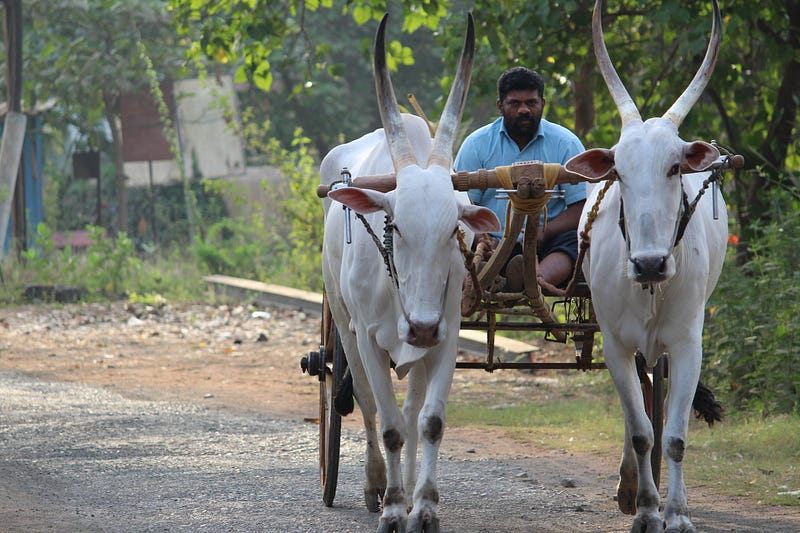
When some humans weren’t busy staring at equine ass, they conjured better, harder, more affordable metals that contributed to the evolution of the rails. This means that the lowly section hand would have to replace the track as newer and shinier materials are introduced.
For instance, in 1845, wooden rails were replaced by iron rails. Turns out, iron was not so great. In 1864, less than 20 years later, the powers that be decided that the rails should be made from that new stuff everyone was raving about, steel.
There have been several other changes to the materials. Martin Schilke says
“From time to time railway rails need to be replaced.” He goes on to provide a detailed account of the composition of rails nowadays and the special way that each one will break.”
When they got broken enough, hardy, hammer wielding “dancers”, like my dear old grandpa, would come along and fix them.
So you see, the length of two horses (or bicorns as pictured above) hindquarters, the ephemeral, fleeting condition of earthbound stuff and the ingenious, dauntlessly innovative nature of human beings conspired to turn my grandfather to “dancing” to put bread on the table.
You know, the three factors just mentioned, especially the latter two, can be directly linked to gravity. Gravity constantly exerts force on stuff, wearing it down; and much of human innovation throughout recorded history has been a battle against gravity (e.g. airplanes, canes and other assistive devices, math, etc.) Gravity is a bully…

* a good deal of the information contained herein and the inspiration for writing this article comes from Sandler, Martin W. Iron Rails, Iron Men, and the Race to Link the Nation: the Story of the Transcontinental Railroad. Candlewick Press, 2015.
All other sources are directly linked near the content they pertain to.
FIN
@JarrettLWilson


