Telling It Like It Is
Here’s What’s Holding You Down
And no, it’s not “fear.”
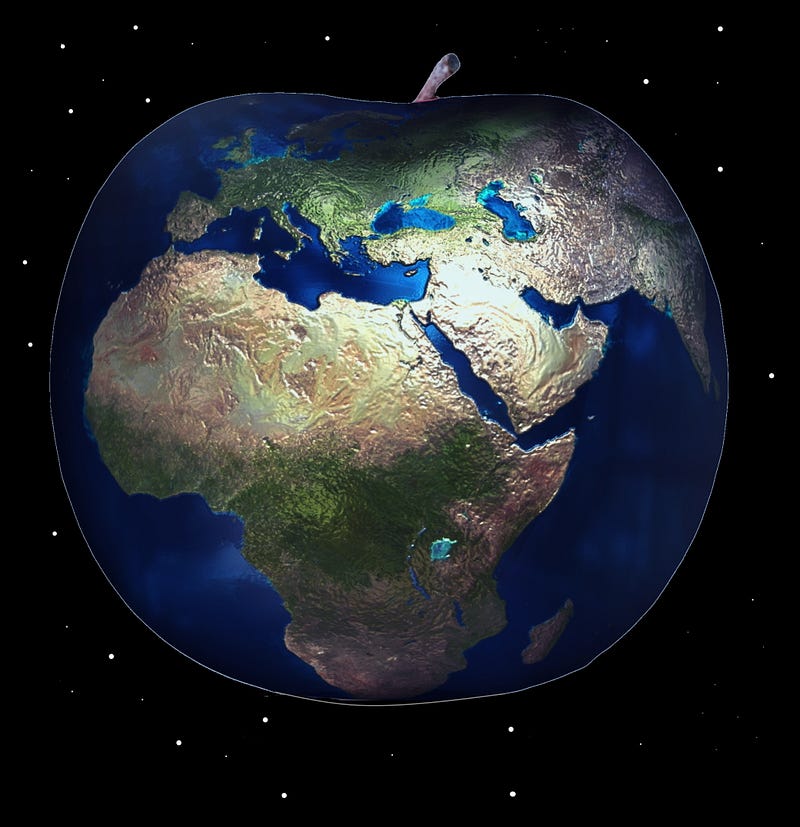
Let’s talk about our ups and downs.
Being the most clever and innovative species on this blue orb, we’ve deluded ourselves into the belief that we hold irrevocable sovereignty over this vast habitat.
I submit to you, dear reader, that this belief is fallacious — that there is a phenomenon on this planet whose dominion exceeds that of every living creature, both in great numbers and individually.
In fact, I don’t think I’m mistaken when I say that greater numbers in opposition to this entity only increases its strength.
What’s more, this force is tireless and everpresent — there is no space you can occupy, no condition you can apply, to escape its subtly firm grasp on you and everything around you.
I speak, dear reader, of that stubbornly predictable, whimsical tyrant “Gravity”.
We’re overthinking some of the most elementary troubles of our times. I’ve produced a protracted list of three mischiefs perpetrated by this most austere purveyor of “here, there and everywhere” for your perusal.
PREFACE — I’m not fond of the listicle or the almost pornographic self-improvement scene. Though this piece follows that format, it is in no way meant to be instructive or even helpful. If, after reading this, some dude or chick was to come away with a new model for living, one of us failed stupendously.
I have just two goals for this particular piece:
1. Give you, dear reader, some fun and interesting facts about Gravity.
2. Expose Gravity for what it is — a cosmic force bent on humiliation, a ninja bully hiding in plain sight at, among other locales, our bowling alleys, our kitchens, and our supermarkets.
Here we go –
What is “Gravity?”
The Romans, who seemed to have a name for everything, used the word gravitas to describe something as “heavy”. Indeed, not only does Gravity mitigate the relative weight of, well, everything, if I understand its use correctly, a Roman player might say something like —
“The gravitas of my coin purse is such that I can’t lift it because of all the denarii!”

Of course, Gravity, insofar as referring to the attraction of stuff to the ground and the binding of space-time, had yet to be discovered.
The force that we now call Gravity was most popularly analyzed as a property of the universe (a “uniforce” if you will) by Isaac “Let’s Discover Something” Newton, after allegedly being accosted by an apple. Thus, he posited that “What goes up, must come down”. Albert Einstein added, “Unless the object passes something with great mass, then it goes down curvedly for the warped space-time around that object.” Without question, Einstein made his case far more intelligently.
I set out to research this phenomenon and, just as an apple allegedly assaulted ol’ Isaac, the subtle violence that is the trademark of Gravity wracked my brain in such a manner that had hitherto been reserved for complex mathematics, rigorous science tasks and, so help me gosh, British literature (esp. Milton). How long did it take Einstein to come up with general relativity?
According to smartypants, John Horton,
“The final theory [of special relativity] emerged after Einstein struggled for seven years with many things: strong hunches about…”
It goes on to describe things that genius physicists struggle with, i.e. inertial and accelerated states of matter, the speed of light relative to who observed it, where they were, and if she/he was moving, if the fabric of space-time is machine washable, etc. Suspiciously absent from that list is the struggle with Gravity itself. I’m sure there were instances in that time where Einstein fell down or dropped something. With that, I give you the topmost egregious affronts perpetrated by Gravity:
1. The Perils of Upward Mobility
Whether you understand Einstein’s gobbledygook or not, and buy into the notion of relativity, there’s one thing for certain — Gravity has you. You may not fall today, you may not fall tomorrow, but someday you will take a spill and Gravity will be there to all but shove the ground into your face!

According to the World Health Organization,
“37.3 million falls that are severe enough to require medical attention occur each year.” What’s more, over 600,000 people die each year from a fall — “of which over 80% are in low- and middle-income countries.”
Plus, the bulk of individuals who die from this seemingly most innocent of blunders are over the age of sixty.*
Those who didn’t fall to their untimely demise get to help shoulder a bill totaling $50 billion at local ERs.
Clearly, Gravity has it in for older, and lower-income folks. Thus, Gravity is an elitist, ageist ninja bully.
It’s as if Gravity is spiting old folks for being upright for so long.
To Gravity’s credit, it tries to bring us down very, very, oh so very gradually. Shortly after birth, we stand with perky optimism. As the years go by, we are brought closer and closer to the earth
Listen, I just dropped a baby carrot. It appeared to go straight down. Nonetheless, it came to rest several feet behind what I’d consider the “drop zone”, landing, nay nesting, in a baby carrot sized tuft of dog hair. This is a signal to move on to Gravity’s role in cementing inanimate objects to the nearest, lowest point, and not allowing them to move until acted upon.
2. Inertia:
Have you ever sat down in front of your TV after a long day of work with a delicious snack and a creamy hot cocoa or what have you? You settle into your favorite chair — the one that caresses your bottom the way a sarcophagus embraces a mummy after 2,000+ years, your little dog jumps up and makes her bed in the valley between your legs as they rest on the elevated footrest thingy. Then you reach over for the remote, only to come up with the controller for an HD-DVD player that you never use. Scanning frenziedly, you catch sight of that essential bauble over on the couch. ZOUNDS! You’re going to have to get up, shattering the ceremonial serenity of the post workday cocoon you’ve erected about yourself. You reach out to it, attempting to will it into your possession like the guy in that movie with the snow and the ninja robot who turns out to be his dad. But alas! Despite the intensity; the raw, unfiltered passion of your desire to have that clicker, it just sits there. Why?

Because of Gravity, dear reader. Gravity commissions his henchman “inertia” to put a crippling fear of movement into remotes, Wahoo marbles not in use, fireproof suitcases, and the like unless they’re already moving. In which case, they are to continue moving that way until acted on by an outside force to change direction, velocity, and/or altitude. In Newton’s day, this was called the “law of inertia”.
Unfortunately, “outside forces” are often things like concrete, mud, toilets, and large bodies of water, whose properties are abjectly abrasive to objects that humans use to manipulate the wider world. Hell, even the colorless, weightless, odorless aether surrounding us is privy to the conspiracy to stifle all movement.
You go to the gym and lift heavy objects over and over in hopes that, should the occasion arise, you can overcome the force of Gravity upon some object. The thing is, some stuff is REALLY heavy! Things like cars, houses, and giant boulders, to name a few.
3. Gravity Finds a “Weigh”
Even the objects we can lift, like corn on the cob, a Christmas ornament, or even a smartphone are subject to the subtle violence of this menace.

The IDC reports (as cited by The Miami Herald) that in congress with some outside force, Gravity is responsible for damaging 95 million smartphones a year. Put another way “Two smartphone screens break each second across the United States, adding up to 5,761 busted screens an hour”.
IDC says the price tag for this particular flavor of “oops” is close to $30 billion a year. This is only for smartphones. We drop other stuff too, right?
In a way, dear reader, we’ve come full circle. You see, the first smartphone was manufactured by a company called “Apple”.
The inspiration for the company name was a hotly debated topic. The apple is pervasive in Western culture in many ways:
1. One a day keeps all physicians away.
2. It is the source of all our worldly knowledge (i.e. man vs. woman, humanity vs. nature, good vs. evil, Sammy vs. David Lee Roth, etc.).
3. When sliced and placed inside a doughy cocoon and exposed to high temperatures, the apple becomes an edible symbol of the United States.
4. Once upon a time, Isaac Newton caught sight of an apple as it succumbed to the tyranny of Gravity.
Thus, we have general and special relativities, our understanding of inertia, and the space-time continuum, among many other curiosities.
Most importantly, we have a name for that menace that makes rain fall, makes heavy things heavy, and won’t allow you or me to fly without the help of some device. Thy name is Gravity, dear reader, Gravity.