
How to Conquer Your Fears and Act on Your Dreams
Fear thrives in imagination but withers in reality.

“When you try to ignore your fear, it grows. When you face it, it shrinks.” — Josh Steimle
Fear is a paradoxical concept.
You’re afraid of hypothetical future situations that exist purely in your imagination. What if I fail? What if it is painful? What if something goes wrong? What if my sister dies? What if I crap my pants in public?
However, these thoughts have very real, tangible consequences. You don’t approach a woman because you’re afraid of rejection. You don’t ask a question because you’re afraid of sounding stupid. You don’t quit your job and change careers because you’re afraid of being broke and miserable.
Fear is an anxious feeling caused by the imagination of an unpleasant event or experience.
From an evolutional perspective, fear is useful. It warns you of potential dangers, like poking a sleeping bear with a stick or, the modern equivalent, throwing yourself headfirst into a buzz saw.
But in today’s world, your fears are often much bigger than they should be. Yes, your outfit might look ridiculous or you might stutter during your presentation, but you won’t get mauled by a sabretooth tiger if you take the wrong step.
Unfortunately, our brains haven’t had enough time to adapt. Your fear can still be paralyzing. It can creep up on you, a slight hunch of a feeling at first, morphing into big, scary nightmares that freeze you dead in your tracks.
Fear keeps you from getting what you want. How often have you held back because you were afraid of what might happen? And how much better would your life be today if you had acted instead? The fulfilling job you never looked for because quitting your current one was too scary. The traveling you never did because of all the risks involved. The woman of your dreams you never talked to but could be married with today.
All this could be your life. If only it wasn’t for your fears.
I know what it feels like. I’ve been there as well. Approaching women, making myself vulnerable and emotionally available, and exploring alternative career paths were all things I was — and sometimes still am — terribly afraid of.
But I realized to create my dream life and become the best version of my true self, I had to conquer my fears. Let me show you how you can do so, too.
To Overcome You First Have to Understand
“If you know the enemy and know yourself, you need not fear the result of a hundred battles.” — Sun Tzu
To overcome your fears, you first have to understand them.
At its core, fear is nothing special. It’s a basic emotion. It’s information your brain presents you to tell you how you feel about a certain scenario, just like it tells you “happiness” when you think of a beach vacation or “anger” if someone takes your parking spot.
Fear itself isn’t the problem. The problem is your reaction to it.
The five basic fears we all have
From a psychological perspective, there are five types of basic fears. Pretty much anything you’re afraid of can be traced back to them.
- Fear of extinction The thought of no longer being around causes existential anxiety in humans. Think of looking over the edge of a high building or drowning in a deep, dark sea.
- Fear of mutilation You’re afraid of having your boundaries invaded or parts of your body or abilities hurt. This is the guy that keeps you from putting your hand into a blender or what makes images of mouth cancer effective measures to reduce smoking.
- Loss of autonomy You’re afraid of losing your freedom — of being forced into or kept from something by circumstances out of your control. Think of claustrophobia or being trapped in a dead-end job with a controlling boss.
- Separation Humans are social animals. Back in the day of Colin the Caveman, separation from your tribe was akin to a death sentence. Today, you’re still afraid of abandonment, rejection, and loss of connection. This fear influences your behavior in social settings to a large extent.
- Ego-death You’re afraid of losing your sense of self-esteem or self-importance. In simpler words: Humiliation, shame, or anything else that threatens the beliefs you have about yourself. A fear of public speaking often comes down to this one — people could see you struggle and think of you as worthless or incapable.
These five basic fears have been around for a long time. They’re hardwired into our brain and we won’t get rid of them anytime soon — so we have to learn to overcome them.
How to Conquer Your Fears
The first step to overcome your fear is counterintuitive: You have to accept it.
By accepting your fear, you take the pressure off yourself. You reduce the panic. You say to yourself Yep, I’m afraid of this — so what?
You can only solve a problem if you first accept it as it is. Through acceptance, you can take a step back and look at the big picture.
Step one: Write down your fear. “I am afraid of X and it’s because as a human, I’m afraid of extinction/mutilation/loss of autonomy/separation/ego-death (more than one may apply).
Recall that fear is about hypothetical future situations or events. Your imagination gives it room to grow. It starts out as a small, innocent sapling, but the more you avoid it, the more room you give your subconscious and imagination to come up with nightmares. Over time, your fears grow into a thick, dark forest with thorny twines that’s hard to cut down.
In the beginning, you worried about quitting your job because you might not find a new one. But over time, your imagination added all sorts of possible scenarios. You’ll go broke, you’ll starve, won’t be able to pay rent, your girlfriend will leave you, everyone will call you a loser, and you’ll end up living on the streets, sharing a lonely campfire with Harry the Hobo.
To get rid of the forest of panic, you have to take away its nutrients. You need to deprive it of the fertilizer and soil it needs to grow.
You have to cut down on your imagination, and face your fears instead — slowly, step-by-step, in an environment in which you feel safe. This is otherwise known as exposure therapy.
With every step you take, you replace your excessive imagination with real-life experiences. You show yourself nothing life-threatening will happen and all the hypothetical worst-case scenarios you dreamed up are exactly that — hypothetical instead of real.
Step two: Face your fear, slowly and step-by-step. With every little move you make out of your comfort zone, you cut down the forest of panic that has been growing in your head. You replace it with real-life experiences that show you there’s nothing to be afraid of and your nightmares won’t become real.
Here’s a simple exercise for you. Take a sheet of paper and write down about five to ten situations related to your fear. Then, rank them from 1 (seemingly harmless) to 10 (facing your worst nightmare).
Here are two examples. A few years ago, I was afraid of approaching women because I was afraid of rejection (separation) and shame (ego-death). I put together a list that looked like this:
- Say “hey” to yourself in the mirror — 1
- Say “hey” to a stranger on the street while passing — 2
- Ask a cashier about his day while paying — 4
- Ask a woman for directions to the train station/restaurant/shopping mall — 6
- Compliment a stranger on his looks/shoes/style — 6
- Approach a guy and start a conversation — 7
- Approach a woman and start a conversation — 9
- Approach a woman, engage in a conversation, and ask for her number — 10
If you’re afraid of quitting your job, your list might look like this
- Look for other job opportunities — 1
- Talk to someone about your thought of quitting — 3
- Review your finances and how long you could do without a job — 5
- Decide to quit and tell someone about it so you’re held accountable — 6
- Send out applications for a new job — 7
- Write your two weeks’ notice — 8
- Quit your job — 10
Depending on your fears and circumstances, your lists might look different, but you get the idea.
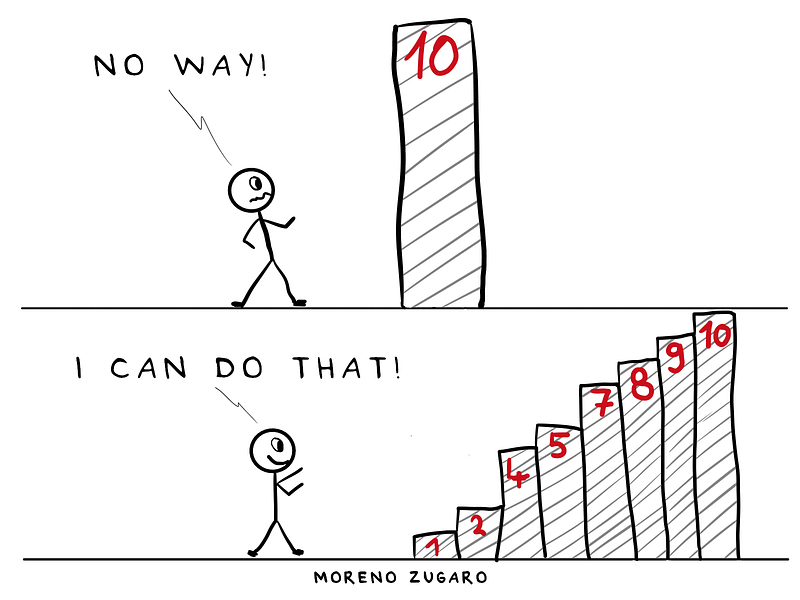
Write your list, rank the individual items, and act them out in ascending order. You’ll have to repeat some of the steps until you feel comfortable with them before tackling the next level.
With every step you take out of your comfort zone, you cut down more of the dark thicket of fear that has been growing in your head. And with every win, you’ll get closer and closer to conquering your fears.
The beauty of these lists is they take the focus off your fear and present you with the next challenging, but doable step instead. But you have to do the work.
Make your steps as small as you want to — but move forward. You have to stay through your discomfort, no matter how bad it feels. If you quit, you reinforce your fear. If you stay, you conquer it.
Understand, Accept, Conquer
“The only thing we have to fear, is fear itself.” — Franklin Roosevelt
Fear itself is neither good nor bad. It can be conducive to your life or put spokes in your wheel, depending on your reaction. It’s an emotion like any other. And as such, you should neither ignore it nor let it control you.
The dark thicket of fear and panic thrives in your imagination but withers in reality.
Face it. Understand the what and why. Accept it as it is. Then, conquer it — step by step, through the discomfort.
True strength and courage aren’t found in living without fear, but in acting in spite of it.
Fear and worry often go hand in hand. Here’s another perspective on worry and letting go of it.
Get The Authentic Man 5–3–1 Newsletter
5 minutes to read. 3 ideas, quotes, and questions to help you become a more Authentic Man. 1 biweekly challenge to get you closer to your dream life. Become the best version of your true self in under 5 minutes!


