
Create a Marketing Strategy for Your Business
The unique strengths and goals, and opportunities in the marketplace shape a firm’s marketing strategy.

Firms are just chucking a product or service out there without a marketing strategy, hoping it will work.
Hoping there is a customer for it.
Hoping there is something that sets them apart from the alternatives.
Having no strategy is like walking across a desert without a compass or map, hoping good luck will help make it out the other side.
“Marketing strategy is an organisation’s integrated pattern of decisions that specify its crucial choices concerning products, markets, marketing activities and marketing resources in the creation, communication and/or delivery of products…
and thereby enables the organization to achieve specific objectives.” (Varadarajan 2010, p. 119)
This article explores what a marketing strategy is and its key components. I discuss five common business orientations and how they influence the marketing strategy and dictate a specific marketing plan's activities.
What is Marketing Strategy?
A marketing strategy is the overall ‘game plan’ for implementing and reaching marketing-related goals.
Focused and achievable, the strategy contains significant objectives, purpose and goals, and essential policies and plans for reaching those goals.
Forward-looking, a marketing strategy focuses on significant decisions that affect the long-term direction of the business. It is unique to each company, dependent on their offering, resources, competition and target customers.
This strategy outlines how a firm interacts with the market and its customers. Objectives must consider what a business does well and what they are not doing well to improve its performance.
In simple terms, marketing aims to reach prospective consumers, turn them into customers, or retain existing customers. To achieve this, a firm must understand its market and customers' needs and wants. Their marketing strategy is the link between them and their potential customers.
The importance of a marketing strategy
If a firm does not have a marketing strategy, it can lack direction. Marketing that is not producing results wastes money, and the firm loses customers who do not know their brand exists.
In an increasingly competitive marketplace, firms must make strategic decisions to increase the chances of making the right decisions.
“(A Marketing Strategy is) essentially a formula for how a business is going to compete, what its goals should be and what policies will be needed to carry out these goals.” (Porter, 1980)
A marketing strategy defines a firm’s plan to improve its performance, accounting for its unique challenges and opportunities. Firms produce their strategy by matching their goals, essential resources and core capabilities, external opportunities and trends, and considering the possible risks they face.
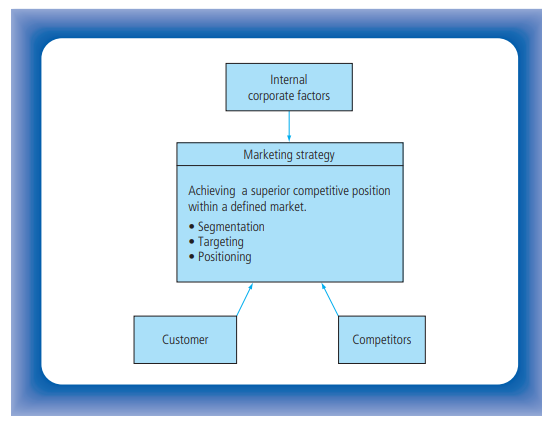
Corporate objectives and strategy transformed into a competitive market position through differentiation and meeting customer needs more effectively than competitors. Marketing defines how a product or service provides value to customers.

What is the difference between a marketing plan and a marketing strategy?
The marketing strategy guides a marketing plan by outlining the firm’s vision, direction and goals.
A marketing plan outlines the practical details of specific and defined marketing actions, activities and tactics to reach those goals. A marketing plan aims to make the strategy a reality.
Marketing strategy is the ‘big picture’ and has a longer timeline than an individual marketing plan, as it contains vital business elements such as branding and their unique value proposition.
A marketing plan includes individual campaigns, which could be over a brief period of six months to a year.
“Strategy decisions and actions… concerning a firm’s desired goals over a future time period, and the means through which it intends to achieve them including selecting target markets and customers; identifying required value propositions; and designing and enacting integrated marketing programs to develop, deliver, and communicate the value offerings.” (Morgan, Whitler, Feng & Chari, 2019)
Creating a marketing strategy
Formulating a marketing strategy can be a daunting process, even for an experienced marketer.
How do you know if your strategy is going to work? To maximise their effectiveness, firms should use the following three co-ordinated steps when creating their marketing strategy:
1. Evaluate the situation, including internal and external environments. Any competitive advantage should be the basis for a marketing strategy, but it still needs to match customer demand. Market research helps to understand the wider business environment and define specific customer needs and identify opportunities.
2. The next phase is the formulation of the strategy that matches products/services with customer segments and outlines specific marketing plans for reaching these target customers.
3. The final phase is implementing the marketing mix activities that provide a competitive market position and the set of actions necessary to put the plan in place to reach its goals.
Critical components of a marketing strategy
The goal of marketing is to align a businesses’ strengths and capabilities with customer needs. Their value proposition and any competitive advantage should be the foundation of their marketing strategy.
These internal factors become essential components of a marketing strategy and brand communications. Other vital tools and techniques that help guide a marketing strategy through understanding and meeting customer needs are segmentation, targeting, and positioning.
Segmentation
Market Segmentation is the act of breaking down a market and grouping together customers who share similar characteristics, behaviours and attitudes.
This process helps businesses to understand their customer needs, optimising their marketing, advertising and sales. Creating buyer personas is part of the segmentation process; these are fictional representations of the customer types in your chosen market segment to illustrate their different personality traits.
This process helps match customer wants and needs with your businesses’ ability to satisfy them.
Targeting
Targeting focuses all marketing efforts on a defined group or group of people called a target market.
The selected market segments share common characteristics and interests to respond similarly to the marketing material. Because advertising and other marketing strategies focus solely on a target market, marketing becomes more affordable, efficient and effective at generating customer leads.
The basis for these targeted customers can be existing customers or groups of people overlooked by the competition. If they are profitable, this presents an opportunity, but it should be long-term to build relationships with customers.
“The marketing strategy lays out target markets and the value proposition that will be offered based on an analysis of the best market opportunities.” (Kotler & Keller, 2012)
Positioning
Firms use positioning to communicate their value proposition and create a brand identity for their products or services.
This position is relative to competitors, defining how a brand is unique and provides a distinct benefit to customers. Marketing communicates this market position, influencing customer perceptions.
Before determining their market position, firms decide on a segment of the market they want to target.
Business Orientations
A firm’s business orientation is its overall strategic organisational focus, which also dictates its marketing strategy.
There are five main orientations: production, product, sales, market, and societal. The strengths of the firm should be the basis for this orientation.
Production orientation
A firm with a production orientation focuses on efficient production as its key performance indicator. The critical concern is mass production, the economy of scale (high volume), cost control and meeting production schedules.
A production orientation does not use customer needs or desires to guide its strategy but instead focuses on producing high-quality products as cheaply and quickly as possible.
This approach assumes that if you create the right products at an affordable price, customers will purchase them, regardless of whether it meets their every need.
Product orientation
Although it sounds similar, a product orientation is vastly different from a production orientation.
Instead of focusing on producing a product cheaply, motivation is product development and innovation to continuously improve products to stay ahead of the competition.
The idea is that the products are of high quality, so they should sell themselves. Sometimes this means that a firm must try and find a market for a product instead of creating a product for a market's needs.
Sales orientation
Sales volume is the focus of a sales orientation. Often these firms employ a large salesforce and focus on short-term sales targets instead of a long-term strategy.
After a production orientation, firms might implement this strategy to move stock that did not sell as well as expected. Companies concentrate their resources on marketing and sales instead of customer needs. They are a means to an end.

Market orientation
Understanding and meeting customer needs is the basis of market orientation.
Also called customer orientation, being responsive to customer needs is the key objective. Customer demand becomes the focus for resources to be able to supply what the market wants.
Understanding the marketplace comes before any production or marketing. If a firm moves its marketing strategy to a market-based orientation, it often requires fundamental organisational structure changes.
A market orientation also considers what the competition is doing and focuses on building long-term relationships with customers.
Societal orientation
Considering society’s long-term interests and doing ‘the right thing’ is the focus of a societal marketing orientation.
This philosophy dictates that the environment and society consider marketing decision-making before the customer wants or the company’s requirements. Ethical considerations come first, focusing on the firm's and its products' impact on society and the wider environment.
Conclusion
This article has explored a marketing strategy and how its key components, segmentation, targeting and positioning, direct a marketing plan, and specific activities.
I explored the five common business orientations production, product, sales, market, and societal, and how they influence a marketing strategy.
Thanks for reading. I hope you enjoyed the article.
If you enjoyed the content, check out this one about the marketing mix.
Read More Medium Articles
Non-Medium members can only read 3 articles a month — become a Medium Member for unlimited access.
If you would like to read more articles like this one, sign up to become a Medium member for only $5 a month.
Subscribe to be notified when I publish new content.


