
How to Build Your Readership by Writing Less and Giving More
Helping others brings more rewards than you think
I’ve been writing on Medium for only a few months, but it’s only over the last five weeks that I’ve been very active in the community.
Is it a coincidence that my views and readership have improved dramatically in this time despite technically posting less? In retrospect, the answer is clearly no, but had you asked me prior to embarking on the exercise I wouldn’t necessarily have agreed. It was just that at the time, it seemed the natural next step.
All new writers go through various stages of development and discovery of course, but Medium itself is a wonderful, ever-changing melting pot of techniques, strategies and ideas. That means something that works for one author may not work for you, but it also means that nothing is set in stone. Here you make your own rules, find your own way and shape the platform according to what you want from it whilst still remaining within the rules of the framework. And that creates incredible opportunity.
Want to succeed? No problem. The standard advice is that you put in the work, show up every day and become a better writer, ergo creating content that people just have to read.
I absolutely agree there is no shortcut to that part, but it’s easy to overlook the bigger picture, something I was personally guilty of for a couple of months before I really started to understand what I was dealing with. The platform itself is a brilliant concept that allows you to be paid for your work — something that is quite astonishing in itself — but it’s only part of the equation. The rest, and by far the biggest element, is the community that thrives within it.
And what a community it is. When I was struggling with curation, established writers took time out of their incredibly busy schedules to answer my inane questions. People flocked to answer my classic noob posts in Facebook threads, posted even after reading medium’s support pages and not quite getting it. I was actually welcomed in and not simply seen as a competitor.
You must understand I come from a business background. You don’t welcome ‘new producers’ there so this was genuinely alien to me. And I liked it immediately because there’s far more going on here than just words.
In fact, as it turns out, being an active part of the community yields far more benefits that just writing. Not only will you find yourself in a position to help people, then you’ll find it will come back to you in the most unexpected ways.
I understand that being involved in your community at any level sounds scary for introverted writers, but I can assure you it isn’t in reality and there are lots of ways to do it both on and off the platform that won’t take you too far out of your comfort zone.
If you can manage to do some, most or even all of the following on a regular basis, I can promise you that the returns will outweigh the time you put in to do it.
Getting Involved in Medium Itself
Like many people, when I first started publishing on Medium I hunkered down, produced pieces and pressed the ‘submit’ button in the hope that this was the piece that would propel me to the limelight.
It never happened.
I realized fairly quickly that I’d have to get involved and have no qualms in saying that, initially, this was to serve my own purpose, i.e. to get some promotion going. However, it didn’t take long to understand that I was doing myself a disservice.
Step 1— Read
To get better, you need to read and learn. Not just the content itself, but how successful writers put a sentence together and build their stories. Reading should be something you do at least as much as writing. But with so many articles out there, how do you find the ones that will speak to you?
I’ve now developed a system to keep up to date with not only articles I find interesting, but ones that use different styles and techniques I’m not familiar with yet or comfortable using, such as poetry and deeply personal pieces. There will be more on this later, but for now its enough to simply understand this basic premise.
Step 2— Clap
Yes, it’s true that we are no longer rewarded with claps alone, but that’s like going to a concert, enjoying it and not clapping at the end. After all, the artist is getting paid anyway, right?
Whilst that may be true, showing appreciation for someone’s work is important and encourages them to continue working. There are also theories that Medium’s secretive algorithm rewards pieces that have higher levels of clapping, but this is unproven at the moment. In any case, it’s a good thing to do.
There’s also something in it for you — clapping a story puts your name against it for the entire life of the article AND it’s owner is informed of your actions. People will see you there and have a higher chance of finding you work or following your profile as a result.
There’s a great debate on how much to clap, from the solitary and consistent ‘one’ camp to the ‘max it out camp’ and everything in between. Personally, I clap random amounts between the two, often giving in to my OCD and clapping to make an even number. Yes, I know that makes no sense, but it works for me!
Step 3 — Highlight
Like something the author wrote? Highlight it! Simply select the text you want, and select the icon that looks like a pen in the resulting context menu. It looks like this:
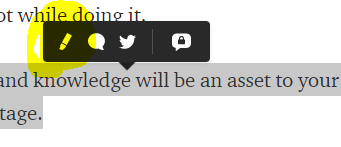
This does a number of things:
- It stores your highlighted comment in your profile so you can revisit it later, which is really handy for keeping track of great little snippets you want to remember in the future
- It lets the author know what you’ve highlighted, raising your profile again
- Anyone who follows you can see your highlight when they visit that article
Step 4— Comment
Writers love to get comments on their work and will often respond. Perhaps there’s something that spoke to you, or perhaps you disagree with the writer’s viewpoint, but in any case, commenting is a good way to show that you appreciated the article.
Whatever your reason for doing so, be respectful and polite — remember that people will always be able to see that comment. You’ll not be paid for claps your response garners, but, like clapping itself, you’ll be associated with the piece forever.
However, don’t spam articles with your own work. People can see through this a mile away and it has the opposite effect. It’s fine, however, to post a link to something that the author might find interesting or complimentary and I often read these myself if someone has taken the trouble to share something with me.
With both claps and comments, it’s worth mentioning your actions are recorded on your profile details. When Medium sends out it’s weekly newsletters, the people who follow you will see what you clapped for and vice versa. It’s another way to get your name in front of eyeballs — and you’ve done it by supporting others!
Step 5— Follow
If you like a piece or an author’s style, follow them. It helps the author build their network and it will, in time, give you exposure to more of their work. In some cases, the author may want to follow you back, exposing your own work to them in due course. Like clapping for an article, your name will also reside in their follow list for all to see.
Personally, I don’t advocate following people randomly in the hope they will follow you back. Whilst there’s some evidence to say this works in gathering numbers, it doesn’t help you build a network of value. Treat your Medium following list as one that you’d really like to have and trust that the right people will find you eventually. Of course, the more active you are in these areas, the more likely that is to happen.
Getting Involved Outside the Medium Platform
Medium itself is only part of the equation and, actually, it’s easier to reach community groups of Medium members in other places, such as Facebook.
The first thing you will need to do is find and join these groups from your Facebook profile. If you have an author’s page, it’s better to join with that rather than your personal profile because you can invite people to like it when it’s appropriate. From a practical point of view, I’ve also found it’s easier to manage notifications separately from your personal ones.
I’ve compiled some pointers and a list of current Facebook groups here:
Most of the groups post a daily share thread which allows you to post ONE of your pieces each day. When you post, it’s a great idea to put a little summary of what the story is about each time as readers are more likely to engage with it. You’ll also stand out as, surprisingly, most people don’t bother.
For example, here’s one I posted earlier today:
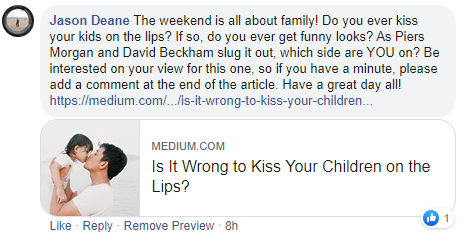
Follow the group rules and make sure it is only one, but also make sure you read more than you post, there’s some guidance on this in the above ‘Facebook Groups’ article and it also covers the system I personally use to select stories for my own consumption alluded to above.
As before, when you find the articles that you like, then first read them, clap for them, comment on them, and, if appropriate, follow the author too. I often comment on the Facebook post as well or like it at the very least so the author knows I’ve seen their work, but I don’t ‘like’ something if I haven’t read it. More than once I’ve had someone tell me they’ve read and clapped on an article and yet their name isn’t on the list of people who clapped — trust me, writers DO quite often dip in and see who’s there!
There are other ways to engage with other people’s work. Many authors now use Instagram (if you do, make sure you use great pictures to head your story) and Twitter among others and, as before, you can like, share and retweet other people’s work as well as your own.
Part of building a following is sharing things that you like, whether it’s yours or not, because people will follow you back for the content you provide.
Consistency is Key
The benefits of spending all of this time away from actual writing should be clear, but, like writing itself, consistency is key. For example, I spend at least 45 minutes each day reading stories, commenting, clapping and answering any questions in the community I feel I can contribute to.
By doing it on any regular basis that suits you, you’ll learn new skills, meet new people and get your name plastered on the articles you’ve enjoyed by clapping or commenting on them. Even better, your profile will be seen as ‘active’ by other writers who will be more inclined to follow you.
Don’t be disheartened if you don’t see an immediate response, because like all things worth doing, building a following takes time. After a while, your own objectives will become secondary to being an active and productive member of the community.
The day will come when you need help with something and want to know how to reach a publication or need some feedback on a tricky piece that’s resisting coming together. And when you do, you’ll know you have a support network to fall back on, made up of people who have enjoyed the help and support you gave them.
And you know what? They’ll be glad to help. Trust me on that.
If you see me in the comments of your favorite piece or lurking in one of the Facebook groups, please come and say ‘hello’ or tell me about your latest work. I’d love to see it!
If you’re looking for more tips on Medium to help build your views, improve your work and, perhaps most importantly, (legally) keep the money you earn safe from the tax man, try these:


