
How to build and sell micro-SaaS while having a full-time job
Hello everyone, this is the preview of my mini-course on how to build and sell micro-SaaS businesses while having a full-time job — join the waitlist here: https://forms.gle/AdeYZAEZoTvYPwb17
First of all, who am I, and why I’m writing this article?
I’m Domenico, a full-time analyst for a fintech right now (I will join a new company in Sep — an international company leader in the gaming field always as an analyst). I have always been passionate about startups and tech, and I met the indie hackers and micro-saas world in 2022.
I explained my story here!
This article will be focused on the entire process of building and selling micro-saas, from day 0 to day 1 (the sale). I learned a lot during these 1.8 years, and I’d like to share with you my errors and strategies for setting up your business logic.
First of all…
What is your goal?
Lesson 1: your goal.

Like in life, you should always write down your goals also from a business perspective. The first thing you should do, even before starting to think about your next idea, is the goal. What does it mean “goal” here?
- I want to build and sell my SaaS
- I want to build and hold my SaaS
They are very different, and the different approaches will change your work for the entire SaaS Life.
The number 1 is more of a “lucrative” approach: I build, scale it a little bit, and sell it. That’s it. It can be done also from a different perspective: I buy it instead of building it, scale it with minimum effort, and sell it. I will speak about this approach in my course — I think this is one of my favorite ones.
The number 2 is a mid-long-term approach. I build something I want to hold, and for achieving that, I know I need to build something good, with good tech basis.
Anyway, they are different, and it depends on your personality maybe, and from your state of mind and professional life.
For example, I prefer the number 1: I’m a business guy (not a tech guy), and I know that I’m good in the validation stage — then from 0 to 1. I don’t know if I would be able to hold a product for a long long time, then I prefer to build something that I want to sell.
Take into consideration your time. It’s very important managing your most useful resource: time. Since this is for people who have a full-time job, I know the time is less than expected.
Once you’ve cleared your goal, you can go on in the process…
I’m writing this article as an introduction to my mini-course (PDF) about this topic. I’m going to write more detailed paragraphs in the PDF, and you’ll find all the contents at the end of this article. Joint the waitlist here.
Validation Stage
The second important step in this journey is the validation part. Whether you want to build and sell something or build and hold a SaaS, you should always follow this stage. This is even more important than the next ones (building, scaling, and more).
This is how I do this part. I know that could be pretty weird, but it worked and I’d like to tell you more about it.
I prefer to validate something having nothing.

Who is an Indie Hacker?
Before telling you how to validate something with nothing, I’d like to introduce you to the beautiful world of Indie Hackers. I discovered this world 1.6 years ago, and it’s amazing.

Alice in Wonderland
This is how I imagine this world: full of creativity, where impossible things can happen in a very unusual and funny way.
Well, who is an Indie Hacker?
An indie hacker is an individual who builds and launches a business or product independently, without the support of a large organization or team. Indie hackers are typically driven by their own ideas, passions, and interests, and are committed to building and launching their own products or businesses.
“Without the support of a large organization or team”. This is a very important point. I identify my person and my work on side projects in this field. Because I always launched new ideas bootstrapped (with no external funds), in a quick and lean way.
How to validate your SaaS with no money and no product
You could also launch a SaaS not identifying yourself as an Indie Hacker, but the economics are important too.
One of my most important values is this one: frugality. I discovered this value thanks to a friend of mine at Amazon. I wrote an entire article on it:https://readmedium.com/what-is-frugality-and-why-you-should-use-it-in-your-startup-3ed4b66e725a
Based on this concept, I always tried to reach more with less than possible. And it’s not only about cost management but also resources management and process efficiency.
What will you need for doing this validation? 2 things:
- An idea
- Building a Landing Page on yep.so
For my validations, I have always used this process:
- Once I get an idea, I don’t build the product. It will be losing time for something you don’t know if it’s going to work, or not. Don’t do that, please.
- I always build a simple landing page on the yep.so website. I did this for my last 2 products, and it worked very well. In that case, you can a) validate your idea without spending money or time, and b) you can collect users’ emails for launching a beta as soon as possible (if the results are good).
- Share the landing page on communities like Indie Hackers Community, Kernal Ideas, Reddit, Hacker News by YC, and Twitter profile. This is a very important stage: you should be able to share it with more people as possible. More people -> more chance to get emails -> more chance to validate the product as soon as possible.
An important note: probably, you will be able to validate more the “pain” point than the product itself, since you’ll not have any product at the launch, and users will not test it. But you will be almost 100% sure there is a problem, and you can solve it.
What is a good number for saying “there is a problem”? Then, there is an opportunity.
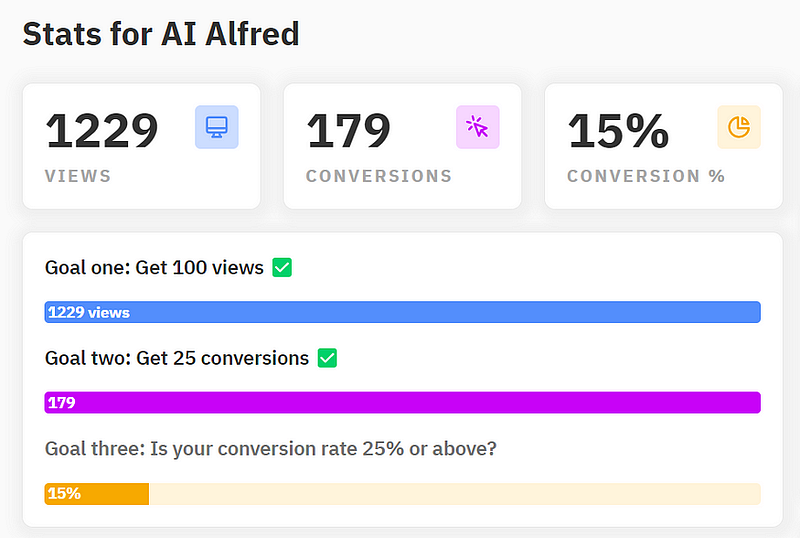
These are the numbers for one of my last products: recapiogpt.com (formerly AI Alfred).
As you can see, we collected 179 emails, and our conversion rate was about 15%. I think it’s very difficult to reach 25% of conversion, but I would suggest to you to put a goal. Of course, if you’re going to get 3 emails on 1000 views, I think it’s not a good product, or you’re not solving a pain point.
In that case, we said: well, the conversion is pretty good, we have almost 200 emails, let’s build a first beta version and test it.
These users are the most important ones for your product: they can test the first private version, and they can drive your future developments. Hear their feedback from day 0.
What I have described above cost me 0$, and very little time for setting up the landing page and a few screenshots (fake) about the product.
Time Management
One of the most important aspects related to the building stage while having a full-time job is time management. I will tell you how I do that while having a 9–5 job, but feel free to use your best strategy according to your needs.
Slot-management
There are a lot of techniques for managing your time in an efficient way, but one of the best methods is the slot-management. It’s very simple, and maybe you’re already using it for your professional time.
The slot-management goal gives you the right focus on a specific task, for a specific amount of time. How to do that? Google Calendar, or any calendar app.
The slot-management consists in “blocking” a slot of your time and dedicating the specific slot to only 1 specific task that you can achieve. You don’t need to waste your time on other tasks. You should name your slot with your task name, and switch off everything around you.
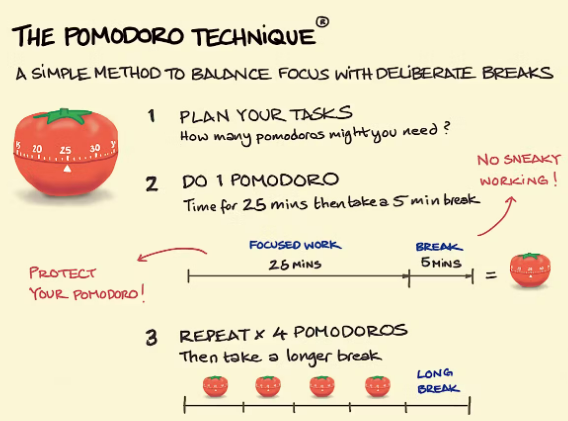
Pomodoro Technique
Do you want to read the next and have more details about the above stages? You only need to leave your email here: https://forms.gle/AdeYZAEZoTvYPwb17
The course will speak about all the steps above (more details, free resources for the validation stage, and more) plus strategies and tips for the building stage, the listing of your saas, and finally the selling section!


