
How To Be Weirdly Happy (Almost) All The Time

Do you struggle to feel genuinely joyful throughout your everyday life?
Are you spending most of the day smiling and laughing? Or does it take something truly momentous for you to feel that rush of happiness?
Perhaps you know someone who appears to be in a fantastic mood all the time.
Meanwhile, you’re constantly feeling sluggish, downcast and in a struggle to get through the day.
You may tell yourself that consistently happy people have something you don’t.
But that’s not necessarily true.
It’s possible for anyone to naturally cultivate a high baseline level of happiness, regardless of the money in their pocket or resources at their disposal.
No, it doesn’t involve taking mind-altering substances either.
Read on for eight actions you can take to naturally increase your levels of everyday happiness.
1. Avoid dopamine spikes
‘Dopamine fasting’ is the latest wellness trend to come out of Silicon Valley.
This involves a prolonged break from any activities that cause dopamine spikes. Sugary foods, alcohol and drugs, sex and masturbation, music and social media should be among the activities put on hold.
The theory is that humans build up a ‘dopamine tolerance’ over time, causing us to require more stimulation to experience the same amount of joy.
A ‘dopamine fast’ aims to reset this tolerance, allowing us to enjoy these activities more once we resume them.
It’s also suggested this will make it easier for us to appreciate life’s little pleasures.

The idea has caused controversy, with sceptics suggesting there is no scientific evidence to back it up.
Yet, it’s not too far-fetched.
It is generally agreed that regular consumption of alcohol and other drugs creates a ‘tolerance’ that leads to greater consumption over time. Meanwhile, many porn addicts also suffer from the need to view increasingly extreme footage to satisfy their cravings.
All of these behaviours induce a “comedown” period, where our mood and physical condition drops dramatically. Often, we cope with this by seeking our next dopamine hit from the same activity. That’s how addictions form. In this case, the only way to reset our brains is to go cold turkey.
So, even if we’re not necessarily addicted to our vices, perhaps a ‘reset’ would make it easier for us to feel great without them?
If a dopamine fast seems too extreme, consider limiting the activities you’re too reliant on for happiness, especially if they involve harmful chemicals. It’ll serve you well in the long run.
2. Regular exercise
When you push yourself to your physical limits, your body releases endorphins that make you feel awesome.
These chemicals have a similar effect on the body as opiates; they help the body to numb pain and fatigue, and can even be responsible for feelings of euphoria.
These are the same chemicals that make you feel good when you eat chocolate or have sex — and they continue to be released hours after your workout is finished. This is why so many fitness experts recommend morning workouts. Maybe you can cycle to work, instead of driving or taking public transport?
Several studies have linked physical exercise with stress reduction, improved sleep and higher overall energy levels.
What’s more, regularly hitting the gym is likely to work wonders for your self-esteem. This isn’t just based on looking better and feeling healthier. It can also feel empowering to witness yourself levelling up physically.

These feelings of pride are what keep people returning to the gym for years on end.
3. Create a positive environment
When I worked in door-to-door sales, all team leaders were banned from complaining.
We were also expected to quickly change the subject when junior team members began to complain.
This sounds insensitive, but there was an important reason for it.
Positive fun vibes are infectious, but so is negativity. When the whole team was in a good mood, everyone’s sales would skyrocket. If one grumpy parasite infected others, the whole team would have a tough day. Sales would drop and our income would suffer.
Although I no longer work in sales, I still notice how contagious other people’s moods can be.
If you’re aiming to boost your baseline level of happiness, stop spending time with people who drain you. Sure, everyone has bad days, but if you have friends who are a constant mood-killer, you’re better off without them.
Perhaps more importantly, you need to make sure you’re not being a wet blanket who brings other people down.
Learn to let the small things go. It’ll do a lot for your overall mood.
“Control your thoughts because they become the words you use. Control your words because they become the actions you perform. Control your actions because they become the character you reflect.” — Robert E. Wells
Here’s a good diagram to work with…
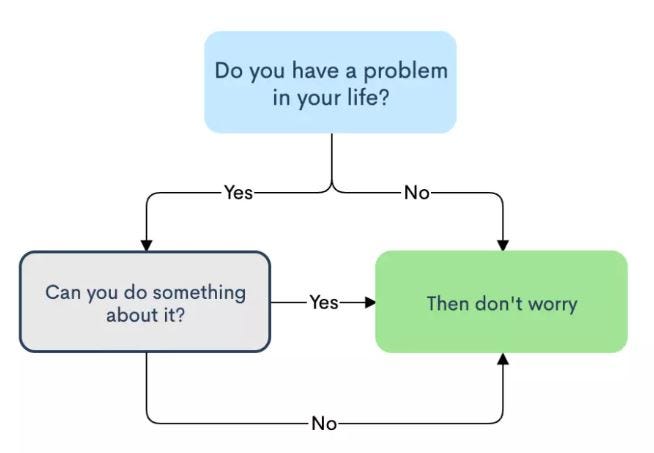
If you’re going through seriously hard times, confide in close friends and family members. Sometimes we need to grieve. Keeping serious problems to yourself is bad for your mental wellbeing.
But there’s nothing to be gained by complaining about small things or circumstances that are out of your control.
4. Meditate
Meditation is the practice of focusing on your body rather than your thoughts. It trains your mind to remain in the present moment, instead of worrying about the past or the future.
The main benefits include reduced levels of stress and anxiety. This makes perfect sense. After all, how can you be anxious and stressed if you’re not inside your thoughts?
Remaining present isn’t easy, especially in the modern day where we have more distractions than ever. However, it is a skill that can be honed like any other, when we meditate regularly.
The most common form of meditation is to sit still in a quiet space and focus solely on your breathing, either with your eyes open or closed. It’s widely recommended to add this practice into your daily routine for at least 20 minutes.
You should sit in meditation for 20 minutes every day — unless you’re too busy; then you should sit for an hour.” — Zen Proverb
The practice itself may be initially frustrating, as you struggle to free yourself from your thoughts. This makes it no different to any new skill you’re trying to learn.
Nevertheless, many people find meditation relaxing and enjoyable as they improve.

5. Get into flow state
Meditation is one of the most common practices used to reach ‘flow state’. This practice is used to describe the sensation of extreme focus. In this state, the rest of your brain almost switches off. No other thoughts block your mind. Time appears to pass quicker. In many cases, you won’t even be held back by fatigue.
Musicians often report reaching ‘flow state’ when they practice their instrument. Athletes experience it when competing in their chosen sport. Artists fall into it when crafting their latest masterpiece.
It is possible to reach ‘flow state’ completing any activity, provided it has the following criteria attached to it.
- The ability to free yourself from distractions.
- A fair level of difficulty — so not too easy, not too hard.
- An intrinsically-rewarding end goal.
It may be possible to create these conditions for yourself, whatever you’re doing.
If you have an inherently dull job at a supermarket checkout, perhaps you could reach ‘flow state’ by aiming to keep your queue short, or by trying to start a conversation with 50% of your customers.
If you’re in the middle of some monotonous data input, try promising yourself a slice of pizza (or some other reward) if you finish within 30 minutes.
If you can fall into ‘flow state’ throughout your everyday life, it could do a lot to increase your overall happiness.
6. Kill your ego
The ego is an internal voice which tells us what role we play in society. It creates expectations for us to behave a certain way and to look cool for other people.
The problem is: our ego tends to be great at talking us out of things that might make us look not so cool. In doing so, it stops us from doing a lot of things that would make us truly happy.
Maybe we don’t approach that beautiful woman, because we’re afraid of rejection. Perhaps we don’t start a new hobby, because we’re worried about looking silly as a beginner.
The ego may talk you out of quitting your job and starting a business, in case you embarrass yourself by failing.
“Embarrassment is the cost of entry. If you aren’t willing to look like a foolish beginner, you’ll never become a graceful master.” — Ed Latimore.
If we always listened to our ego, we probably wouldn’t take any of the risks that might make our lives fantastic.
That’s why it’s well worth taking active steps to kill your ego.
Consider:
- starting a new hobby from scratch;
- completing a social freedom challenge;
- asking your crush out on a date;
- hanging out with people who are more successful than you.

Make an effort to complete these activities in public. If you want to go one step further, document your efforts on the internet.
This will humble you. It’ll prevent you from being the coolest person in the room.
But, ultimately, it’ll lift a weight off your shoulders — because you’ll no longer care about looking like the coolest person in the room. Instead, you can focus on doing the things that make you happy!
Imagine attending a party and not caring what other people thought of you. I predict it’ll do a lot for your overall happiness levels.
7. Build your self-esteem
When you’re proud of who you are, it serves as a huge shot in the arm for your overall happiness levels.
The internet is packed with self-esteem-boosting exercises, but here are a few of my favourites.
- Write 50 reasons why you’re awesome;
- Make decisions based on the values you want to live by;
- Talk to your ‘inner child’.
8. Stay on your purpose
When you have a meaningful and exciting reason to wake up in the morning, this can feel so empowering.
It makes you feel purposeful, as if there’s a good reason for you being on this planet.
What’s more, progress towards your goal can feel extremely gratifying.

So, what goals are you working towards in 2020?
If you’re not sure, try asking yourself: what are five things I’d do if I wasn’t afraid?
How to get started
Firstly, get your fundamentals in check. Maintain a basic level of health. Make sure you’ve got enough income to pay your bills. Without that, it’s going to be hard to focus your mind on these tasks.
From there, you’re ready to make some lasting changes to your mindset.
Our digital course 4 Weeks To Unstoppable Confidence features 28 tasks to help you boost your self-esteem, kill your ego and feel amazing inside your own body. What’s more, these daily tasks are structured in a way that allows you to manage your progress without becoming overwhelmed.
Start today and you’ll feel like a new person before you know it.