
Headline Hacks
How to Add Clarity and Curiosity to Your Headlines
Without being a clickbaiter — my 10-point cheat sheet
“Do you have a question about headlines?” I asked my friend and business accountability partner Tatyana recently. She told me she’s confused.
The common advice is that we’ve got to be really clear with our headline, we need to write attention-grabbing headlines, but we mustn’t write clickbait.
I agree. I’ve been researching and practicing headlines for many months. And I’ve come across plenty of confusing and contradictory information.
My head hurts!
Which headlines do you use and when? How do you write headlines with clarity that also attract curiosity? How do you steer clear of clickbait? And why should we care anyway — we write to get clicks, don’t we?
I dug through my research, reviewed lots of headlines, wrote lots more for practice, and gathered what I think will help us all sort out these headline shenanigans! I’ve included real headline examples to show you what I’m talking about.. Before we dive in, here’s my 10-point cheat sheet:
- Piggyback on TED Talk headlines
- Find out what your readers are interested in
- Highlight the extraordinary (but it has to be true)
- Numbers add credibility (3 tips)
- Discover your reader’s desires
- Connect to their emotions
- Use proven templates
- Surprise us
- Use details to arouse curiosity
- Use these two lists to spot clickbait
1. Piggyback on TED Talk Headlines
TED talks have gifted us with learning, inspiration, and wonder. These 18-minute talks, both live and online, encourage conversations that matter, help people connect, and include communities. The most popular TED talks have been watched up to 63 million times online.
There are many factors that affect the views of a TED talk. But no matter how great the feat or research, no matter how astonishing the content of the talk — it won’t matter if the headline doesn’t stir people’s curiosity. We won’t know the idea is worth spreading if we’re not tempted to click play to watch the videos — or click pay to hear the talk live.
Their headlines have to be good and they are — especially the top five. That’s why we’ve got to piggyback on them — deconstruct them to understand how they work — so we can create headlines that are as impactful as theirs.
The Top 5 Most Viewed Ted Talks and Why They Work
Headline 1
Do schools kill creativity? — Sir Ken Robinson (Views 63M)
Why it works:
- It’s controversial
- Questions naturally arouse curiosity
- It speaks to our desire to be creative
Headline 2
Your body language may shape who you are — Amy Cuddy (Views 55M)
Why it works:
- It arouses curiosity.
- It’s a novel topic.
- It helps us to understand ourselves.
Headline 3
This is what happens when you reply to spam email — James Veitch (Views 52M)
Why it works:
- The subject is a common frustration: spam email.
- It arouses curiosity.
- Anticipation — suggests this could be entertaining or scientific, or both.
Headline 4: How great leaders inspire action — Simon Sinek (Views 47M)
Why it works:
- It makes us want to click
- Powerful, short words
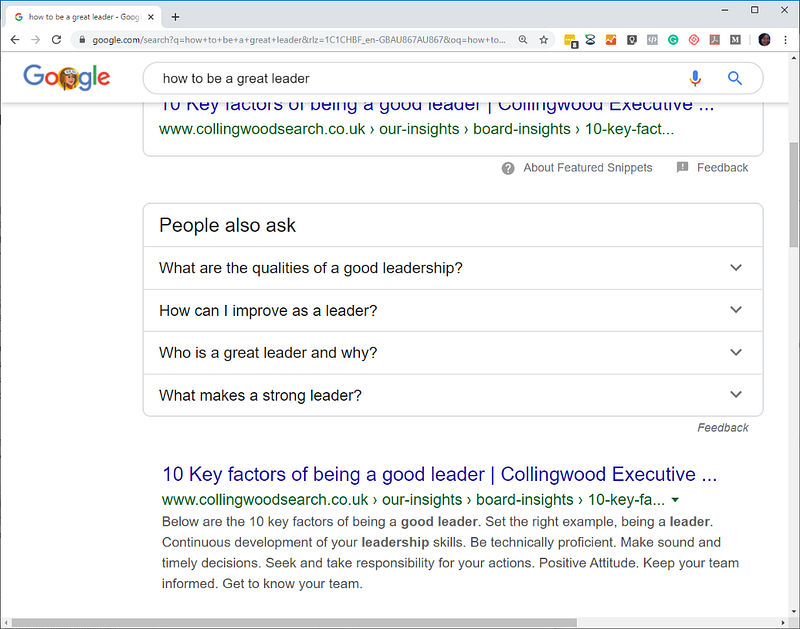
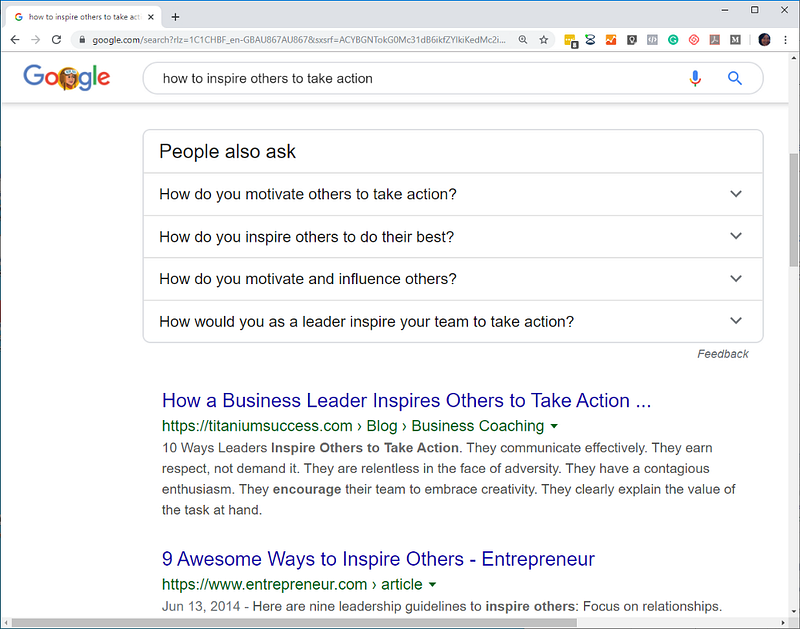
- A specific solution to a common desire. We can imagine looking up “How to be a great leader” “How to inspire others to take action” (screenshots below). The headline is powerful because it combines the two questions.
Headline 5
The power of vulnerability — Brené Brown (Views 44M)
Why it works:
- Addresses a common fear
- Unexpected approach
- Arouses curiosity
2. Find Out What Your Readers are Interested in
Say you want to know more about writing a book. What would you want to know? Perhaps:
- Why do people self-publish?
- What is the process of writing a book?
- Where should I sell my book?
- When would I get paid?
- Should I get a publisher — or should I just self-publish?
- How much would I get paid for each book sold?
Do you see what you begin each question with?
Why What Where When Should How
These words come to mind naturally when you’re curious about something, don’t they?
Real headline examples
- Why promoted women are more likely to divorce
- What is the amygdala?
- Where Confidence Comes From
- When Are Potatoes Ready to Be Pulled?
- Should I get LASIK?
- How a TV Sitcom Triggered the Downfall of Western Civilization
3. Highlight the Extraordinary
…but it has to be true.
- How To Gain 1,000,000 Instagram Followers in 4 Days
- What I Learned From Writing an eBook in Under 30 Days and Selling It for $19.95
- What makes an article popular on Medium? We analyzed 10,000+ data points to find out
- I Earned 50K With a 6-Week-Old Email List
- How We Got 11.3 Million Pageviews without the Growth Hacking Bullshit
Do you notice what these have in common? They all use numbers. Which brings us to point 4.
4. Numbers Add Credibility
Numbers are easy to digest. On social media, list posts (along with infographics) receive more shares on average than other content types.
A word of caution: Don’t overuse listicles on Medium. They can be considered clickbaity and sometimes we get sick of them — it’s a love/hate relationship!
More ways to use numbers in headlines:
- Give Me 5 Minutes and I’ll Give You 5 Ways To Earn More
- Persuasive Phrases: 9 Lines That Will Get People to Commit
- Lessons I’ve Learned from Writing Over 1,100 Medium Essays
- 90% Of Blogging Success Comes Down To This
- 16 tricks to turn your Medium drafts into beautiful looking stories
3 tips about using numbers
What number? If you had to pick, is there a number that’s better to use than others?
Buzzsumo analyzed social share counts of over 100 million articles in an 8-month period. Their research of Most Engaging Numbers in Headlines based on average Facebook engagement tells us the top numbers to use are: 10, 5, 15, 7, and 20. It wasn’t a coincidence that I chose 10 points for this article!
Should we use the arabic number or spell out the word? Use the number. It’s recognized faster than the word. Don’t make busy people use their brains more than they need to.
Check what number was used in your headline People will check!
5. Discover Your Reader’s Desires
As writers, we don’t create people’s desires to lose weight, make more money, or show their success to others.
But we can channel those desires onto a particular product (or an article), and we can be rewarded for it (get plenty of profit, claps, comments, reputation, admiration, respect).
This is how direct response copywriter Eugene Schwarz wrote for the most successful direct marketers in the U.S., helping them to sell hundreds of millions of dollars worth of products across different industries.
Examples of mass desires
- Women want to be attractive
- Men want to be virile
- All of us want to be healthy
- To be financially stable
- To have the option to work less
- To be loved
- To be happy
- To own a certain car
- To follow the latest fashion
- To deck out our homes a certain
How to figure out what people desire
Maslow’s Hierarchy of Needs gives a good overview of what we value. You can also find out what people desire from:
- Surveys
- Talking to people around you
- Noticing what influencers are saying
- Being aware of ads
- Checking out blogs
- Browsing social media
- Checking the news
- Flicking through “trash mags”
Combine your research with more objective sources, such as surveys and research.
Real headlines
Headline 1: They laughed when I sat down at the piano. But when I started to play! (Mass desire: to be admired for mastering a difficult skill)
This famous headline by Gene Schultz overcame the problem of selling music lessons by correspondence to a bigger audience than those who would be interested in a “Play Real Tunes on the Piano in Five Days” approach.
Headline 2: “How To Tell If Someone Is Truly Smart Or Just Average” — Mass desire: to be smart/to be more than average
Headline 3: Here’s How to Tell in 5 Questions If Your Workplace Is the Worst Kind of Toxic — (Mass desire: to work in a place that fits personal values)
Headline 4: “Why haven’t TV owners been told these facts” (Mass desire: to avoid being exploited)
Here, Schultz uses a common resentment or unvoiced protest to capture a far greater market than a direct statement of the solution would produce.
Schwartz faced the problem of selling a DIY TV repair manual. People didn’t think they had the skills to do it. The market had to include non-handymen by exploiting the existing resentment against TV repairers that rip people off.
Headline 5: How to stay calm when you know you’ll be stressed — Daniel Levitin (Mass desire: to be in control)
For more detail about how to appeal to your reader’s desires, check out How Legendary Copywriter Gene Schwartz Wrote Bestselling Headlines.
6. Connect to Your Reader’s Emotions
Sensory words can elevate your writing from bland text, causing your readers’ eyes to gloss over, into words that pop out, reaching deep into your readers’ hearts, arousing their minds, stirring their souls.
Marketers are catching on to the importance of addressing our senses when it comes to presenting their products and services. Damn right they should — our emotions, opinions, and experiences matter!
in 2001, the results of a significant study were published that have great potential to help writers and marketers make more impact on their readers. The study found that tangible words are recognized faster and that words evoke a sensation or perceptual experience in the minds of readers.
Yet lead researcher Barbara Juhasz discovered that not all words evoke the same sensory experience. She created an index she called the sensory experience rating (SER) scale to rank the strength of the sensory experience evoked by nearly 3,000 mono-syllabic words, including nouns, verbs, adjectives, and adverbs.
Her team found a word like incense produced a strong sensorial reaction, more quickly than a word like box. Incense was rated 5.90 — it’s a word that may create a mental image of incense, but it also activates the part of the brain related to smell.
Headline examples
Here are popular headlines that include highly rated words:
- Hungry (5.09): Livinia Nixon’s weather cross interrupted by hungry rhino
- Baby (5.4): Brazilian police officers save choking 21-day-old baby in dramatic video
- Breakfast (5.90): Breakfast of Champions — Wheaties, 1930s
- Money (4.80): There Are Some Things Money Can’t Buy. for Everything Else, There’s Mastercard — Mastercard, 1997
- Outrage (4.0): Pictures of donkeys painted to look like zebras spark outrage
Use sensorial words in your headlines.
Read more about how sensorial words can help you write gorgeous headlines (including 194 highly rated sensorial words).
7. Use Proven Headline Templates
Here are five templates, why they work, and real headlines to show you how they work.
Headline template 1
Why it works:
- A How-to without saying “How-to.”
- Builds curiosity if you choose a topic many people are interested in.
- Credibility from mentioning a specific timeframe and amount.
Real headline: 9 Business Lessons I Learned Making $100,000 Online in the Past 3 Years
Headline template 2
I Wish I’d Known
Why it works:
- Goes against our perception of something
- Builds curiosity
- There’s anticipation that it will be a shocking, entertaining, true story
Real headline: I Wish I’d Known My Mother Couldn’t be Trusted When I Was Young
Headline template 3
The Truth About
Why it works:
- Anticipation
- Curiosity
- Reignites desire
Real headline: The Truth About Earning $15,000 a Month as a Writer
Headline template 4
Why it works:
- Numbers typed out as numerals literally stop the wandering eye
- We expect facts or experience
- Boosts credibility
Real headline: 11 ways to get more (real!) Instagram followers
Headline template 5
How to
Why it works:
- We’re informavores: our brains lap up information the way it laps up food and sex
- We’re hard-wired for curiosity
- We’re always looking for faster ways to get sh*t done
Real headline: How to increase your website traffic without SEO
When all you want to do is submit your damn post as quickly as possible, headline templates are a great place to start.
Want more templates? Here are 24 headline templates that lead to magnetic titles.
8. Surprise Us
Real headlines
Headline 1: Only 5% Wash Their Hands Properly After Going To The Toilet
Headline 2: Queenslanders Have Been Tucking Into an Undiscovered Fish Species
Headline 3: Little-Known Protein Appears to Play Important Role in Obesity and Metabolic Disease
Headline 4: Antarctica Breakthrough: How NASA Satellite Spotted ‘Puzzling’ Discovery Emerging From Ice
Headline 5: What makes a good life? Lessons from the longest study on happiness
To use the power of surprise in your headlines, use words such as:
- Astonishing
- Breakthrough
- Discovery
- Eye-opening
- Little-known
- Myths
- Priceless
- Puzzling
- Secret
- Undiscovered
- Unusual
- Wacky
- What
- Longest
9. Use Details to Arouse Curiosity
You can’t say everything in a headline, so be specific. Specificity invites curiosity. Here are five headlines and reasons we’re tempted to click.
Real headlines
Headline 1: Parents Continue to Buy Kids Sugary Fruit Drinks, Despite Health Risks What makes us curious enough to click? We wonder why parents would do this.
Headline 2: Your body language may shape who you are What makes us curious enough to click? We wonder “what body language do I have” and “what does it mean about me?”.
Headline 3: Pro Golfer Forgives Fan With Down Syndrome Who Yelled During Crucial Shot What makes us curious enough to click? We wonder what the crucial shot was, how he reacted, and whether it affected his result.
Headline 4: Why Seychelles has world’s worst heroin problem What makes us curious enough to click? We wonder what’s going on in Seychelles.
Headline 5: More than half of the world’s donkey population could be killed over the next five years to meet rising demand for Chinese medicine, charity warns What makes us curious enough to click? We wonder how donkeys could possibly be used in medicine.
10. Use These Two Lists to Spot Clickbait
Clickbait is a term used for headlines that are sensationalized or misleading to entice people to follow a link and read, view, or listen to online content. It’s a headline that offers a teaser to exploit the curiosity gap by leaving out information — but doesn’t give enough specific information to let the reader know what they can expect.
Headlines must still entice —but without clickbait.
How to figure out if you’re writing clickbait
It can be a blurry line between what’s clickbait and what’s not. It’s not a science — it’s subjective.
To learn more about this, I reviewed 88 headlines to figure out the differences between clickbait headlines and non-clickbait headlines. Use the following lists to spot clickbait.
List 1: Characteristics of clickbait headlines
- Based on hype
- Overpromises — content underdelivers
- Exaggerates
- Sounds like headlines from a “trash mag” (gossip and celebrity news)
- Teases but doesn’t say enough to manage reader expectations
- Uses power words to sensationalize
- Deceptive
List 2: Characteristics of enticing non-clickbait headlines
- Answers questions
- Uses curiosity with specificity, tells what to expect
- Transparent, not deceptive
- Aren’t manipulative
- Uses curiosity, surprise, emotions — without exaggeration
- Focuses on reader benefits
- Appeals to emotion using power words in a natural, subtle way
- Don’t falsely advertise
- Based on fact, research
Non-clickbait real headlines
- The election fallout: what happens next?
- I quit alcohol for 50 days and this is what happened
- The unbelievable speed of electron emission from an atom
- How to Instantly Create Intimacy With Any Person You Meet
- My father paid four times his weekly wage for the greatest gift of my life
- Too Much Fructose Could Leave Dieters Sugar Shocked
Thankfully, there are many ways to write headlines in a genuine, credible, helpful way that entices readers without clickbait.
If you’re still not sure how to identify clickbait, check out How To Write Genuine Headlines Without Clickbaiting. In it, you’ll find a detailed 10-step process so you can write enticing headlines that won’t be mistaken for clickbait.
Summary
Tips about headlines can be confusing.
How can we be really clear in our headline, while grabbing attention without clickbait?
Use my 10-point cheat sheet, keep practicing your headlines, and you’ll get better at it.
- Piggyback on TEDTalk headlines
- Find out what your readers are interested in
- Highlight the extraordinary (but it has to be true)
- Numbers add credibility (3 tips on using numbers)
- Discover your reader’s desires
- Connect to their emotions
- Use proven templates
- Surprise us
- Use details to arouse curiosity
- Use these lists to spot clickbait headlines
Happy headlining!