
How the rich geek culture sustained hands-on science education at home during the pandemic
From DIY instruments and smartphone sensors for at-home experimentation to commodity augmented reality, online video material, and introductory programming.
In 2020 the Covid19 pandemic swiped across the world. Lockdown protocols entered in action to mitigate spread. One of the many aspects of our lives that got very affected was education: of course, it impacted learning very much, besides affecting the psychology of students and teachers and probably to-be-seen consequences on global and regional economies, social inequalities, and more. But the pandemic also pushed educators to embrace new technologies and think about how to adapt curricula.
In this story, I touch on one especially positive point, drawn from the experiences of chemistry and biology teachers in several high schools and universities who had during the pandemic no access to laboratories yet managed to continue providing their students with practical science sessions that, of course, they carried out at their homes. For this, educators devised activities and instrumentation that students could execute or build at home. Examples span from making monitoring how household chemicals react by using DIY instruments to augmented reality applications that simulated molecular modeling kits or even laboratory protocols in student phones and computers. Noteworthy, a large number of these experiments, DIY instruments, smartphone or computer programs, and other resources are possible thanks to the existence of a very rich Geek Culture, as I intend to convey in the story’s title.
Table of contents
Experiments at home with DIY laboratory equipment and smartphones
Educational web-based augmented reality for chemistry and biology
Educational material in online videos and science channels
An opportunity for students to play games …ehem… develop computer skills
Some closing thoughts
Further reading and key links
Experiments at home with DIY laboratory equipment and smartphones
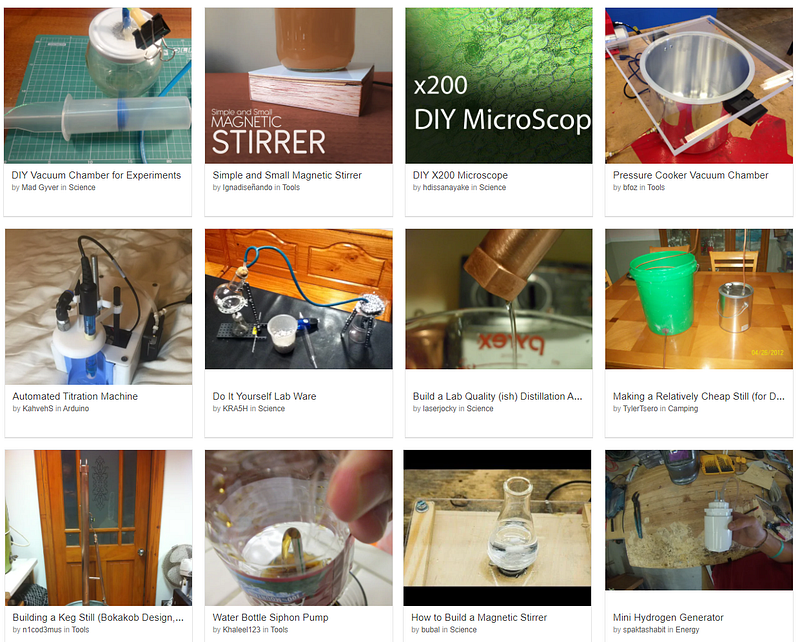
Low-cost laboratory instruments built with relatively little expertise and a good deal of handcraft talent have existed for a long time but flourished in the last decade especially thanks to 3D printers, easier ways to distribute information, open hardware policies, hackathons, and similar events, organizations dedicated to promoting inexpensive instrumentation for research and education (see for example TReND in Africa), and the gathering of curious geeks, teachers, and sci-tech aficionados into physical groups and virtual forums.
Just to mention a few examples of DIY instruments that the geek culture has developed, I have seen open plans for spectrometers sensitive to UV, visible, and infrared spectroscopies, including their absorption, emission, and Raman effects; also DIY instruments like centrifuges, low-pressure pumps, pipettes, microscopes, and chromatography and molecular biology kits.
Building some DIY instruments requires a certain level of familiarity with electronics, optics, etc., while others can be just assembled from spare materials, plus some 3D-printed pieces in certain cases and occasionally with very specific elements purchased ad hoc. Clearly, the starts of DIY instrumentation in the last decade are our modern smartphones, which include sensors for many different kinds of signals from accelerometers, light intensity, and light color to sound sensors complemented with fast internal calculations (to for example decompose a soundwave into its spectrum of frequencies, just to mention one application). There are several free apps that report and log the inputs from all these sensors in real time, some even running as web pages hence not requiring any software installation.
Researching the peer-reviewed literature I have seen teachers who have their students use a webcam-based spectrophotometer to collect emission, absorption, and fluorescence spectra in a 20 USD DIY instrument fully equipped with a diffraction grating and a slit to select wavelengths with ~1 nm resolution in the range from 380 to 1000 nm (here). Simpler colorimetric analyses without the need for light circuits to select wavelength are possible thanks to the separate nature of channels for red, green, and blue light in the detectors in webcams. Thus, by using webcam-equipped smartphones or tablets students can determine series of compounds in various samples (example here), experiment with Beer’s law (as in this article), follow reactions with strong color change, for example, bleaching of a food dye (here), follow enzymatic reactions such as the amylase-catalyzed degradation of starch (taking the enzyme from the students’ own saliva! see here), among many, many other experiments.
Educational web-based augmented reality for chemistry and biology
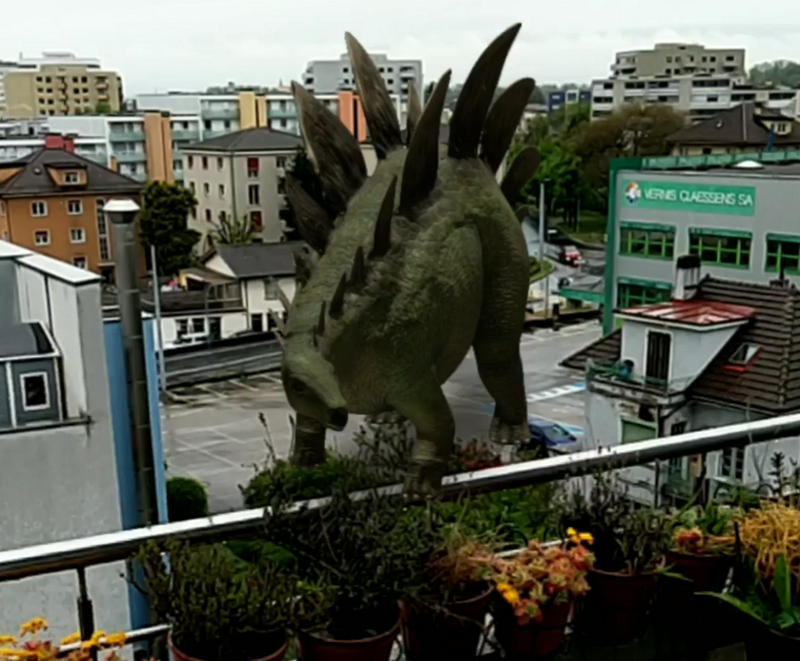
Augmented reality (AR) that runs in normal smartphones, tablets and laptops, thus without the need to buy any special hardware, has exploded in the last decade (Pokemon Go, any?). Already before the pandemic, many educators exploited the engagement of the younger generations for AR to build AR software with didactic activities. Since even in middle-income countries a large proportion of the population has access to smartphones, these AR activities have a very wide reach, even more those that are web-based as they don’t require any software installs so users just need to access a regular webpage to use the AR content.
For example, I and my colleagues developed a website called moleculARweb which contains several pedagogic activities for AR-based visualization of chemistry and structural biology concepts. In fact, it’s not just visualization of 3D objects, as they can move in realistic ways and even interact with each other, thus giving a more clear picture of how atoms make molecules and how molecules make biology possible. If you want to have an idea of what moleculARweb’s activities look like, see these videos on my YouTube channel (audio is in Spanish but the automatic translations work quite well!).
I promise I will do posts specifically dedicated to moleculARweb describing how we made it, and how teachers can use it in their classes! For the moment, teachers can check out this paper or this preprint.
AR applications in science education are not limited to viewing molecules. Google provides WebXR experiences to observe annotated, in some cases animated, 3D content for a wide range of chemistry and biology subjects: plants, cells, animals, etc. Some educators have even created AR experiences that replicate in-lab experimentation, such as simulated acid-base titrations (here) or oxygen gas generation as bleach oxidizes hydrogen peroxide (here).
Educational material in online videos and science channels
There is a huge amount of educational material on all possible subjects, even very advanced topics on quantum physics, and a quite large number of channels dedicated to broader science communication (some having become influencers in their own right). Among a long list, some of my favorite educational YouTube channels are Veritasium and PBS Space Time in English, and Quantum Fracture, El Robot de Platon, and Date un Vlog in Spanish. Video produces very strong engagement, is very descriptive, clear and arguably more complete than static images or spoken descriptions alone. In fact, communicating ideas through videos is so efficient that many peer-reviewed have accepted movies in their supporting materials for years. And there’s even one journal, called Journal of Visualized Experiments, which specializes on video tutorials of laboratory protocols. During the pandemic, many teachers had to upload their lessons as online videos that are now available for everybody to watch for free; and some teachers of practical laboratory sessions recorded themselves doing experiments for the students, which you can also watch now online. The best of all is that often, the teachers are experts in what they are explaining because they use it in their own research!
An opportunity for students to play games …ehem… develop computer skills
Another very important point is that being forced to spend more time on computers opened the possibility for students and teachers (well.. actually everybody!) to develop new computer skills. Many teachers took this seriously and introduced their students to the world of programming, and some even to that of bioinformatics. Programming skills are essential today even for researchers that think of themselves as wet-lab scientists. Gaining experience through simple, engaging programming languages like Python or the combination of HTML and JavaScript at a young age is a great asset for future development. Jupyter notebooks, Google Colab notebooks, HTML-JavaScript, and others make this easy, fun, and quickly productive.
Some closing thoughts
The pandemic is leaving us many interesting instruments for education that could stay with us and become part of the “new normal”. For example, thousands of university-level professors across the world recorded their lectures online and left the videos freely available on media like YouTube. They even had to record parts of them multiple times, so the videos have a good chance of being somewhat better than the real talk they would normally give in a class. The next time these teachers need to lecture, they could just send their students a link to that same video and only after the students have watched the material then do in-person meetings to clear out doubts and discuss specific cases, problems, and issues, on top of the regular in-person practical activities. In the same way, instead of having several students working together on the same 20-year-old spectrophotometer (this happened to me in Argentina and of course happens everywhere else when the activity involves an expensive instrument). But wouldn’t it be far better to have much smaller groups of students utilizing their DIY instruments and getting the data right on their smartphones?
Another legacy of education in times of pandemic could include hybrid remote/in-person classes, more flexible deadlines for assignment completion, more work at home, adapted metrics and procedures for student evaluation, and as exposed here perhaps also many more practical sessions by combining experimentation at the university with high-end equipment with DIY-based sessions at students’ homes. Once more, geek culture to the rescue.
Further reading and key links
Where to find articles describing specific activities and DIY instruments: ChemEdXchange, the Journal of Chemical Education, the journal Biochemistry and Molecular Biology Education.
General effects of the pandemic on education: paper 1, paper 2, paper 3, paper 4, paper 5; paper 6, paper 7, paper 8.
My peer-reviewed comment on all this, more extensive and including more examples.
moleculARweb website for chemistry education with web augmented reality: website, 1st paper (preprint here) How was it made? The technology is explained here, here, here, (more papers to come here); moleculARweb uses JavaScript libraries like Three.js, Cannon.js, and AR.js
I am a nature, science, technology, programming, and DIY enthusiast. Biotechnologist and chemist, in the wet lab and in computers. I write about everything that lies within my broad sphere of interests. Check out my lists for more stories. Become a Medium member to access all stories by me and other writers, and subscribe to get my new stories by email (original affiliate links of the platform).


